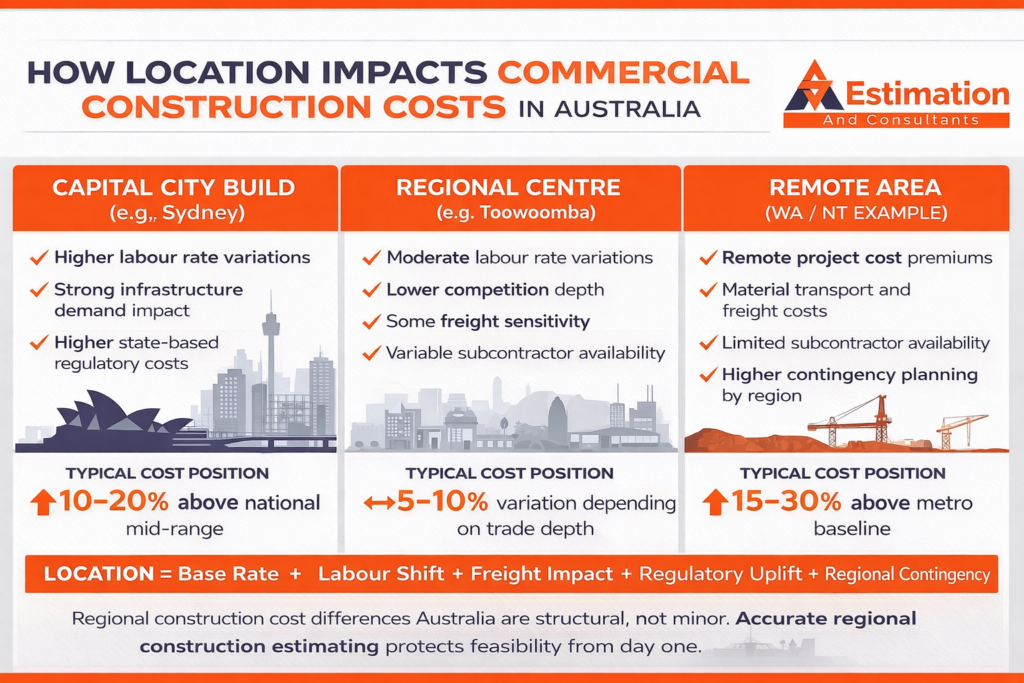
Commercial construction cost in Australia is not a single national number. A warehouse in Sydney will not cost the same as a similar facility in Toowoomba. Regional construction cost differences in Australia reflect real variations in labour markets, demand levels, and pricing depth. Ignoring these differences weakens feasibility from the start.
Metro vs regional cost differences influence contractor competition, trade availability, and overall risk exposure. That is why estimating accuracy by location is critical. Estimating commercial projects by region requires reliable local benchmarks and disciplined commercial build cost forecasting. At AS Estimation & Consultants, our approach to location-based cost estimating protects budgets by aligning Australian commercial construction costs with real regional construction pricing in Australia, not assumptions.
The Big Picture: National Economic Drivers (Macro Factors Only)
Before we compare Sydney to Perth or metro to regional towns, we need to look at the national forces shaping commercial construction costs in Australia. These macro pressures sit above location-specific factors. They drive regional construction cost differences in Australia at a broad level and heavily influence commercial build cost forecasting across every state.
Inflation and Economic Drivers
Inflation and economic drivers affect projects in every capital city and regional centre. When construction inflation in Australia rises, input prices move almost everywhere at once. Steel, concrete, fuel, and imported finishes follow national construction cost trends, not just local conditions. That shifts the commercial construction cost in Australia before we even factor in geography.
Interest rates also play a quiet but powerful role. Higher borrowing costs reduce contractor margins and increase financing pressure. At the same time, wage growth creates ongoing labour cost escalation. Together, inflation, wage pressure, and national material price cycles reshape budgets, making accurate commercial build cost forecasting more complex for estimators.
Infrastructure Demand Impact Across States
Infrastructure demand affecting costs is another national-level driver. When the government infrastructure pipeline expands, major transport, health, and energy projects absorb labour and materials. This infrastructure demand impact increases market competition levels, particularly in high-growth states, and influences tender price differences by location.
As public projects ramp up, contractors reallocate resources from private developments. This shifts the construction demand cycle Australia-wide. The government pipeline impacts construction markets by tightening labour pools and raising subcontractor rates. Even if your project is private, national demand patterns will influence pricing strategy and overall feasibility.
City-Level Cost Benchmarking: Capital Cities Compared
When we talk about regional variations in commercial construction costs across Australia, capital cities set the reference point. This section is about cost benchmarking by city, not causes. By comparing Sydney, Melbourne, Brisbane, and Perth, we better understand commercial building costs by state and how estimates must adjust accordingly.
Melbourne vs Sydney Construction Costs
Melbourne vs Sydney construction cost estimates often lead the national conversation. NSW commercial construction rates typically sit at the higher end due to strong market competition levels and sustained demand. Melbourne, while competitive, can show different pricing behaviour depending on project type and location within the city.
Labour rate variations also differ between the two markets. CBD productivity constraints, site access limitations, and tight programs can push Sydney higher on certain builds. Meanwhile, VIC commercial build cost trends may reflect broader contractor availability and shifting tender competition. For estimators, city benchmarking is not optional — it is the starting line.
Brisbane Commercial Build Cost Comparison
A Brisbane commercial build cost comparison often shows a different profile from Sydney and Melbourne. QLD commercial construction cost levels can be more moderate, but that does not mean predictable. Regional migration effects into South East Queensland continue to influence Brisbane construction pricing.
Subcontractor availability plays a major role here. During busy cycles, labour tightens quickly, shifting rates upward. Cost benchmarking by city helps clarify where Brisbane sits relative to other capitals. For accurate estimating, you must track how the Queensland capital moves within the national landscape.
Perth Construction Price Trends
Perth construction cost estimating trends reflect a market shaped by resource-driven labour demand. WA commercial construction cost levels can rise quickly when the mining and energy sectors expand. This affects labour rate variations across trades, especially specialist subcontractors.
Material transport and freight costs also make Perth more sensitive to supply movement compared to East Coast cities. While this section focuses on benchmarking rather than causes, it is clear that Perth behaves differently. For estimators, recognising WA’s unique pricing pattern is critical for realistic budget alignment.
Metro vs Regional Construction Pricing
When discussing regional variations in commercial construction costs across Australia, the metro vs regional construction pricing gap is one of the most practical realities estimators face. Geographic spread changes workforce depth, productivity, and competitive tension. These metro vs regional cost differences directly influence feasibility, risk allowance, and final tender alignment.
Labour Rate Variations Across Australia
Labour rate variations across Australia are often the first cost shift seen outside capital cities. In metro areas, subcontractor availability is stronger, and competitive tension helps control pricing. In regional markets, regional labour shortages impact timelines and cost certainty much faster.
Key workforce differences include:
- Skilled Trade Scarcity – Fewer specialist trades available locally.
- Regional Productivity Differences – Smaller crews and longer mobilisation times reduce output efficiency.
- Wage Premiums in Remote Areas – Higher regional trade rates in Australia to attract qualified workers.
These factors create measurable metro vs regional cost differences that must be reflected early in estimating strategy.
Remote Project Cost Premiums
Remote project cost premiums go beyond standard labour adjustments. Once a project moves well outside metropolitan zones, remote construction cost Australia increase due to operational realities.
Common premium drivers include:
- Accommodation and Travel – Flights, vehicle hire, and living allowances.
- Lower Market Competition Levels – Fewer bidders, reduced pricing pressure.
- Smaller Subcontractor Pool – Limited specialist availability drives upward pricing.
Metro vs regional construction pricing becomes significantly wider in these conditions. For estimators, recognising remote cost escalation at the feasibility stage prevents serious underpricing and protects budget credibility.
Logistics and Material Transport Cost Impact
When assessing regional variations in commercial construction costs across Australia, freight and supply movement deserve their own focus. This section excludes macroeconomics and compliance. It looks purely at material transport and freight costs, and how construction supply chain variation reshapes budgets depending on distance, access, and supplier reach.
Material Transport and Freight Costs
Material transport cost impact becomes more visible the further a project sits from major supply hubs. Freight cost in Australia is not uniform. Distance from suppliers directly increases handling, delivery time, and fuel exposure. For projects requiring heavy structural steel freight, the transport burden alone can materially lift overall build cost.
Western Australia and the Northern Territory are especially sensitive to this. WA and NT freight sensitivity reflects longer supply lines and reliance on east coast manufacturing. Construction supply chain variation means identical materials can carry different landed costs depending on location. For estimators, freight is not a side note — it is a measurable line item.
Supply Chain Disruption and Lead Time Risk
Supply chain disruption affects scheduling just as much as pricing. Construction material delays in Australia have shown how quickly timelines can shift when procurement depends on limited regional suppliers. Regional supplier dependence increases vulnerability if stock availability tightens.
Longer lead time extensions often result in indirect cost growth. Contractors respond through tender pricing strategy adjustments and risk loading in tenders. This is not about inflation; it is about delivery certainty. Construction supply chain variation introduces timing risk that must be priced carefully during early estimating stages.
State-Based Regulatory and Compliance Cost Differences
Beyond labour and freight, state-based regulatory costs create real pricing gaps across Australia. These compliance cost differences are not minor. Each state applies planning rules, environmental standards, and building interpretations slightly differently. Construction compliance costs by state must be assessed carefully during feasibility to avoid underestimating risk and approval-related delays.
Legislative variation affects documentation, consultant input, authority fees, and program duration. Even when projects look similar on paper, state-based compliance cost differences can materially change final budgets. For estimators, understanding local regulatory settings is just as important as measuring quantities.

Key Regulatory Cost Drivers
- Planning Approval Requirements – Different assessment pathways, authority fees, and approval timelines across states.
- Environmental Compliance Standards – State-specific environmental impact requirements and sustainability thresholds.
- Building Code Interpretation Differences – Variations in how NCC provisions are applied or enforced locally.
- Consultant and Certification Fees – Different state registration systems and professional requirements.
- Documentation and Reporting Obligations – Extra submissions, audits, or compliance tracking depending on jurisdiction.
Accurate estimating means pricing these regulatory layers early, not discovering them during construction.
What This Means for Estimating Strategy
Understanding regional variations in commercial construction costs across Australia is only useful if it changes how you estimate. This is where strategy matters. Estimating commercial projects by region requires more than adjusting rates. It requires location-specific thinking, disciplined forecasting, and structured risk control from day one.
Why National Average Rates Are Dangerous
Using national average rates may seem efficient, but it weakens the accuracy by location. Tender price differences by location reflect real labour, freight, and compliance pressures. If those are ignored, commercial build cost forecasting becomes unreliable.
Hidden regional premiums are often missed in early feasibility. These gaps later appear as variation claims or budget overrun risk. Regional cost estimating in Australia must reflect actual market behaviour, not blended averages. Strong estimates are built on local benchmarks, not national shortcuts.
Procurement Strategy Adjustment by Region
Procurement strategy adjustment is the practical response to regional cost pressure. Early subcontractor engagement improves pricing clarity, especially where subcontractor availability is limited. Waiting until late tender stages often increases uncertainty.
A regional procurement strategy construction model may involve local sourcing strategy decisions or adjusted tender packaging changes to suit market depth. Estimating commercial projects by region means aligning procurement with market reality, not assuming one structure works everywhere.
Contingency Planning by Region
Contingency planning by region protects the project from avoidable shocks. Remote project cost premiums, freight volatility buffer allowances, and labour availability buffer provisions must reflect local risk levels.
A regional construction risk allowance should be structured, not arbitrary. Supply chain risk premium adjustments and freight volatility considerations should be measured against actual market exposure. Contingency planning by region strengthens feasibility accuracy and preserves budget integrity from concept to completion.
A Simple 5-Step Regional Estimating Framework (Actionable Model)
Understanding regional construction cost differences in Australia is only valuable if it improves decision-making. This location-based commercial estimating framework turns insight into action. It helps estimators move from theory to structured execution when estimating commercial projects by region, reducing surprises and protecting feasibility.
This checklist separates cost benchmarking by city from labour rate variations, material transport and freight costs, state-based regulatory costs, and contingency planning by region. It keeps the regional construction cost differences in Australia measurable and controlled.
The 5-Step Regional Estimating Model
- Step 1: Benchmark the City
Start with cost benchmarking by city. Compare live tender data and recent commercial projects to understand the base pricing level in that capital or regional centre before adjusting anything else. - Step 2: Adjust for Labour Conditions
Factor in labour rate variations, subcontractor depth, and productivity differences. Workforce pressure often shifts pricing faster than materials. - Step 3: Price Freight and Logistics
Assess material transport and freight costs based on supplier distance and project location. Freight can materially alter the total build cost. - Step 4: Add Regulatory Cost Uplift
Include state-based regulatory costs such as approvals, consultant inputs, and compliance requirements specific to that jurisdiction. - Step 5: Apply Regional Contingency Buffer
Finalise with structured contingency planning by region. Adjust allowances based on remote exposure, market depth, and local risk profile.
FAQs
Commercial construction costs vary because Australia is not one uniform market. Labour rate variations, infrastructure demand, freight distance, and state-based regulatory costs all shift depending on location. Regional construction cost differences in Australia reflect real market behaviour, not random pricing. Estimating commercial projects by region means understanding those local pressures instead of relying on national averages.
No, metro projects are not always more expensive than regional ones. Metro projects often have higher labour rates and tighter site conditions, but they also benefit from stronger subcontractor availability and competition. Regional projects may look cheaper at first, yet remote project cost premiums, lower market competition levels, and freight exposure can close the gap quickly. The answer depends on location and market depth.
Regional labour shortages impact both price and program. When skilled trades are limited, contractors add margin to manage risk. This affects tender price differences by location and reduces estimating accuracy by location if not properly considered. Labour rate variations across Australia must be assessed early to avoid budget pressure later.
Material transport and freight costs should be priced as a defined cost component, not absorbed into general rates. Freight cost construction in Australia can vary significantly depending on the supplier distance, and access conditions. Estimators should assess transport risk separately, especially where construction supply chain variation creates delivery uncertainty.
The safest approach is to use a structured, location-based commercial estimating framework. Start with cost benchmarking by city, then adjust for labour rate variations, freight exposure, and state-based compliance cost differences. Add contingency planning by region to reflect local risk. This method protects commercial build cost forecasting from hidden regional premiums.
Conclusion
Regional construction cost differences in Australia are not small adjustments. They are structural shifts that directly affect feasibility, funding, and risk exposure. When location is treated as a minor variable, budget surprises follow. When it is treated as a cost multiplier, estimating accuracy by location improves, and financial control strengthens.
Commercial build cost forecasting only works when it reflects real local conditions — labour rate variations, freight exposure, market depth, and compliance settings. Accurate regional construction estimating in Australia requires disciplined benchmarking and structured risk allowances.At AS Estimation & Consultants, our focus is simple: protect feasibility, strengthen cost certainty, and support informed decision-making through precise, location-driven analysis.