One of the most common mistakes in construction cost planning is waiting until builder quotes arrive before looking seriously at the budget. By that stage, important decisions may already be made, and changing the design, scope, or expectations can become harder and more expensive. That is why estimator timing in construction has such a direct impact on cost planning quality.
When to use a building cost estimator is not only a tender-stage question. In most cases, the right time is much earlier, during pre-construction cost planning and other key construction cost planning stages. A building cost estimator for cost planning helps owners and project teams make better choices across the project lifecycle, estimating process, with stronger financial planning for construction, and clearer project cost planning support from the start.
What a Building Cost Estimator Actually Helps You Do
A building cost estimator does much more than give you one price. They help you understand where your money is going, what your project is likely to cost, and where risks may appear. That is why a building cost estimator for cost planning is useful early, not only at tender time.
With quantity takeoff and pricing, labour and material cost analysis, and estimate validation and review, estimators support better choices from the start. This is how estimators improve cost planning and support budget accuracy improvement before you commit to design changes, builder quotes, or construction work.
- Quantity Takeoff and Pricing
A construction estimator’s role starts with measuring the work properly. This includes materials, labour, and trade quantities, so you can see what the project really needs and avoid missing cost items early. - Scope Review and Cost Checks
A cost planning consultant reviews the scope to make sure the estimate matches the actual work. This helps spot gaps, unclear inclusions, and cost risks before they turn into expensive surprises. - Labour and Material Cost Analysis
Estimators break down current labour and material rates to build a realistic budget. This step is vital for improving budget accuracy with estimators, especially when prices are changing. - Cost Forecasting and Budgeting
A building cost estimator for cost planning helps forecast likely spending across the project. This gives you a clearer budget report and helps you plan funding, timing, and financial decisions with more confidence. - Estimate Validation and Review
An independent estimate service can check whether your pricing, builder quote, or tender figure makes sense. This kind of construction cost review helps confirm value and reduce the chance of overpaying. - Core Deliverables You Can Expect
Good building estimating support usually includes a building estimate before project start, a project estimate breakdown, trade-based pricing, tender review, variation checks, and contingency and risk planning. These deliverables make cost control much easier throughout the job.
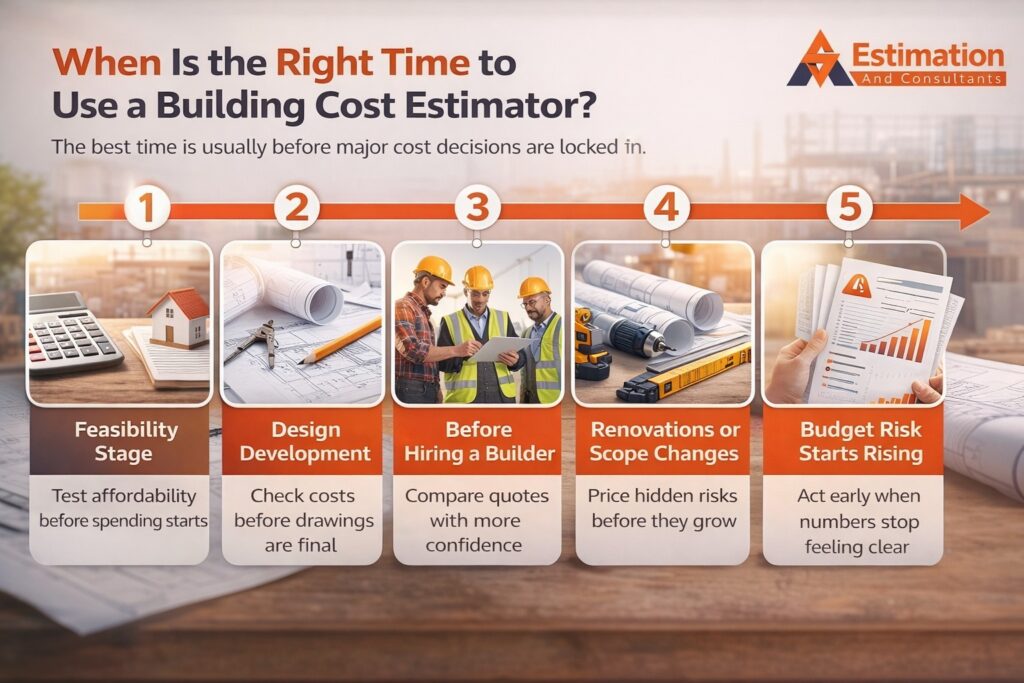
Use a Building Cost Estimator at the Feasibility Stage
The feasibility stage is where you test whether the project makes sense before real spending begins. A cost estimator during the feasibility stage helps you check affordability, review scope fit, and see whether the project is realistic before design fees, consultant costs, and time commitments start building up.
This is where pre-construction cost planning services add real value. A building estimate before project start gives you a clearer view of likely costs, budget limits, and possible risks. That is why early cost estimating matters. It helps you make better decisions before you move too far into design or builder discussions.
Best for New Builds, Developments, and Budget-Led Projects
Some projects benefit more from feasibility stage estimating because the financial risk is higher from the start. This is especially true when the scope is large, the funding is tight, or the return on investment matters.
- Custom Homes
A feasibility estimate helps test whether the planned home matches the available budget before detailed design begins. - Duplexes and Multi-Unit Builds
Early pricing supports development budget planning by showing whether the numbers work before deeper design and approval costs. - Commercial Fit-Outs
Residential and commercial estimating helps identify likely build costs, fit-out allowances, and budget pressure points early. - Investment Projects
A project viability estimate supports cost forecasting and budgeting, which helps investors judge risk, margin, and funding needs with more confidence.
Use a Building Cost Estimator Before and During Design Development
Using a building cost estimator before design helps keep the project aligned with the budget before drawings become too detailed. During design development, even small layout, finish, or scope changes can move costs quickly. This is where design-stage cost control supports better decisions and helps avoid budget drift early.
Cost planning during design development gives owners and designers real cost feedback while there is still time to adjust. With labour and material cost analysis, scope definition and validation, and a proper design-phase estimate, you get better budget accuracy improvement before approvals, builder pricing, or documentation begins.
Use Cost Checks Before Approvals, Specifications, and Scope Expansion
Fresh estimates are most useful when the design reaches a decision point. These checks help show how estimators improve cost planning across the main construction budget planning stages.
- At Concept Design
A concept estimate tests whether the first idea fits the available budget before more time is spent refining it. - At Schematic Design
Schematic design costing gives a clearer cost picture once layouts, systems, and major elements start taking shape. - Before Final Specifications
A design cost review helps check how finishes, fixtures, and materials affect the budget before selections are locked in. - Before Approvals or Documentation
Pre-documentation cost planning helps confirm that the developed design is still financially workable before final drawings move forward. - When Scope Expands
A design update estimate or scope change cost check is useful when extra floor area, upgraded finishes, or added features start pushing costs upward.
Use a Building Cost Estimator Before Tender Submission or Builder Engagement
This is one of the most useful stages for cost planning before hiring a builder. Estimating before tender submission gives you a clear price benchmark before quotes come in. With tender-stage estimating, estimate validation and review, and quantity takeoff and pricing, you can compare offers properly and spot missing items early.
A pre-tender estimate also puts you in a stronger position before contract talks begin. It helps with builder pricing comparison, quote benchmarking, and contractor pricing support, which reduces guesswork and lowers the chance of budget surprises after you commit.
This Is Often the Best Time for Homeowners Comparing Quotes
For homeowners, this is often the best time to hire a cost estimator because builder quotes can look similar while covering very different things. An independent estimating service helps with homeowner quote comparison, checks omissions, and supports estimate validation and review before hiring a builder.
- Clear Quote Review
A builder quote review service helps you see what is included, what is missing, and whether one quote is unrealistically low. - Better Budget Protection
This helps in preventing budget overruns because you are making decisions based on verified pricing, not guesswork.
This Is Also Valuable for Contractors Preparing Bids
This stage also matters for builders and pricing teams who need accurate numbers before submitting work. Contractor estimating support services can help with outsourced takeoff services, contractor bid estimating, and tender support estimate work when internal capacity is tight.
- Outsourced Takeoffs
Quantity takeoff and pricing support can save time and improve consistency when bid deadlines are close. - Bid Support
Extra estimating help makes tender-stage estimating more accurate, especially on larger or fast-moving jobs.
Use a Building Cost Estimator for Renovations, Extensions, and Scope Changes
Renovation work often carries more uncertainty than a new build. That is why using a cost estimator for renovations can be so helpful. Before work starts, they can review scope definition and validation, labour and material cost analysis, and likely upgrade costs so your budget reflects the real job, not just the ideal version of it.
This matters for extensions, alterations, and mid-project scope changes too. Renovation estimate planning helps you prepare for demolition risk, service upgrades, and hidden site conditions. For homeowners, this is often when homeowners need a cost estimate most, because small changes can quickly affect cost, timing, and overall project decisions.
Why Renovation Timing Matters More Than People Think
In renovation work, timing matters because the biggest cost problems often appear after the project has already started. Hidden defects, structural surprises, relocated plumbing or electrical services, council requirements, and finish upgrades can all push the budget higher if they are not considered early.
- Hidden Defects
Existing buildings can hide damage, poor past work, or outdated systems. Early review supports hidden cost planning and helps reduce renovation budget risk before it becomes a bigger issue. - Structural and Service Changes
Walls, beams, drainage, wiring, and plumbing often need more work than expected. This is where contingency and risk planning support remodel cost control. - Approvals and Finish Upgrades
Council issues, compliance changes, and upgraded finishes can shift the budget quickly. That is why early cost estimating matters and why improving budget accuracy with estimators supports better cost control strategies and helps in preventing budget overruns.
Use a Building Cost Estimator Whenever Budget Risk Starts to Rise
You do not always need to wait for a formal project stage to get estimating help. Sometimes, the best time to hire a cost estimator is when the warning signs start showing up. Scope creep, unclear inclusions, finance pressure, changing material rates, and inconsistent quotes are all budget risk triggers that can throw cost planning off track.
This is where estimate validation and review, cost forecasting and budgeting, and contingency and risk planning become useful. A cost estimator for better financial planning helps you respond early, not late. That is one of the most practical ways of improving budget accuracy with estimators and preventing budget overruns before the problem grows.
Common Signs You Need an Estimate Right Now
When budget pressure starts building, a fresh estimate can give you clarity fast. These cost planning warning signs usually mean it is time to review the numbers before making the next decision.
- You Do Not Know the True Total Cost
If the full build cost still feels unclear, a building estimate with the help of a professional building estimator before project start helps set a more realistic budget and supports better financial planning for construction. - Quotes Vary Too Much
When builder prices are far apart, it is often a sign that scope, inclusions, or pricing assumptions are not aligned. This is one of the clearest signs you need an estimator. - The Design Keeps Changing
If layouts, finishes, or floor area keep shifting, costs can move quickly too. A fresh review helps protect budget accuracy and improvement before changes stack up. - The Budget Is Tight
When there is little room for error, early cost checking matters more. It helps with preventing budget overruns and gives you stronger control over spending. - The Lender or Stakeholders Need Clarity
If finance approval depends on clearer numbers, an updated estimate supports confidence, reporting, and decision-making. - Your Contingency Feels Unclear
If you are unsure what risk allowance is enough, that is a strong reason to get a proper estimate review. This is how estimators improve cost planning when uncertainty starts rising.
How Estimators Improve Cost Planning Across the Project Lifecycle
A building cost estimator for cost planning helps bring structure to the numbers from the start of a project to the final pricing stage. Instead of relying on rough guesses, you get clearer budgets, better cost forecasting and budgeting, and stronger financial planning for construction as decisions begin to shape the real cost.
This is the real value of a cost estimator. They support better budget control, smarter scope decisions, stronger tender review, and more confidence at each stage. That is how estimators improve cost planning across the project lifecycle and help reduce budget overruns before they become harder to manage.
- Clearer Budget Direction
Estimators help turn ideas into realistic numbers. This gives you a working budget that is easier to trust and use for planning. - Smarter Scope Decisions
With clearer pricing, you can see which items fit the budget and which ones may need to change before costs drift too far. - Better Tender Review
Estimators help check builder quotes against the expected cost, which makes tender comparisons more useful and less risky. - Improved Cash Planning
Good estimating supports financial planning for construction by helping you prepare for likely spending, not just hopeful spending. - Reduced Overrun Risk
With contingency and risk planning built into the process, you are in a better position to avoid cost shocks later. - More Confidence at Every Stage
Construction estimating at different project stages gives owners, builders, and decision-makers stronger cost planning support and better project cost certainty.
Who Should Hire a Building Cost Estimator?
A building cost estimator is useful for anyone who needs clearer numbers before making a project decision. It is not only for large developers or builders. Homeowners, renovators, architects, and commercial clients can all benefit from independent estimating services when cost certainty matters early.
The main value is service fit. Some people need help before design starts, while others need pricing support before tender or during changes. That is why residential and commercial estimating works across many project types, from small home upgrades to larger construction jobs.
- Homeowners Planning a Build
When homeowners need a cost estimate, it is usually before committing to design, finance, or a builder. Early pricing helps test whether the project fits the real budget. - Renovators and Extension Clients
Using a cost estimator for renovations helps account for hidden conditions, scope changes, and upgrade costs before work begins. - Developers Managing Feasibility
Developers often need early numbers to test project viability, forecast costs, and make better investment decisions before moving forward. - Architects Supporting Budget Alignment
Architects can use estimating input to keep design ideas aligned with budget expectations as the project develops. - Builders Needing Pricing Support
Construction estimate support for builders is useful when preparing bids, checking quantities, or managing tender workloads. - Commercial Clients and Project Teams
A building cost estimator for new builds can help commercial clients review scope, compare options, and plan spending with more confidence.
Quick Guide: When to Use a Building Cost Estimator
| Project Stage | When to Bring in an Estimator | What They Help With | Why It Matters |
| Feasibility Stage | Before design starts or money is committed | Tests affordability, checks scope fit, and supports early financial planning | Helps you decide if the project is realistic before costs grow |
| Design Development | Before drawings are finalised and when design changes happen | Reviews cost impact, checks labour and material rates, and keeps the design aligned with the budget | Helps control costs before rework or overspending happens |
| Before Tender or Builder Engagement | Before requesting quotes or signing with a builder | Benchmarks expected cost, compares quotes, and identifies missing items | Helps you make stronger pricing decisions and avoid quote surprises |
| Renovations, Extensions, and Scope Changes | Before renovation work begins, and when changes are added | Reviews hidden risks, service upgrades, demolition costs, and variation pricing | Helps reduce the chance of budget blowouts from unknowns and changes |
| When Budget Risk Starts to Rise | When quotes vary, costs feel unclear, or the scope keeps shifting | Validates pricing, reviews contingency, and checks cost movement | Helps prevent budget overruns before they become harder to manage |
| Across the Project Lifecycle | At each major cost-sensitive decision point | Supports ongoing cost planning, review, and budget control | Gives you better financial clarity from start to finish |
FAQs
You should hire a building cost estimator as early as possible, ideally at feasibility or before design starts, because that is when cost advice has the most value. Early estimating helps test affordability, shape scope, and support better budget decisions before drawings, quotes, and commitments begin to lock you in.
A building cost estimator measures the likely cost of the work and helps with quantity takeoffs, pricing, budget planning, cost reviews, and tender checks. A building cost estimator actually does much more than give you one figure, because the role also includes cost advice through design development, procurement, and risk-aware budget control.
No, a building cost estimator is not the same as a builder’s quote. A building cost estimator gives you an independent cost view based on scope, quantities, and pricing logic, while a builder’s quote is a commercial offer to carry out the work. That is why an independent estimate is useful for quote benchmarking and checking omissions before you sign anything.
Yes, a building cost estimator can help before drawings are finished, and that is often one of the best times to use one. Order-of-cost estimating and early cost planning are specifically used to guide decisions before full documentation is complete, so owners and designers can adjust the scope before the budget drifts too far.
A cost estimator is useful for renovations and extensions because renovation work carries more uncertainty than many new-build decisions. Hidden conditions, service relocations, design changes, and change orders can all affect the final cost, so early estimating helps people set a more realistic budget and reduce surprise costs later.
Conclusion
The smartest time to use an estimator is before major financial commitments are made and at every point where cost decisions can change the direction of the project. If you are asking when to use a building cost estimator, the answer is usually earlier than most people think. A building estimate before project start gives you clearer numbers, stronger pre-construction cost planning, and better control over the budget before risk starts to grow.
Across the full project lifecycle estimating process, early cost advice helps owners, builders, and project teams make better decisions with less guesswork. That is often the best time to hire a cost estimator: before design moves too far, before tender, before signing with a builder, and whenever budget pressure starts rising. If your goal is cost planning before construction and preventing budget overruns, independent estimating services can give you the early estimate support needed to move forward with more confidence.