How much will it actually cost to knock down your old house and rebuild a new one? That is the main question most homeowners ask when they start looking at the knockdown rebuild cost in Australia. It can be a smart choice when your land is valuable, but the current home no longer suits your family, lifestyle, or long-term plans.
The real knockdown rebuild price in Australia is not just the cost of the new house. A proper budget should include demolition and rebuild pricing, approvals, site preparation, service connections, temporary accommodation, external works, and contingency. In 2026, with changing construction costs, clear construction estimating for rebuilds is important before you commit.
How Much Does A Knockdown Rebuild Cost In Australia In 2026?
The knockdown rebuild cost Australia 2026 depends on more than one simple average. Your final price can change based on the size of the home, location, design type, finish level, site condition, demolition work, and approval pathway. Online figures can help with early planning, but a proper home rebuild estimate needs a full cost breakdown, including the rebuild cost per m² in Australia, siteworks, approvals, and possible labour and material cost escalation.
For homeowners asking how much a knockdown rebuild costs in Australia, the safest answer is this: treat the average knockdown rebuild cost as a starting point, not the final number. A simple project home may cost less than a custom design, while custom residential construction cost estimates can rise with premium finishes, complex layouts, and difficult sites. Your house rebuild price should always be based on your actual block, scope, and builder quote.
Key cost factors include:
- Home Size: A larger home usually means more materials, more labour, and a higher total rebuild cost in Australia.
- Location: Building costs can change between Sydney, Melbourne, Brisbane, Perth, regional areas, and established suburbs.
- Design Type: A standard project home is usually easier to price than a fully custom design.
- Finish Level: Basic, mid-range, and premium finishes can create a major gap in the final cost.
- Site Condition: Sloping land, poor soil, rock, drainage issues, or tight access can increase siteworks.
- Demolition Needs: Asbestos, waste removal, trees, and difficult access can increase demolition costs.
- Approval Pathway: Council rules, permits, engineering, and compliance checks can affect both cost and timeline.
Why The Total Cost Is More Than The Builder’s Base Price
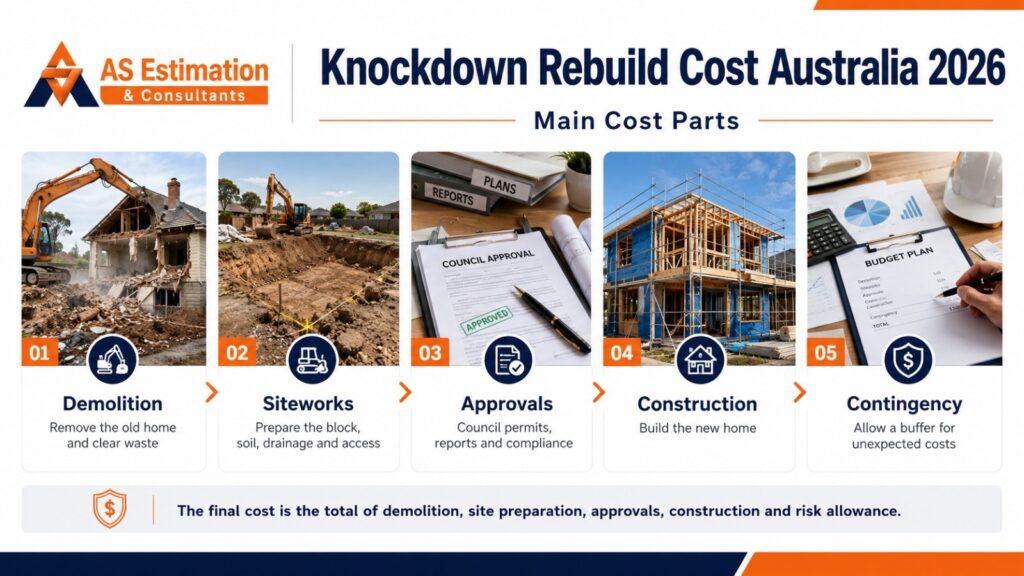
The builder’s base price usually covers the construction contract, but it may not include the full rebuild journey. A real total rebuild budget should also allow for demolition, siteworks, council fees, design costs, engineering, service disconnections, landscaping, driveways, fencing, temporary accommodation, and a contingency allowance. These items are often where hidden costs in knockdown rebuild projects appear.
Good end-to-end rebuild project budgeting means looking beyond the advertised build price. You need to include council approvals and permits, utility disconnection and reconnection, external works, and possible knockdown rebuild extras before you commit. A proper knockdown rebuild cost breakdown 2026 gives you a clearer picture of the full rebuild cost and helps reduce budget surprises later.
Common costs outside the builder’s base price include:
- Demolition and Waste Removal: Removing the old home, clearing waste, and handling asbestos if found.
- Siteworks: Excavation, levelling, drainage, retaining walls, and soil-related work.
- Design and Engineering: Plans, structural engineering, soil reports, surveys, and energy reports.
- Council Approvals: Permits, certificates, inspections, council fees, and compliance requirements.
- Service Connections: Electricity, gas, water, sewer, stormwater, and internet disconnection or reconnection.
- External Works: Landscaping, fencing, driveways, paths, gates, and outdoor areas.
- Temporary Accommodation: Rent, moving, storage, and living costs while the rebuild is underway.
- Contingency Allowance: A budget buffer for delays, variations, site issues, or price changes.
Knockdown Rebuild Cost Breakdown 2026
A clear knockdown rebuild cost breakdown 2026 helps you see the full project cost, not just the new home price. In Australia, the main cost areas usually include demolition, asbestos checks, site preparation, design, engineering, approvals, construction, services, external works, temporary accommodation, and contingency. This gives you a more realistic knockdown rebuild budget before you speak with builders.
For 2026, it is smart to use current market numbers, not old estimates. ABS reported that building construction output prices rose in the March 2026 quarter, driven by house construction, and RLB expects construction cost escalation to stay under pressure through 2026 because of labour, capacity, and procurement issues. That means your rebuild project cost should include a buffer, not just the lowest quote.
A simple 2026 planning guide may look like this:
- Demolition and Waste Removal: Allow around $10,000–$20,000 for many single-storey homes, and $20,000–$50,000 for many double-storey homes. Complex sites can cost more.
- Asbestos Removal: Allow a separate amount if the home is older. Some 2026 guides place asbestos removal from around $1,500–$15,000+, depending on where it is found and how much must be removed.
- New Home Construction: Use $1,500–$5,000+ per m² as a broad planning range, depending on the builder, location, finish level, and design complexity.
- Design and Professional Fees: Full architectural or building design services can be a major cost. Some Australian build guides place full-service design fees around 8%–15% of construction cost, depending on scope.
- Siteworks, Approvals, Services, and External Works: Price these separately. They change based on your land, council, drainage, slope, soil, access, and final inclusions.
Demolition, Waste Removal, And Asbestos Costs
Demolition is the first big item in a demolition and rebuild cost guide. The cost depends on the size of the house, building materials, access, trees, waste volume, local council rules, and whether asbestos is present. In 2026, many Australian demolition guides place single-storey house demolition around $10,000–$20,000, while double-storey homes can sit around $20,000–$50,000.
Older Australian homes need extra care. Asbestos may be found in eaves, roofing, wall sheeting, old flooring, fencing, sheds, or wet areas. If asbestos is found, the asbestos removal cost must be added to the house demolition cost in Australia. This can increase the full cost to demolish and rebuild a house, so it should never be treated as a small afterthought.
Key costs to check:
- Demolition Permit Cost: Some councils need permits, notices, or bonds before demolition starts.
- Waste Removal Cost: Waste disposal can form a large part of the demolition price.
- Asbestos Removal Expenses: Older homes should be checked before you accept a final demolition quote.
- Access Issues: Tight blocks, narrow streets, trees, or nearby homes can increase labour and equipment costs.
Site Preparation And Excavation Costs
After demolition, the land must be made ready for the new home. This is where site preparation and excavation costs can change a budget very quickly. A flat and clear block is easier to price. A sloping block, poor soil, rock, drainage problems, tree roots, retaining walls, or tight site access can increase the sitework cost to rebuild.
This part should be checked before comparing builder prices. Some builder quotes include only basic site allowance, while the real excavation cost rebuild depends on soil test results, site levels, stormwater needs, slab design, and access. A realistic budget should allow for the site conditions’ impact on rebuild pricing, especially if the block is not simple.
Common cost drivers include:
- Sloping Block Rebuild Cost: Sloped land may need more excavation, retaining walls, drainage, and engineering.
- Soil Condition Cost: Reactive soil, rock, fill, or weak ground can change footing and slab costs.
- Drainage Work: Stormwater upgrades can add cost, especially on established or tight suburban blocks.
- Access Limits: Narrow blocks can make machinery, deliveries, and excavation harder.
Design, Engineering, And Approval Costs
Before the build starts, homeowners often need design work, drawings, engineering, soil tests, land surveys, energy reports, certifier fees, council approvals, and building permits. These design and engineering costs for rebuilds are often missed because people focus only on the builder’s construction price. A proper budget should include them early.
For a full design service, some Australian construction guides suggest architecture or building design fees can sit around 8%–15% of construction cost, depending on how much design, documentation, and support is needed. Council fees, building permits, engineering, and approval costs vary by state, council, site conditions, and approval pathway, so they should be priced separately before tender.
Key costs to allow for:
- Design Fees Rebuild: Building designer, architect, or draftsperson fees.
- Engineering Cost Rebuild: Structural design, footing design, soil-based engineering, and reports.
- Council Fees Rebuild: Planning approval, building permits, inspections, certificates, and local charges.
- Rebuild Approval Cost: Costs may rise if the block has trees, heritage rules, bushfire controls, flood risk, or drainage issues.
Construction Cost Per Square Metre
The main new home build cost is often shown as a home build cost per square metre. This helps with early planning, but it is not the final answer. In Australia, 2025–2026 guides place new build costs around $1,500–$5,000+ per m², depending on the state, builder type, finish level, and design complexity.
When checking house rebuild cost per square metre in Australia, look at what is included. A basic project home, a mid-range custom home, and a premium architectural home can all have very different prices. Bathrooms, ceiling heights, façade, roof shape, windows, kitchen quality, flooring, insulation, fixtures, and finishes all affect the final rebuild cost per m² in Australia.
Key pricing differences include:
- Project Home Rebuild Cost: Usually more controlled because plans and inclusions are standard.
- Custom Rebuild Cost: Usually higher because design, engineering, layout, and finishes are more specific.
- Finish Level: Basic, mid-range, and premium finishes can change the total price fast.
- Design Complexity: Large windows, high ceilings, complex roofs, and detailed façades can increase cost.
- Location: Sydney, Melbourne, Brisbane, Perth, and regional areas can all price differently due to labour, materials, and local demand.
What Affects Knockdown Rebuild Pricing The Most?
The knockdown rebuild cost in Australia in 2026 can change a lot from one project to another. Two homes may look similar on paper, but the final quote can be very different because of location, block condition, home size, design complexity, finish level, builder type, access, and site constraints.
This matters even more in 2026 because construction pricing is still under pressure in parts of Australia. RLB reports that pricing pressure is returning in selected markets, while recent market commentary notes that house construction output prices have continued to rise. That means labour and material cost escalation should be allowed for in early home rebuild pricing.
Key rebuild cost factors include:
- Location: Labour, freight, council rules, and trade availability can change by city or region.
- Block Condition: Slope, soil, drainage, rock, and access can increase siteworks.
- Home Size: A larger floor area usually means more labour, materials, and time.
- Design Complexity: Custom layouts, large windows, high ceilings, and complex roofs cost more.
- Finish Level: Basic, mid-range, and premium selections affect the final price.
- Builder Type: The project home vs custom home rebuild cost difference can be large.
- Market Escalation: Rising labour, materials, and procurement costs can affect quotes.
Location And Local Construction Market
Location is one of the biggest knockdown rebuild price factors. Rebuilding costs in Sydney, Melbourne, Brisbane, Perth, and Adelaide can differ because each market has its own labour supply, material transport costs, council rules, approval delays, and trade demand. Regional areas may also cost more if materials or specialist trades need to travel further.
Established suburbs can add another layer of cost. Tight streets, limited access, older services, trees, neighbouring homes, and stricter council requirements can all affect pricing. This is why rebuild cost Sydney, rebuild cost Melbourne, rebuild cost Brisbane, and rebuild cost Perth should not be treated as one national average. A local estimate is always safer.
Common location-based cost drivers include:
- Trade Availability: Fewer available trades can increase labour costs.
- Material Transport: Freight can add cost, especially in regional or remote areas.
- Council Requirements: Local permits, inspections, and planning rules can change the budget.
- Established Suburbs: Older blocks may need more service upgrades, access planning, or site protection.
Project Home Vs Custom Home Rebuild
The choice between a project home and a custom home has a major impact on cost. A project home rebuild is usually easier to control because it uses standard designs, fixed inclusions, repeat systems, and fewer custom changes. This can make budgeting simpler for homeowners who want a clear, practical build path.
A custom knockdown rebuild usually costs more because it involves unique design work, engineering, layout changes, material choices, and detailed specifications. Custom home construction costs can also rise with premium finishes, larger rooms, complex façades, and special site solutions. For better knockdown rebuild budgeting in Australia, the design should be clear before tender.
Main differences include:
- Volume Builder Rebuild: Better for standard blocks, fixed plans, and cost control.
- Custom Home Cost: Higher when the layout, structure, and finishes are tailored.
- Tender-Ready Rebuild Budgeting: More important for custom homes because the scope must be clear.
- Finish Level: Rebuild pricing by finish level. Australia can shift quickly when selections change.
Hidden Costs In Knockdown Rebuild Projects
Many hidden costs in knockdown rebuild projects appear because early estimates only cover the obvious items. The builder’s price may not include asbestos removal, difficult excavation, drainage upgrades, utility disconnection and reconnection costs, landscaping, driveways, fencing, window coverings, moving costs, or temporary accommodation during rebuild.
These knockdown rebuild extras can cause a rebuild cost blowout if they are not planned early. A safe budget should include a clear contingency allowance for rebuild projects, especially when the home is older, the block is difficult, or the design is still changing.
Common hidden rebuild costs include:
- Asbestos Removal: Older homes may need checks before demolition.
- Siteworks: Poor soil, slope, rock, or drainage can increase cost.
- Services: Power, gas, water, sewer, and internet may need disconnection and reconnection.
- External Works: Landscaping, driveways, fencing, paths, and retaining walls may not be included.
- Living Costs: Rent, storage, moving, and pet accommodation can add up.
- Variations: Design changes, finish upgrades, and builder variations can increase the final price.
Temporary Accommodation And Moving Costs
Homeowners need somewhere to live while demolition and construction happen. Temporary accommodation budgeting should include rent, moving costs, storage, pet accommodation, insurance changes, and extra travel during the build.
If the project takes longer than planned, these costs keep growing. That is why rebuilding project timeline and budgeting should include a realistic allowance for delays, not just the best-case handover date.
Contingency For Unexpected Costs
Every knockdown rebuild budget needs a rebuild contingency. Unexpected costs can come from asbestos, poor soil, drainage issues, approval delays, design changes, material increases, and builder variations.
Good knockdown rebuild contingency planning gives you room to handle these costs without stress. For a simple project, a smaller buffer may work. For an older home, custom design, or difficult block, the rebuild risk allowance should be stronger.
Knockdown Rebuild Vs Renovation Costs
Renovation may look cheaper at first, but it can become costly if the existing home has poor structure, old plumbing, outdated wiring, hidden defects, or a layout that no longer works. This is why a proper rebuild vs renovation cost comparison should look at the full project, not just the starting price.
A knockdown rebuild may make more sense when you want a modern layout, better energy performance, fewer structural compromises, and long-term value from rebuilding a home on existing land. While custom home construction costs can be higher upfront, the final result is often clearer, cleaner, and easier to plan.
| Factor | Renovation | Knockdown Rebuild |
| Starting Cost | It may look cheaper at first | Usually higher upfront |
| Hidden Cost Risk | Higher risk from old structure, defects, asbestos, wiring, and plumbing | More predictable if the scope is clear before building |
| Layout Flexibility | Limited by the existing home | Full control over layout, room sizes, and design |
| Structural Issues | Existing problems may remain or cost more to fix | The old structure has been removed completely |
| Energy Efficiency | Can be improved, but may be limited by the old building | Easier to build with modern insulation, windows, orientation, and systems |
| Approval And Site Risk | Depends on the renovation scope | Depends on demolition, council rules, siteworks, and rebuild approval |
| Long-Term Value | Good for smaller upgrades | Often better for long-term living and land value |
| Best For | Homes with a solid structure and minor upgrade needs | Old homes, poor layouts, major defects, or full lifestyle changes |
If you are deciding whether to renovate or rebuild, do not compare only the first quote. Compare the full cost, hidden rebuild cost risks, future maintenance, design limits, and the final value of the home. That is the real way to judge whether a knockdown rebuild is worth it.
How To Plan A Realistic Knockdown Rebuild Budget Before Tender
Do not rely only on rough online numbers when planning a knockdown rebuild. A proper rebuild budget plan should be built before tender, not after builder quotes come in. This helps you compare prices fairly and avoid missing key costs like demolition, siteworks, approvals, external works, and contingency.
For better rebuild cost planning before tender, start with real project information. Get a site inspection, demolition quote, asbestos check, soil test, land survey, concept design, inclusions schedule, approval pathway, siteworks allowance, external works allowance, and an independent knockdown rebuild estimate where possible.
Key items to prepare before tender:
- Site Inspection: Understand access, slope, drainage, trees, and site risks.
- Demolition Quote: Know the real cost to remove the existing home.
- Asbestos Check: Older homes may need testing before demolition.
- Soil Test: Soil conditions can affect footing, slab, and engineering costs.
- Survey: A land survey helps confirm boundaries, levels, and site constraints.
- Concept Design: Builders need a clear design to price the work properly.
- Inclusions Schedule: List finishes, fixtures, fittings, appliances, and materials.
- Approval Pathway: Check if the project needs council approval, permits, or reports.
- Siteworks Allowance: Include excavation, drainage, retaining walls, and access costs.
- External Works Allowance: Add landscaping, driveway, fencing, paths, and outdoor areas.
- Contingency: Keep a buffer for changes, delays, or unknown site issues.
- Independent Cost Estimate: Use a rebuild cost planner or quantity surveyor to check the budget.
Simple Knockdown Rebuild Budget Formula
A simple formula can make knockdown rebuild budgeting in Australia much easier to understand:
Total Budget = Demolition + Siteworks + Design + Approvals + Construction + Services + External Works + Temporary Accommodation + Contingency
This formula works because it looks at the full project, not just the builder’s construction price. If you miss one part, your total rebuild cost may look lower than it really is. Good end-to-end rebuild project budgeting helps reduce hidden rebuild cost risks before the project starts.
Why A Quantity Surveyor Can Help
A quantity surveyor or construction estimator can prepare a more reliable budget before tender. This gives homeowners a clearer view of likely costs, exclusions, allowances, and risk areas. It also helps when comparing builder quotes, because the cheapest quote is not always the most complete quote.
Using quantity surveyor cost planning services can support better tender-ready rebuild budgeting. A good independent rebuild estimate can show whether the price matches the design, site conditions, inclusions, and current market rates. This reduces under-budgeting and gives you more confidence before signing a building contract.
FAQs
A knockdown rebuild in Australia in 2026 can cost very differently from one project to another. The final price depends on demolition, siteworks, home size, design type, finish level, council approvals, and local construction costs. For a safer budget, do not rely only on the builder’s base price. Look at the full project cost before you start.
A knockdown rebuild is not always cheaper than renovating, but it can be a better value when the existing home has major problems. Renovation may look cheaper at first, but old wiring, plumbing, structural issues, asbestos, poor layout, and hidden defects can increase the final cost. A rebuild gives you a fresh start on the same land.
A knockdown rebuild budget should include more than the new home construction price. It should allow for demolition, asbestos checks, site preparation, excavation, design, engineering, council approvals, utility disconnection and reconnection, landscaping, driveway, fencing, temporary accommodation, and contingency. Missing these items can make the budget look lower than it really is.
The hidden costs in a knockdown rebuild often include asbestos removal, difficult excavation, drainage upgrades, retaining walls, service reconnections, temporary accommodation, storage, moving costs, landscaping, driveways, fencing, window coverings, and builder variations. These costs are easy to miss if the early estimate only focuses on the house build.
You should allow a contingency in a knockdown rebuild because unexpected costs can happen during demolition, siteworks, approvals, or construction. Poor soil, asbestos, drainage issues, design changes, price increases, and builder variations can affect the final cost. A contingency gives you a safety buffer before problems become stressful.
Final Thoughts: Is A Knockdown Rebuild Worth The Cost?
A knockdown rebuild can be worth the cost when your land is valuable, your current home no longer works for your needs, and you want a modern home without moving to a different suburb. It can give you a better layout, stronger long-term value, and fewer limits than trying to repair an old structure.
The key is to base your decision on the full knockdown rebuild cost in Australia, not just the builder’s advertised price. Good knockdown rebuild budgeting Australia should include demolition, siteworks, approvals, construction, services, external works, temporary accommodation, and contingency.
Before you commit, get proper rebuild cost planning before tender. A clear rebuild cost estimate or quantity surveyor cost planning services can help you compare builder quotes, understand exclusions, and avoid under-budgeting. Strong, tender-ready rebuild budgeting gives you more confidence before signing a contract.