At first glance, one builder quote can look like the obvious winner. The price is lower, the total feels manageable, and the decision seems easy. But in many cases, that cheaper quote includes more allowances, more exclusions, and more variation exposure, which means the real cost may rise later. That is why builder quote comparison is not just about price. It is about cost certainty in Australian construction, scope clarity, and hidden risk.
If you want to compare builder quotes in Australia properly, you need to look deeper than the number at the bottom of the page. A smart building quote comparison should help you spot hidden construction costs, understand what is actually included, and see where the biggest risks sit before signing. This guide is designed to help homeowners compare construction quotes fairly, review a builder’s estimate with confidence, and make a better pre-contract quote review decision from the start.
Why Builder Quotes Vary So Much
Builder quotes vary because builders do not always price the same job in the same way. One may include more detail, stronger finishes, and clearer site costs, while another may leave gaps or use low allowances. That is why the lowest number is not always the safest number.
To make a fair builder quote comparison, you need to look beyond price and check scope, allowances, risk pricing, and exclusions. When you understand how builders price residential quotes, it becomes much easier to compare construction quotes fairly and avoid hidden construction costs later.
- Different Scope, Different Price — Some quotes include demolition, permits, landscaping, engineering, or service connections, while others leave them out. These scope gaps in builder quotes create false savings and make totals look cheaper than they really are.
- Plans and Specifications Matter — If the drawings and specifications are not equally detailed, each builder will make different assumptions. This affects quote inclusions and exclusions and reduces contract transparency from the start.
- Finish Standards Change The Number — One builder may allow for basic fixtures and finishes, while another may price better quality items. This is one of the biggest reasons why quotes differ on the same house build.
- Risk Pricing Is Handled Differently — Some builders carry more risk inside a fixed-price quote. Others shift uncertainty into allowance-based pricing, which reduces cost certainty in Australian construction and increases later adjustment risk.
- Allowances Can Hide Real Cost — Prime cost items and provisional sums can make a quote look competitive at first. An allowance-heavy quote often carries more hidden construction costs than a clearer fixed-price quote.
- Builder Margin and Assumptions Affect Value — Builders also apply different margins, exclusions, and pricing assumptions. That is why builder quote comparison should focus on like-for-like quote scope, not just the total at the bottom.
Common Mistakes When Comparing Builder Quotes
Many homeowners make the same mistake during builder quote comparison. They focus on the final price and miss the details that drive real cost. That is where trouble starts. Small gaps in scope, weak allowances, and hidden exclusions often lead to hidden construction costs later.
This section is meant to diagnose the problem, not fix it yet. When you understand these common quoting mistakes in Australian construction, you can see why a proper quote review before contract signing matters so much.
- Looking Only at the Bottom-Line Price — The cheapest quote can become the most expensive build when it relies on allowance-based pricing, vague scope, or weak detail. This headline price trap often hides extra costs that appear later and hurts budget blowout prevention.
- Missing the Difference Between Fixed and Allowance-Based Pricing — A quote with more fixed price building quotes usually gives stronger cost clarity. A cheaper quote with many prime cost items or provisional sums may look better now but carry more risk later.
- Ignoring Inclusions, Exclusions, and Assumptions — This is one of the biggest homeowner quote mistakes. If quote inclusions and exclusions are not clear, missing items can turn into surprise extras, delays, and variation risks once the work begins.
- Overlooking Scope Gaps in Builder Quotes — Two builders may not be pricing the same job at all. Missing site works, permits, finishes, or service connections create false savings and make it easy to compare quotes wrongly.
- Not Testing Prime Cost and Provisional Sum Allowances — Many people accept builder quote allowances without checking if they are realistic. Low PC allowances and low provisional sum risk items can make one quote seem cheaper, even when it is not truly comparable.
- Underestimating Hidden Construction Costs — Hidden exclusions, soft assumptions, and unclear wording are builder quote traps. They may not stand out at first, but they often become the reason one quote ends up costing far more than expected.
What Is Actually Included in a Builder Quote?
A builder’s quote is not just a single number. It is a pricing document made up of fixed costs, allowances, exclusions, assumptions, and variation terms. If you do not understand these layers, it becomes very easy to compare two quotes the wrong way and choose a price that only looks cheaper on paper.
When reviewing a house build quote format, the goal is to see how the builder has structured the price and where the risk sits. Some parts of the quote give strong cost certainty. Other parts are only estimates. That difference matters because it affects contract transparency, hidden construction costs, and the chance of budget pressure later.
- What You Are Really Comparing — A proper builder quote structure usually includes fixed-price items, prime cost items, provisional sums, and the fine print around quote inclusions and exclusions. It may also include assumptions and variation terms. These building quote components decide whether the quote is solid and transparent or filled with uncertainty that can cause trouble later.
Fixed-Price Items
Fixed-price items are the clearest part of most quotes. These are costs the builder has been able to measure and define properly before work starts. They usually relate to work, materials, or services that are already described well in the plans, specifications, or scope of work. Because the details are clearer, these items are more reliable during builder quote comparison.
This part of the quote gives the strongest cost certainty in Australian construction. In a fixed price vs allowance-based quotes review, fixed-price items are usually safer because they are less likely to move unless the scope changes. That does not mean they can never change, but it does mean the builder has taken more pricing responsibility up front rather than pushing uncertainty onto the homeowner later.
- Why Fixed-Price Items Matter — They make quote transparency for house builds much stronger because the homeowner can see what has been priced with real certainty, not just estimated loosely.
Prime Cost Items
Prime cost items, often called PC items, are allowances for products that have not been selected at the time the quote is prepared. These are usually fixtures and finishes such as toilets, taps, sinks, tiles, appliances, door hardware, or light fittings. The builder includes an estimated figure, but the final amount depends on the actual products chosen later by the owner.
This is why prime cost items in Australia should always be looked at closely. A quote may appear competitive simply because the prime cost allowances are unrealistically low. When understanding builder quote allowances, homeowners need to know that PC items are not firm prices. They are placeholders. If the selected products cost more than the allowance, the difference becomes an extra cost and changes the real total of the build.
- What Makes PC Items Risky — They often look harmless in the quote, but low fixture allowances can quietly create hidden construction costs once selections are made.
Provisional Sums
Provisional sums, or PS items, are allowances for work that cannot be accurately priced at the quoting stage because the builder does not yet know the full scope or conditions. These often relate to excavation, drainage, rock removal, demolition surprises, structural repair, or similar work affected by site conditions. In simple terms, the builder is estimating the cost because the final work is still uncertain.
That is why provisional sums explained for homeowners need to be treated carefully. In the prime cost items vs provisional sums discussion, the big difference is this: PC items are usually about product selection, while PS items are about uncertain work. That makes provisional allowances riskier in many cases, because site cost uncertainty can grow fast once construction starts and more is revealed on site.
- Why Provisional Sums Need Attention — They can make a quote look reasonable at first, but they often carry some of the biggest uncertain work costs in the whole construction estimate breakdown.
Exclusions, Assumptions, and Variation Terms
This is the part of the quote where a lot of hidden risk sits. Exclusions show what the builder has not included in the price. Assumptions show what the builder has presumed to be true when preparing the quote. Variation terms explain how changes will be priced and approved if the work changes after signing. These details shape the real cost of the project more than many homeowners realise.
If quote inclusions and exclusions are vague, the owner may end up paying for items they thought were already covered. If assumptions are too soft, the quote may fall apart once the actual work begins. If the variation clause review is poor, even a small change can become expensive. This is why contract transparency and construction contract risk management matter so much before signing any building contract.
- Where Cost Surprises Usually Start — Hidden contract terms, missing exclusions, and unclear approval wording are often the reason a quote turns into a more expensive build later.
- What To Check Before Signing — Look closely at the exclusions list, quote assumptions, variation pricing method, and builder margin on changes, because this is often where variation risks in building quotes begin.
Prime Cost Items Explained for Australian Homeowners
Prime cost items are allowances in a builder’s quote for products that have not been chosen yet. In simple terms, the builder includes a set amount for supply-only items such as fixtures and finishes, but the final cost depends on what the homeowner selects later. This is why prime cost items explained Australia is such an important part of quote comparison.
When understanding builder quote allowances, homeowners need to know that PC items can change the real cost of the build in a big way. A quote with low fixture budget allowances may look cheaper at first, but that saving can disappear once real products are chosen. This is where hidden costs in builder quotes Australia often begin, and why PC items matter for budget blowout prevention.
- What Prime Cost Items Really Mean — A PC item is not a fixed final price. It is an allowance for a product that still needs to be selected, which means the actual spend may end up higher or lower than the amount shown in the quote.
Common Prime Cost Items in Residential Quotes
Common prime cost items usually include products the owner chooses based on style, finish, and budget. These often cover toilets, basins, tapware, sinks, appliances, tiles, light fittings, door handles, and other visible finish items. Because these selections are often made later, the builder uses fixture and finish allowances as placeholders in the quote.
This matters because many homeowners do not realise how many builder selection items sit inside the PC section. One quote may include modest fixture allowance examples, while another may allow for more premium choices. That can create a large pricing gap between quotes, even when the total scope looks similar on the surface. In a fair builder quote comparison, these common PC items should always be reviewed closely.
- Why These Items Matter So Much — They are the products people notice and upgrade most often, which means they are one of the easiest places for quote totals to shift later.
Why Low Prime Cost Allowances Mislead Homeowners
A low PC allowance can make a builder’s quote look more competitive than it really is. On paper, the total seems attractive because the allowance is small. In real life, the products a homeowner actually wants may cost much more than the amount allowed. That gap then becomes an extra cost, even though the original quote appeared cheaper.
This is one of the biggest hidden construction costs in residential building quotes. A builder may allow for a basic toilet, basic tapware, and low-cost tiles, while the owner expects mid-range or premium finishes. That difference becomes a fixture upgrade cost later. This is why understanding builder quote allowances is so important for avoiding budget blowouts from builder quotes and reducing prime cost allowance risk.
- Where the Problem Starts — The quote is not always wrong, but the allowance may not match the finish standard the homeowner has in mind.
How To Test Whether a Prime Cost Allowance Is Realistic
The simplest way to test a PC allowance is to compare it against the finish level you actually want. If you are planning on mid-range or premium fixtures, the allowance should reflect that. Homeowners should look at supplier pricing, showroom ranges, and likely product choices rather than accepting the allowance without question. This gives much better contract transparency before signing.
A realistic PC check is part of the smart quote review before contract signing. It helps homeowners compare fixture budgets properly and see whether one quote is only cheaper because the allowances are too low. This is also where an independent estimate review can help. When asking what to check before signing a building quote, a pre-contract allowance review should always be near the top of the list.
- A Simple Rule To Follow — If the allowance does not match the products you would actually buy, then it is not a realistic allowance for your project.
Provisional Sums Explained for Homeowners
Provisional sums are allowances for work that cannot be priced properly when the quote is prepared. In simple terms, the builder knows the work may be needed, but the full scope is still unclear. That is why provisional sums explained for homeowners are such an important part of comparing builder quotes in Australia.
Unlike fixed prices, provisional sums carry more uncertainty from the start. The amount in the quote is only an estimate, and the final cost can rise once the real site conditions or work requirements become clear. This is where hidden construction costs often appear and why fixed price vs allowance-based quotes should never be judged by total price alone.
- What a Provisional Sum Really Means — It is not a locked-in cost. It is an estimated allowance for uncertain site work, which means the final amount may end up lower or much higher than the number shown in the quote.

Common Provisional Sum Areas in Australian House Builds
Provisional sums usually appear in parts of the job where the builder cannot fully inspect, measure, or confirm the work before construction begins. Common provisional sums in Australian house builds include excavation, rock removal, drainage work, retaining walls, demolition surprises, service relocation, and structural rectification. These are all areas where site cost uncertainty can affect the final result.
This matters because these uncertain work items often sit below the surface or depend on conditions that only become clear once work starts. A quote may include a reasonable-looking allowance, but the actual site may require more labour, more machinery, or more repair than expected. That is why these site allowance examples are some of the highest hidden costs in builder quotes in Australia.
- Why These Areas Matter — They often involve ground conditions, existing services, or concealed problems that cannot be priced with full confidence at the quote stage.
Why Provisional Sums Are Riskier Than Prime Cost Items
The main difference in the prime cost items vs provisional sums discussion is the source of the risk. Prime cost items usually relate to product choice, such as taps, toilets, or tiles. Provisional sums relate to an uncertain work scope. That makes the provisional sum risk harder to control because the issue is not at the start or finish level. It is the work itself.
This is why provisional sums are often riskier than prime cost items in a builder quote comparison. A homeowner can usually manage a product upgrade by choosing a cheaper item or adjusting finishes. But with uncertain site work, the cost may increase because the builder must complete the job properly once the real condition is known. In a fixed price vs allowance-based quotes review, PS allowance risk often carries less cost certainty in Australian construction.
- PC vs PS in Simple Terms — PC items are usually about what you choose. Provisional sums are usually about what the site forces you to deal with.
How To Reduce Provisional Sum Exposure Before Signing
The best way to reduce provisional sums is to reduce uncertainty before the contract is signed. That means getting better information early. Site inspections, soil tests, engineering detail, service checks, and clearer design documents all help the builder price the work with more confidence. The more known facts in the quote, the less room there is for uncertain allowances.
This step is a key part of construction contract risk management and smart quote review before contract signing. Homeowners who want to improve quote certainty should ask whether the builder has enough information to replace provisional sums with firmer pricing. In some cases, an independent estimate review can also help identify where more detail is needed. When asking what to check before signing a building quote, reducing PS exposure should always be high on the list.
- A Practical Way To Lower Site Risk — Better drawings, better site information, and better investigations usually lead to fewer provisional sums and a more reliable quote.
Variation Risks Explained Before You Sign
Variation risk is one of the biggest reasons a builder’s quote becomes more expensive after the contract is signed. A quote may look clear at first, but if the scope is weak, the wording is vague, the allowances are unrealistic, or the site conditions are uncertain, extra costs can build up fast during construction.
This is why variation risks in building quotes matter so much during builder quote comparison. Many post-contract extras do not come from one big mistake. They come from small gaps that were missed early. Good budget blowout prevention starts by spotting contract variation exposure before the build begins, not after the invoices arrive.
- Client Changes Still Cost Money — Some variations are owner-driven variations, not builder errors. Upgraded finishes, layout changes, added features, or late product choices can all create upgrade cost changes. Even small design change variations can affect labour, materials, and timing once the original scope has already been priced.
- Missing Scope Creates Preventable Extras — One of the most common quoting mistakes in Australian construction is weak scope detail. Missing electrical plans, incomplete joinery detail, unclear painting extent, landscaping gaps, and poor consultant coordination often lead to quote gaps. These are preventable extras that should have been clearer before signing.
- Vague Wording Shifts Risk Back to the Homeowner — If the quote inclusions and exclusions are not written clearly, the homeowner may assume something is covered when it is not. This vague scope risk often turns into a variation claim later. Strong contract transparency is what separates a reliable quote from a risky one.
- Site Conditions Can Change the Real Cost Fast — Some building variation risk only appears after work starts. Rock, poor soil, drainage problems, asbestos, hidden structural issues, and service complications are all risk items in residential building quotes. These unforeseen site costs often connect directly to provisional sums and hidden construction costs.
- Variation Clauses Can Make Small Changes Expensive — Contract terms matter more than many people realise. Unclear pricing methods, verbal approval practices, excessive builder margin on changes, and weak documentation can all increase variation clause risk. This is why quote review before contract signing is a key part of construction contract risk management.
- The Real Issue Is Not Change Alone, But Poor Control — Variations do happen in construction, but the real problem is when the quote and contract do not control them properly. When asking what to check before signing a building quote, always look at how quote variations happen in construction, how they will be priced, and how they must be approved.
How To Compare Builder Quotes Fairly Step by Step
The right way to compare builder quotes is to remove the noise and focus on what is really being priced. A low number can look attractive, but it does not always mean better value. Real builder quote comparison is about scope, allowances, exclusions, variation rules, and overall cost certainty in Australian construction.
This is the core action step in the blog because it gives homeowners a practical quote review method. If you compare house build quotes the right way, you can spot hidden risk early, improve contract transparency, and make a clearer quote decision before signing anything.
- Standardise the Scope Across Every Quote — Before you compare prices, make sure every builder has priced the same job. Align the drawings, inclusions schedules, engineering details, finishes, and notes. This step reduces scope gaps in builder quotes and creates a like-for-like quote comparison. Without that, comparing construction quotes fairly is almost impossible.
- Compare Fixed-Price Items Separately From Allowances — Do not blend everything into one total. Pull out the fixed price building quotes section and compare it on its own. Then separate the prime cost items and provisional sums. This helps you see the difference between fixed vs allowance pricing and makes quote certainty much easier to judge.
- Total Up Prime Cost Items and Provisional Sums on Their Own — One of the smartest steps in a builder quote framework is to measure the uncertainty inside each quote. Add up the PC and PS allowances separately. The quote with the lowest allowance totals may offer better budget blowout prevention than a cheaper quote with higher allowance exposure.
- Review Exclusions and Assumptions Line by Line — This is where many hidden construction costs begin. Go through permits, demolition, service connections, landscaping, retaining, approvals, and upgrade assumptions one by one. A careful line-by-line quote review helps you understand inclusions and exclusions in quotes before they turn into missing cost problems later.
- Compare Variation Rules and Margin on Changes — A lower quote can still be risky if the contract change pricing is weak. Check how each builder handles post-contract changes, how the builder variation margin is applied, and how variations must be approved. This is a key part of construction contract risk management and quote review before contract signing.
- Choose the Lowest-Risk Quote, Not Just the Lowest Number — The safest builder quote is usually the one that is clearest, most complete, and most realistic. Good builder quote comparison is not about chasing the cheapest total. It is about choosing the quote that gives the strongest quote transparency for house builds and the lowest risk of costly surprises later.
Example Builder Quote Comparison Table
A builder quote comparison table makes the whole review process easier to understand. Instead of jumping between separate quotes and trying to remember what each builder included, you put the key details in one place. That makes builder quote comparison more practical, more accurate, and much more useful before contract signing.
This kind of builder quote matrix also helps with residential building estimate analysis because it shows more than just price. It helps homeowners compare quotes side by side, spot risk, and see whether one quote is truly a better value or simply looks cheaper because of low allowances, missing scope, or softer contract terms.
What Columns To Include in Your Comparison Sheet
A good comparison sheet should show the exact items that affect price, certainty, and risk. Start with the builder name and total quoted price, then break the quote into the parts that matter most. This should include fixed-price content, prime cost items, provisional sums, exclusions, assumptions, variation margin, timeline, payment stages, and a simple risk notes column. These are the core quote matrix columns that make a builder quote comparison checklist in Australia actually useful.
The goal is not to make the table complicated. The goal is to make the pricing clear. When the right comparison sheet fields are in place, it becomes much easier to understand builder quote allowances and judge quote transparency for house builds. A quote that looks strong on price may start to look much weaker once the exclusions, provisional sums, and variation clause risk are written out in plain view.
- Total Price — Shows the headline figure, but should never be reviewed on its own.
- Fixed-Price Content — Helps you see how much of the quote is firm and how much cost certainty it offers.
- PC Total — Shows how much of the quote sits in prime cost items and product allowances.
- PS Total — Highlights how much of the price depends on provisional sums and uncertain work.
- Exclusions and Assumptions — Makes hidden gaps easier to spot before they become expensive surprises.
- Variation Margin and Risk Notes — Shows how post-contract changes may be priced and where the biggest concerns sit.
How To Use the Table To Spot the Real Cheapest Quote
The real value of the table is that it helps you test the quote behind the total. A builder may appear cheaper at first, but the comparison table often shows why. The price may rely on low prime cost items, high provisional sums, thin scope, or broad exclusions. Once those risks are visible, the cheapest number on the page may no longer be the real cheapest quote.
This is where comparing construction quotes fairly becomes much more practical. A strong builder quote comparison should look at allowance totals, hidden construction costs, variation exposure, and the level of cost certainty in Australian construction. That is how you do a proper builder quote reality check. The best quote is usually the one with the clearest scope, the most balanced pricing, and the lowest risk of budget pressure later.
- Check Low Allowances First — A low total may be built on unrealistic PC items or PS amounts rather than real savings.
- Look for High Exclusions — If too many costs sit outside the quote, the price may only look cheaper because work has been left out.
- Compare Variation Exposure — A quote with weak variation rules or high margins can become more expensive after signing.
- Measure Certainty, Not Just Cost — The quote with stronger fixed-price content is often safer than one with heavier allowance-based pricing.
- Read the Risk Notes Carefully — Your own notes column can quickly show which quote carries the biggest budget blowout prevention concerns.
- Choose the Clearest Value — The goal is not just to find the lowest number. It is to find the quote that gives the best balance of price, clarity, and risk control.
When To Get an Independent Estimate Review
An independent estimate review makes sense when a builder’s quote feels hard to trust, hard to compare, or too unclear to sign with confidence. It is not only for large custom homes. It can also help with renovations, complex site conditions, large allowance exposure, or major price gaps between builders.
This kind of quote, a second opinion, supports a better homeowner quote comparison strategy without adding pressure or sales talk. It helps you slow down, check the numbers properly, and reduce the chance of hidden cost surprises later. In many cases, it is one of the smartest steps for quote review before contract signing.
- Complex Projects Need Clearer Review — If the project includes renovations, structural changes, difficult access, or heavy site work, an independent estimate review can help you understand whether the quote is realistic and complete.
- Big Gaps Between Quotes Are a Warning Sign — When one builder is much cheaper or much higher than the others, it often means the quotes are not pricing the same thing. That is a strong reason to get an independent quote review before making a decision.
- Large Allowances Increase Risk — Quotes with high provisional sums or weak prime cost items often need a closer look. These are common risk items in residential building quotes and can lead to hidden construction costs later.
- Vague Wording Should Not Be Ignored — If the quote uses unclear language, broad assumptions, or soft exclusions, it becomes harder to know what you are really buying. That is exactly when a builder quote review service can add value.
- A Good Review Checks the Right Things — A proper estimate review before signing should test scope completeness, allowance realism, exclusions, variation terms, and overall cost certainty in Australian construction. It should not just comment on the total price.
- The Goal Is Better Decisions, Not More Confusion — A strong building estimate assessment gives better contract transparency and helps you understand what to check before signing a building quote. The aim is simple: reduce risk, improve clarity, and help avoid budget blowouts from builder quotes.
Signs You Should Get a Second Opinion
Some quotes show warning signs straight away. Large provisional sums, unrealistic PC allowances, unclear exclusions, vague wording, and wide price differences between builders are all common signs that the quote needs another look. These issues do not always mean the builder has done something wrong, but they do mean the homeowner is carrying more uncertainty.
This is where a second opinion becomes useful. It helps you identify quote red flags before they turn into variation risks or hidden construction costs. If the quote feels hard to follow or too dependent on assumptions, an unclear builder quote review can save a lot of stress later.
What an Independent Review Should Check
A proper independent review should go deeper than the final number. It should check whether the scope is complete, whether the allowances are realistic, whether the exclusions are fair, and whether the variation terms create extra risk. It should also test whether the quote offers enough contract transparency to support a confident decision.
This kind of residential building estimate analysis is useful because it improves quote transparency for house builds. A good review acts like a practical estimate review checklist. It helps homeowners see what is actually included, what is missing, and where the biggest pricing risks sit before the contract is signed.
Builder Quote Comparison Checklist for Australian Homeowners
Before choosing a builder, it helps to step back and review every quote with a simple checklist. This final check is where the whole builder quote comparison process comes together. It helps you move past sales language, focus on the numbers, and make a clearer decision before signing.
A good pre-contract builder checklist is not about finding the cheapest line on the page. It is about checking scope, allowances, exclusions, and variation risks in a calm, practical way. This is one of the best ways to improve contract transparency and support budget blowout prevention before the build starts.
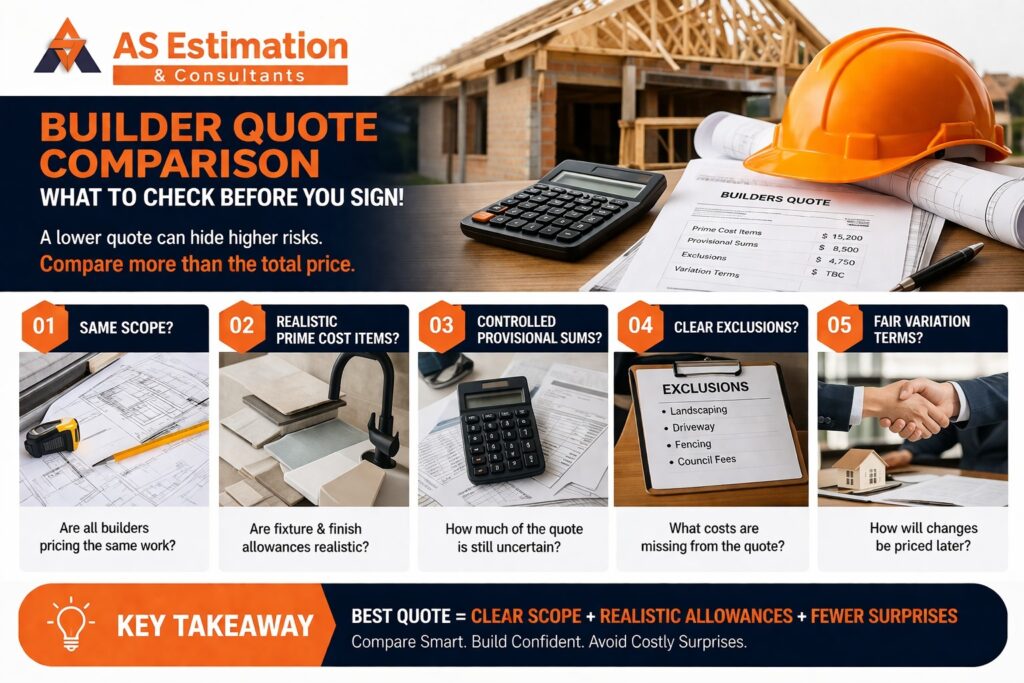
- Check That Every Quote Covers the Same Scope — The first step in any builder quote comparison checklist Australia is to confirm that all builders priced the same job. If plans, finishes, engineering, or inclusions are different, the prices are not truly comparable.
- Review Prime Cost Items Carefully — Prime cost items should match the finish level you actually expect. If the allowances are too low, the quote may only look cheaper at the start. Understanding builder quote allowances is a key part of choosing a builder wisely.
- Control Provisional Sums Where Possible — Provisional sums should be kept realistic and limited where better information can reduce uncertainty. Too many provisional sums can weaken cost control and increase risk items in residential building quotes.
- Clarify Exclusions and Assumptions — A strong quote sign-off checklist should always include a careful review of quote inclusions and exclusions. Hidden gaps, weak assumptions, or soft wording can create confusion, extra charges, and avoidable stress later.
- Review Variation Terms Before You Sign — Variation risks in building quotes often come from unclear approval methods, poor pricing rules, or high margins on changes. This step matters because a low starting price can still become expensive if the variation clause risk is not controlled.
- Consider an Independent Review if Needed — If the quote still feels unclear, an independent estimate review can help you compare builder estimates with more confidence. Sometimes, a second set of eyes is the best final builder quote review before making a commitment.
Checklist Points To Cover
The best checklist is simple, but it should still cover the right decision points. Make sure the scope is the same across all quotes, the prime cost items are realistic, the provisional sums are under control, and the exclusions are fully explained. These points help turn a basic price review into a proper builder comparison checklist.
You should also confirm the assumptions, review the variation terms, and think about whether an independent estimate review is worth getting before you sign. When homeowners ask what to check before signing a building quote, these are the points that matter most because they protect clarity, reduce surprises, and support a better final decision.
FAQs
To compare builder quotes in Australia properly, you need to look beyond the total price. You should compare the scope of work, prime cost items, provisional sums, exclusions, assumptions, and variation terms side by side. A fair builder quote comparison only works when each builder has priced the same job with the same level of detail.
Prime cost items in a builder’s quote are allowances for products that have not been selected yet. Prime cost items in a builder’s quote usually cover fixtures and finishes such as toilets, taps, tiles, appliances, and light fittings. The final cost can go up or down depending on the actual items you choose later.
Provisional sums in a builder’s quote are estimated allowances for work that cannot be fully priced at the quote stage. Provisional sums in a builder’s quote often apply to excavation, drainage, rock removal, site repairs, and other uncertain work. Because the full scope is not yet known, the final cost can end up higher than the original allowance.
The difference between prime cost items and provisional sums is that prime cost items relate to product selections, while provisional sums relate to uncertain work. The difference between prime cost items and provisional sums matters because product choices are often easier to control, while uncertain site work can create bigger cost changes once construction begins.
One builder’s quote is often much cheaper than another’s because the builders may not be pricing the same scope, finish level, risk, or allowances. One builder quote may also rely on lower prime cost items, higher provisional sums, or more exclusions. That is why the cheapest quote is not always the best value.
Conclusion
The best builder quote is not the one with the lowest number. The best builder quote is the one with the fewest surprises, the clearest scope, and the most realistic pricing. When you compare builder quotes properly, you give yourself a much better chance of making a safer contract decision and avoiding hidden build costs later.
In the end, a good builder quote comparison comes down to clarity, realism, and risk exposure. Homeowners who focus on cost certainty in Australian construction, contract transparency, and what to check before signing a building quote are far more likely to avoid budget pressure during the build. That is how to compare builder quotes in Australia with confidence and make a smarter choice from the start.
If you want extra peace of mind before signing, AS Estimation & Consultants can help you review builder quotes with a clear, practical eye. Our team helps homeowners compare scope, allowances, exclusions, and variation risks so you can make a more informed decision and reduce the chance of costly surprises later.