Builders hear the term construction takeoff services all the time, but many still want a simple answer to one question: what do they actually get? Before tendering starts, builders need clear quantity information they can use for planning, pricing, and scope review, not just another technical report.
That is why this topic matters. Good construction takeoff services Australia help builders understand the scope earlier, support tender preparation, and make the difference between takeoff and estimating easier to understand. In simple terms, takeoff gives the quantity base that helps builders price with more clarity and less guesswork.
What Construction Takeoff Services Actually Mean
Construction takeoff services are part of pre-construction. Their job is to measure and extract quantities from drawings and specifications before full pricing begins. In simple terms, they show builders what needs to be counted, measured, or allowed for, so there is a solid starting point for tendering, budgeting, and planning.
This section is about quantity, not always full pricing. That is the key to the construction quantity takeoff process, explained in plain language. A drawing-based quantity takeoff helps builders understand the scope early, reduce guesswork, and work from clearer numbers before moving into a full estimate.
What Is Usually Measured
A takeoff usually covers the main items shown on the plans. This helps turn drawings into practical quantity data that builders can use for pricing, ordering, and scope review. Depending on the project, the measured items may include:
- Areas: Floor areas, wall areas, ceiling areas, and other measured surfaces
- Lengths: Skirting, framing runs, pipe runs, roofing edges, and linear elements
- Counts: Doors, windows, fixtures, fittings, and repeated components
- Volumes: Concrete, excavation, fill, and other bulk materials
- Trade Quantities: Items linked to concrete, steel, carpentry, finishes, and other packages
Through blueprint and drawing analysis, builders get a clearer picture of what materials and quantities are required by the trade. That is why material takeoff services Australia and construction measurement services Australia are useful before pricing and procurement begin.
What It Does Not Always Include
A takeoff does not always include the full cost of the project. It may not cover labour rates, supplier pricing, overheads, profit margins, or broader cost advice unless those services are included separately. This is where many builders mix up takeoff vs estimate.
That is the main difference in construction estimating vs takeoff services. A takeoff gives the measured quantities. Estimating support services for builders in Australia can then use that quantity data to build a full price. So, quantity takeoff is not full pricing unless it is offered as part of a wider estimating add-on service.
What Builders Actually Get From a Takeoff Service
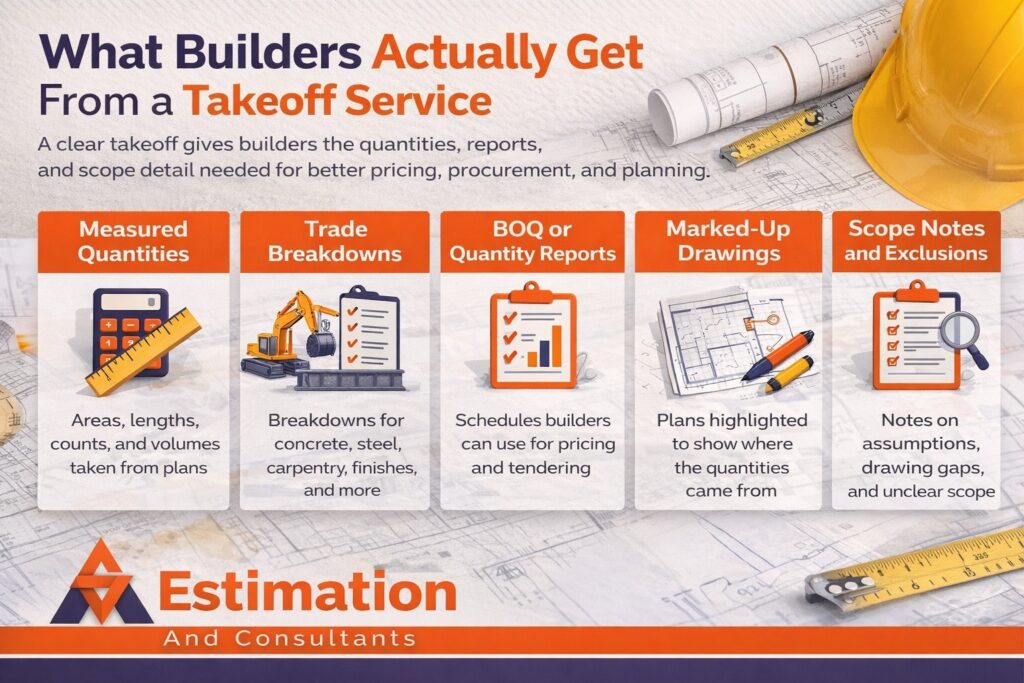
This is the part builders want to see clearly. A takeoff service gives them real working information, not just a general summary. It turns drawings into usable quantity data that supports pricing, procurement, and scope review before work starts. That is what makes the service practical.
In most cases, the builder receives a takeoff package with clear quantity reports and supporting documents. These takeoff deliverables help improve scope clarity and measurement accuracy, so the team can make decisions with better confidence instead of relying on rough assumptions.
Quantity Reports and Trade Breakdowns
The main output is usually a set of quantity reports. These reports organise the job by trade, material type, area, or package, so builders can use the information for pricing and ordering. This makes the numbers easier to read and easier to pass on to buyers, estimators, or subcontractors.
A good construction takeoff report often includes material quantity reports for the main trades involved in the project. For example:
- Concrete Quantities: Slabs, footings, columns, and other measured concrete items
- Steel Quantities: Reinforcement, structural steel, or other metal components shown on the drawings
- Carpentry Quantities: Framing items, timber elements, joinery-related counts, and measured lengths
- Finishes Quantities: Floor finishes, wall finishes, ceilings, paint areas, and related surface measurements
This is where quantity takeoff services for builders in Australia and material takeoff services in Australia become useful. Instead of reading every plan manually, the builder gets organised numbers that can be used for costing, trade pricing, and procurement planning.
BOQs, Marked-Up Drawings, and Scope Notes
A takeoff package often includes more than just raw numbers. Builders may also receive supporting documents that show how the quantities were measured and how the scope was interpreted. These documents help make the takeoff easier to check and more reliable to use.
The most common supporting items include:
- BOQ-Style Sheets: Structured quantity summaries that help with pricing, tender review, and package comparison
- Marked-Up Drawings: Highlighted plans that show where the measured quantities came from
- Scope Notes: Notes that explain assumptions, exclusions, unclear details, or drawing gaps that may affect the final numbers
This part matters because bill of quantities preparation services and blueprint and drawing analysis give builders more than a list of numbers. They also support construction scope validation, especially when plans are incomplete, revised, or open to interpretation.
How Builders Use Takeoff Services in Real Projects
A takeoff becomes useful when builders start using it in the real workflow. It is not just a document that sits in a folder. It helps the team move from drawings to pricing, budgeting, ordering, and planning with clearer numbers. That is where the commercial value really shows.
In practical terms, takeoff for builders supports better tender decisions, cleaner scope review, and more controlled buying. It gives the project team a stronger base for pricing and planning, which helps reduce missed items, rushed decisions, and avoidable cost pressure later.

Before Tender and Pricing
Before a tender goes out, builders use takeoffs to check quantities and prepare pricing with more confidence. This helps create a cleaner bid, improves pre-tender quantity verification, and makes subcontractor comparisons more accurate because everyone is pricing from a clearer quantity base.
This stage matters because taking off services before tender in Australia supports better tender pricing preparation and reduces the risk of missed quantities. In simple terms, builders get pricing-ready quantities that make bid quantity support more reliable and less dependent on guesswork.
During Budgeting and Procurement
Once the job moves into planning, the same takeoff data helps with early budgeting and material ordering. Builders can use the quantities to shape cost plans, check package needs, and time procurement more carefully. This makes the numbers useful beyond the tender stage.
It also supports procurement planning by improving material ordering support and helping teams think through waste, allowances, and buying sequences. That is why cost planning using quantity takeoff plays such an important role in takeoff services for cost control and budgeting.
Types of Takeoff Services Builders May Need
Not every builder needs the same type of takeoff. The right service depends on the project, the scope, and how the quantities will be used. A small house, a commercial build, and a renovation all create different measurement needs, so the takeoff should match the job, not follow one fixed format.
This matters because builders are not all buying the same output. Some need a fast residential takeoff to support pricing. Others need a commercial takeoff with deeper package detail. Some only need one trade measured. That is why understanding the type of takeoff service helps builders get the right support from the start.
Residential, Commercial, and Renovation Work
Project type shapes the kind of takeoff a builder needs. Residential work usually needs quick, clear quantities for pricing, ordering, and planning. Commercial construction takeoff services in Australia often involve more drawing detail, more trade packages, and more coordination across the job, so the reporting usually needs to go deeper.
Renovation work needs even more care. Existing conditions, demolition, unknown site issues, and partial scope changes can make the drawings harder to read and the quantities less straightforward. That is why takeoff services for renovation projects in Australia often require closer interpretation and stronger construction scope validation than standard new-build work.
A simple way to think about it is:
- Residential Work: Best when the goal is fast quantity clarity for houses, duplexes, and similar builds
- Commercial Work: Best when the project needs deeper package detail and broader trade coordination
- Renovation Work: Best when existing conditions make the scope harder to interpret and measure
Full-Project vs Trade-Specific Takeoffs
Some builders need the whole project measured. A full-project takeoff gives one clear quantity base across the main trades, which makes it easier to support pricing, procurement, and planning from one working set of numbers. This suits builders who want a broad view of the entire job before moving ahead.
Other builders only need selected packages measured. That might be concrete, steel, carpentry, or finishes. In those cases, trade-specific takeoffs and subcontractor quantity breakdowns are more practical than a full-project report. This is useful when the team only needs package-specific pricing, procurement support, or scope checking for one trade.
For quick comparison:
- Full-Project Takeoff: Covers the full job and supports whole-project pricing and planning
- Trade-Specific Takeoff: Focuses on one package or trade where more targeted quantity detail is needed
Construction Takeoff vs Estimating: What Is the Difference?
Builders often mix these two together, but they do different jobs. A takeoff measures what is in the drawings. Estimating uses those quantities to build the price. In simple terms, takeoff gives the numbers, and estimating gives the cost.
| Area | Construction Takeoff | Estimating |
| Main Purpose | Measures quantities from drawings and specifications | Applies pricing logic to measured quantities |
| Focus | Areas, lengths, counts, volumes, and material quantities | Labour, supplier rates, plant, overheads, and margins |
| Output | Quantity reports, trade breakdowns, and BOQ-style sheets | Cost estimate, tender pricing, or budget sheet |
| Used For | Scope review, procurement planning, and tender preparation | Budgeting, quoting, and final pricing |
| Main Question: It Answers | How much is needed? | How much will it cost? |
This difference matters because good estimating depends on good takeoff data. Takeoff creates the cost estimation foundation data, while estimating turns that information into a working price. That is why construction estimating vs takeoff services should be treated as connected, but not the same.
Why Accuracy Matters More Than Most Builders Think
Accuracy in a takeoff affects more than the numbers on a sheet. It shapes pricing, ordering, budgeting, and margin control from the start. When quantities are measured properly, builders can reduce quantity errors, improve tender accuracy, and make better decisions before the job moves into costly stages.
That is why a reliable takeoff adds real value. It supports cost control through accurate quantities, helps avoid cost overruns, and gives the team a stronger base for planning and buying. In simple terms, better quantity data leads to fewer surprises and more control across the project.
Common Problems a Good Takeoff Helps Prevent
When quantities are wrong or incomplete, the damage usually shows up later. A missed item in the tender can weaken the price. A wrong material count can affect ordering. An unclear scope can create confusion between trades. These issues often look small early on, but they become expensive once work starts.
A good takeoff helps prevent that by improving construction scope validation, supporting pre-tender quantity verification, and giving builders stronger procurement planning support. It helps the team catch missed quantities early, avoid procurement mistakes, and reduce scope gaps before they turn into delays, variation claims, or margin loss.
A simple way to see the risks is:
- Missed Tender Items: Important quantities are left out, which weakens pricing and puts margin at risk
- Wrong Order Quantities: Over-ordering or under-ordering leads to waste, delay, or rushed buying
- Scope Gaps: Missing or unclear quantities create confusion between trades and packages
- Weak Quote Comparisons: Subcontractor prices are harder to compare when quantity bases are inconsistent
What Builders Should Look For in a Takeoff Service Provider
Choosing a takeoff provider should not come down to price alone. Builders need clear deliverables, reliable revisions, strong trade detail, and reports that support real estimating work. The best outsourced construction takeoff services Australia give practical value, not just fast numbers.
A useful provider helps with scope clarity and measurement accuracy, fits into the estimator workflow, and understands Australian project expectations. That is what makes the Australian takeoff support more reliable for pricing, procurement, and tender planning.
- Clear Deliverables: Builders should know exactly what they will receive, such as quantity reports, trade breakdowns, marked-up drawings, and scope notes.
- Measurement Accuracy: The provider should show a consistent approach to quantities, so the reports are useful for pricing, ordering, and scope review.
- Revision Handling: Drawings often change, so a good service should handle updates cleanly without creating confusion in the takeoff.
- Trade Depth: The provider should be able to measure the level of detail needed, whether for full-project reports or trade-specific packages.
- Australian Project Familiarity: It helps when the team understands local documentation habits, construction measurement services in Australia, and measurement standards compliance like AIQS or Australian standards.
- Estimator Workflow Fit: The takeoff should be easy for estimators, buyers, and project teams to use, not something that needs to be reworked before it becomes practical.
FAQs
Builders usually get measured quantities taken from drawings and specifications. This often includes quantity reports, trade breakdowns, marked-up plans, and notes about assumptions or exclusions. In simple terms, builders get a working quantity base they can use for pricing, procurement, and scope review.
No, a construction takeoff is not the same as an estimate. A construction takeoff measures the quantities shown in the plans, while an estimate applies pricing, labour, supplier rates, and cost logic to those quantities. So, a takeoff tells you what is needed, and an estimate tells you what it may cost.
Takeoff accuracy is so important for builders because small quantity errors can turn into bigger cost problems later. Accurate quantities help reduce missed items, improve tender pricing, support better material ordering, and protect margins. Better accuracy usually means better decisions from the start.
Yes, builders can use takeoff services for tendering and budgeting. A takeoff gives clear quantity data that can support bid preparation, early cost planning, procurement decisions, and subcontractor comparisons. That is why takeoff services are useful before both pricing and project delivery.
No, all projects do not need the same type of takeoff. Residential, commercial, and renovation jobs often need different levels of detail and different reporting formats. Some builders need a full-project takeoff, while others only need one trade or package measured.
Conclusion
Construction takeoff services give builders more than measured quantities. They give a clearer view of the job before money is committed and materials are ordered. That means better tender support, stronger budgeting, smarter buying decisions, and more control over scope before site work begins.At AS Estimation & Consultants, this is exactly how we support builders across Australia. We do not just provide measurements. We provide quantity clarity, contractor bid preparation support, project budgeting support through takeoffs, and better cost control through accurate quantities. If you want practical, reliable takeoff services for accurate pricing and bidding, our team is here to help you plan with more confidence before construction starts.