A carpentry estimate is a clear cost forecast prepared before work begins. It outlines expected labour, materials, and assumptions so you can plan properly instead of guessing. When done well, it supports cost accuracy, improves budget control, and reduces surprises.
This is why a carpentry estimate matters—it creates estimate transparency and gives you construction cost certainty before committing to the job.
What A Carpentry Estimate Actually Is (And What It Isn’t)
A carpentry estimate is an informed cost forecast based on the current scope of work, materials, and labour assumptions. It helps plan budgets early, but it is not a fixed promise. Understanding this difference avoids confusion, disputes, and cost surprises later.
As the scope changes, prices can move. That’s normal—and expected—when clarity improves.
- What an Estimate Is
A professional cost projection based on scope definition, quantities, and typical contractor pricing methodology. - What an Estimate Is Not
It is not a final invoice or a locked price. It reflects the best-known information at the time. - Estimate vs Quote
A carpentry quote vs estimate differs mainly in certainty. Quotes are usually fixed; estimates allow adjustment. - Estimate vs Invoice
An invoice reflects completed work. An estimate is prepared before work begins. - Why Prices Change
When scope details, materials, or access change, cost accuracy improves, and the estimate updates. - Why Transparency Matters
Clear estimates improve estimate transparency and help customers understand how carpenters price work.
What You Need To Provide To Get An Accurate Carpentry Estimate
A carpentry estimate is an informed cost forecast based on the current scope of work, materials, and labour assumptions. It helps plan budgets early, but it is not a fixed promise. Understanding this difference avoids confusion, disputes, and cost surprises later.
As the scope changes, prices can move. That’s normal—and expected—when clarity improves.
- What an Estimate Is
A professional cost projection based on scope definition, quantities, and typical contractor pricing methodology. - What an Estimate Is Not
It is not a final invoice or a locked price. It reflects the best-known information at the time. - Estimate vs Quote
A carpentry quote vs estimate differs mainly in certainty. Quotes are usually fixed; estimates allow adjustment. - Estimate vs Invoice
An invoice reflects completed work. An estimate is prepared before work begins. - Why Prices Change
When scope details, materials, or access change, cost accuracy improves, and the estimate updates. - Why Transparency Matters
Clear estimates improve estimate transparency and help customers understand how carpenters price work.
The Carpentry Cost Breakdown (Where The Number Comes From)
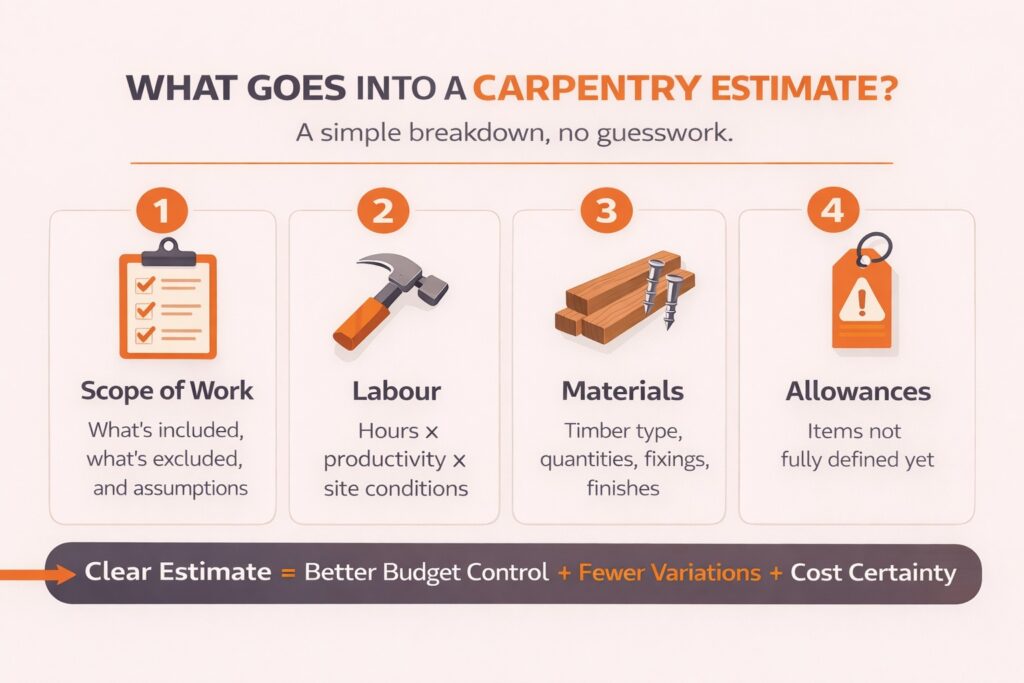
A carpentry cost breakdown shows where the final number comes from instead of presenting a vague total. It separates labour, materials, and allowances so customers understand what they’re paying for. This clarity improves cost accuracy, supports better decisions, and avoids the frustration of “mystery totals” later in the project.

When estimates are transparent, it’s easier to see how carpenters price work and what might affect the final cost.
Labour: How Carpenters Price Work
Labour is usually the biggest and most flexible part of a carpentry estimate. Carpenters calculate labour based on hours per task, not guesswork. Complexity, access, sequencing with other trades, and rework risk all affect carpentry labour productivity rates. Tight spaces, detailed finishes, or poor site access can increase time and cost. This is why a carpentry labour hours estimate may change as scope details become clearer.
Materials: Quantities + Timber Specification
Materials are priced using measured quantities and agreed specifications. Timber grade, size, and whether engineered or solid timber is used all affect pricing. Wastage allowances, fixings, and hardware are also included. Clear timber specification improves cost accuracy and reduces disputes. When customers understand labour and material costs in carpentry, pricing feels logical rather than inflated.
Allowances and Exclusions: The Stuff That Can Change The Price
Allowances cover items not fully defined at the estimate stage, while exclusions clearly state what is not included. These are common carpentry estimating mistakes when misunderstood. If selections change or extra work is added, variations occur. Clear allowances and exclusions improve estimate transparency, support budget control, and help customers read a carpentry estimate with confidence.
Residential vs Commercial Carpentry Estimates: What Actually Changes
| Area of Comparison | Residential Carpentry Estimate | Commercial Carpentry Estimate |
| Documentation Level | Often based on drawings, site visits, and discussions | Requires detailed drawings, specs, and formal documentation |
| Site Rules & Access | Flexible access with fewer restrictions | Strict site rules, inductions, and limited working hours |
| Coordination Needs | Minimal trade coordination | High coordination with multiple trades and supervisors |
| Tolerance for Change | Higher tolerance as the scope evolves | Low tolerance; changes usually trigger variations |
| Risk Identification | Fewer risks, easier adjustments | Higher risk exposure due to scale and compliance |
| Estimate Transparency | Simpler breakdowns are common | Detailed line items are expected for pricing approval |
Why This Matters to You
Understanding whether you’re dealing with a residential carpentry estimate or commercial carpentry pricing helps you judge realism, not just price. Different rules, risks, and controls explain why two projects of similar size can have very different numbers.
Framing vs Finish vs Joinery (Why The Same “Size Job” Prices Differ)
Even when two jobs look “the same size,” the price can be very different because the scope is not the same. Framing is usually measured by speed and quantities, finish carpentry is priced around detail and time, and joinery depends on design, materials, and installation conditions. This is where cost accuracy comes from.
A framing carpentry cost estimate is often more predictable because it’s driven by linear metres, sheets, studs, and clear production rates. Finish carpentry pricing can move more because small details take time—scribing, mitres, reveals, and fitting to imperfect walls. Joinery estimating basics include both making and installing, and the joinery scope can change quickly with hardware choices, finishes, and site access.
| Scope Type | What It Usually Includes | What Drives Price Most | Why Costs Can Change |
| Framing | Walls, floors, roof framing, structural timber | Quantities + labour productivity | Design changes, structural revisions, and access constraints |
| Finish Carpentry | Skirting, architraves, doors, trims, feature details | Time + detail level | Site conditions, uneven surfaces, and higher finish expectations |
| Joinery | Cabinets, wardrobes, built-ins, shelving, install | Design + materials + hardware + install time | Changes in layout, hardware upgrades, finishes, and measurements |
Quick takeaway: If you’re comparing a framing estimate, a finish carpentry quote, and a joinery quote basics side-by-side, don’t expect them to behave the same. Each scope has its own “price engine,” and understanding that prevents surprises.
How To Read A Carpentry Estimate (Quick Customer Checklist)
Reading a carpentry estimate properly helps you avoid disputes, delays, and budget shocks. Instead of focusing only on the total price, look at how clearly the work is defined. Strong estimate transparency makes it easier to compare quotes and understand where risks may sit.
A good estimate should answer questions before work starts, not after problems appear.
- Scope Defined Clearly
Check that the scope definition explains exactly what work is included and where it starts and ends. - Specifications Stated
Materials, timber type, and finish level should be written, not assumed. - Line Items Explained
A clear carpentry cost breakdown shows how labour and materials are priced. - Allowances Identified
Allowances should be visible so you know what may change later. - Exclusions Listed
Exclusions reduce disputes and support fair quote comparison. - Timeline and Payment Terms
Start dates, duration, and payment stages help with planning and risk identification.
Comparing Carpentry Quotes (Like-for-Like Without Overthinking)
Comparing carpentry quotes works best when you keep it simple and consistent. The goal is not to find the cheapest number, but the most reliable one. Clear estimate transparency helps you spot real differences and avoid decisions that lead to budget stress later.
When quotes are compared like-for-like, budget control and variation prevention become much easier.
- Align the Scope First
Make sure every quote is pricing the same work, not different assumptions. - Normalise Allowances
Check that allowance amounts are similar so totals aren’t misleading. - Confirm Timber Specification
Different timber grades or finishes can change pricing significantly. - Clarify Exclusions
Hidden exclusions often explain why one price looks cheaper. - Check Timeline and Warranty
Shorter programs or stronger warranties may justify higher pricing. - Compare Value, Not Just Price
Accurate carpentry budgeting comes from clarity, not the lowest quote.
Common Carpentry Estimating Mistakes (That Cost Customers Money)
Most carpentry budget blowouts come from small estimating mistakes made early. These issues are easy to miss but expensive later. Spotting them upfront improves cost accuracy and helps customers avoid disputes, delays, and unnecessary variations.
Knowing the common carpentry estimating service mistakes allows you to manage risk before work begins.
- Vague Scope Descriptions
Poor scope definition leads to assumptions, gaps, and arguments during the job. - Missing Preparation or Demolition
Prep work is often overlooked, yet it affects time, access, and sequencing. - Unspecified Timber or Finishes
Without clear timber details, prices can shift once selections are made. - Unrealistic Labour Allowances
Underestimated hours increase rework risk and reduce cost accuracy. - Unclear Exclusions
Missing exclusions hide future costs and weaken estimate transparency. - No Variation Process Explained
A clear change process is key to risk identification and budget control.
Why A Carpentry Estimate Matters (Real-World Outcomes)
A well-prepared carpentry estimate does more than set a price. It gives you clarity before work starts and confidence while it’s underway. When expectations are clear, decisions are easier, and stress stays low.
This is why a carpentry estimating service matters in real projects, not just on paper.
- Budget Control From Day One
Clear pricing supports accurate carpentry budgeting and reduces financial surprises. - Fewer Variations
Defined scope and allowances support variation prevention throughout the job. - Better Project Planning
Timelines, sequencing, and resources are easier to plan with clear costs. - Fewer Disputes
Estimate transparency keeps everyone aligned and avoids misunderstandings. - Higher Cost Certainty
Clear assumptions improve construction cost certainty and decision-making. - Smarter Budget Planning
Reliable estimates support long-term carpentry budget planning with confidence.
Wrap-Up: The 3 Questions To Ask Before You Approve Any Estimate
Before approving any estimate, stop and check clarity, not price. These three questions help you understand scope, risk, and cost movement. They protect your budget and reduce disputes once work begins.
- What Exactly Is Included?
Ask for a clear scope definition so there’s no confusion about what work is covered. - What’s Allowed for and What’s Excluded?
Review allowances and exclusions to avoid gaps that lead to surprise costs. - What Changes the Price and How Are Variations Handled?
Understanding this supports estimating transparency and variation prevention when scope shifts.
FAQs
A complete estimate clearly states the scope definition, lists key materials and finishes, shows a carpentry cost breakdown, and explains allowances and exclusions. If any of those parts are missing or vague, it’s harder to trust the number.
A carpentry quote vs estimate usually comes down to certainty. An estimate is a best forecast based on current information, while a quote is often closer to a fixed price for a clearly defined scope. If the scope changes, both can change—but estimates move more often.
Prices move when the scope becomes clearer. Access issues, hidden conditions, changes in timber specification, or extra prep can affect labour productivity and material quantities. This is normal when the original estimate was based on limited detail.
Look for separation between labour and material costs in carpentry, plus any allowances. You should also see what is excluded. This estimate transparency helps you understand how carpenters price work and prevents “mystery totals.”
Allowances are budget placeholders for items not fully selected or confirmed at the time of pricing. They matter because if the real cost is higher than the allowance, you pay the difference. Clear allowances and exclusions improve cost accuracy and help with accurate carpentry budgeting.
Conclusion
A carpentry estimate is more than a price—it’s a planning tool that protects your budget and sets expectations before work begins. When the scope, costs, and assumptions are clear, decisions become easier and disputes less likely. Understanding how estimates work helps you plan with confidence, compare quotes fairly, and achieve real cost certainty.