Tender submissions often fail not because of poor capability, but because of gaps in preparation. Many contractors rush the tender estimate process, overlook key details, or rely on assumptions when handling tender pricing before submission. This leads to weak bids, missed costs, and reduced contractor bid confidence.
That’s where tender estimating services for contractors play a critical role. With proper tender submission support and structured pre-submission estimating, contractors can approach each bid with clarity and control. Instead of guessing, they follow a process that improves accuracy, reduces risk, and strengthens overall bid performance.
Why Contractors Struggle Before Tender Submission
Most contractors don’t lose tenders because they lack skill—they struggle because of pressure, unclear tender documents, and gaps in the scope of works. Tight deadlines often lead to tender mistakes, rushed decisions, and bid errors that could have been avoided with a structured approach.
The real challenge is not effort, but control. Without a clear system, avoiding underquoting in construction tenders becomes difficult. Contractors often rely on assumptions instead of verified data, which makes reducing tender pricing errors before submission more of a guess than a process. This weakens confidence and increases financial risk.
Common Pre-Submission Mistakes
Before submission, a few recurring mistakes cause most of the damage. These are not complex issues—but they are easy to overlook when time is short, or the tender inclusions and exclusions are not clearly reviewed.
- Missing Scope Items: Parts of the scope of work are overlooked, leading to incomplete pricing and future losses.
- Wrong Assumptions: Contractors rely on guesswork instead of validating tender documents and site conditions.
- No Proper Validation: Estimates are submitted without a full tender inclusions and exclusions review, increasing tender risks.
Another key issue is the lack of proper variation risk control. Without including a realistic risk allowance before tender submission, even a small oversight can turn into a major cost problem later. These estimating errors don’t just affect pricing—they affect the entire project outcome.
What Tender Estimating Services Actually Include
Tender estimating services give contractors a clear, structured way to prepare their construction bid estimate before submission. Instead of guessing or rushing, these services provide outsourced estimating support that breaks the job into measurable, costed parts, helping improve accuracy and decision-making.
From start to finish, the estimating services scope covers everything needed for a confident submission. With proper tender submission support, contractors can rely on accurate numbers, clear pricing logic, and fewer surprises during project execution.
- Tender Document Review: Checks drawings and specifications to understand the full project scope.
- Quantity Takeoff & Measurement: Accurate tender takeoff and pricing services to quantify all work items.
- Cost Breakdown & Pricing: Detailed tender cost breakdown services covering labour, materials, and equipment.
- Subcontractor & Supplier Inputs: Collects and compares quotes for realistic pricing.
- Risk & Margin Planning: Adds buffers and profit margins to protect against uncertainty.
- Final Estimate Review: Ensures the construction bid estimate is complete, accurate, and ready for submission.
Step-by-Step: What Happens Before Submission
Before a tender is submitted, there’s a structured process behind the numbers. Good tender estimating services don’t just produce a price—they build it step by step, checking every detail along the way. This approach reduces risk and gives contractors clarity before committing to a final figure.
Each stage plays a role in turning raw tender documents into a reliable construction bid estimate. When done properly, this process removes guesswork and ensures the submission is based on facts, not assumptions.
1. Tender Documentation Review & Scope Analysis
This is where everything begins. The team carefully studies the tender documents, including drawings and specifications, to understand the full scope of work. A proper tender documentation review helps identify missing details, unclear items, or gaps that could affect pricing later.
Through detailed tender scope analysis, contractors can confirm what is included and what is not. Reviewing the bill of quantities for tender submission ensures that no major scope items are missed, which is critical for avoiding disputes and cost overruns once the project starts.
2. Quantity Takeoff & Cost Breakdown
Once the scope is clear, the next step is measuring the work. Quantity takeoff for tender pricing ensures every element is counted accurately, from materials to labour requirements. This step forms the backbone of accurate tender cost estimating.
A structured labour and material cost breakdown helps contractors understand where money is being spent. Instead of lump-sum guessing, this method creates transparency and control, making it easier to adjust pricing and avoid costly mistakes during construction.
3. Subcontractor & Supplier Pricing Validation
No estimate is complete without real market input. Subcontractor quote comparison ensures that external pricing is realistic and competitive. Contractors gather multiple quotes and assess them against procurement requirements to avoid overpaying or underpricing.
This step strengthens contractor tender pricing services by aligning estimates with actual market conditions. It also reduces the risk of relying on outdated or unrealistic rates, which can lead to financial pressure once the project begins.
4. Preliminaries, Overheads & Cost Structuring
Direct costs alone are not enough. Preliminaries and overheads in tender estimates cover site setup, supervision, administration, and other indirect expenses that are often overlooked.
A proper tender cost breakdown services approach ensures these costs are included and structured correctly. Without this step, contractors may win the job but struggle to manage actual expenses during execution due to underpriced project overheads.
5. Margin, Contingency & Risk Pricing
This stage focuses on protecting the business. Margin calculation ensures the project remains profitable, while contingency allowance covers uncertainties that may arise during execution.
Including a realistic risk allowance before tender submission is critical. Margin and contingency in tender pricing help contractors balance competitiveness with safety, ensuring they don’t win work at the cost of future losses.
6. Independent Estimate Review & Validation
Before final submission, the estimate must be checked. An independent estimating review provides a fresh perspective, helping identify errors, missing items, or incorrect assumptions that may have been overlooked.
Tender estimate validation ensures the numbers are accurate and aligned with the project scope. This final step builds confidence, knowing the tender price is not just complete, but reliable and ready for submission.
Final Tender Review Before Submission
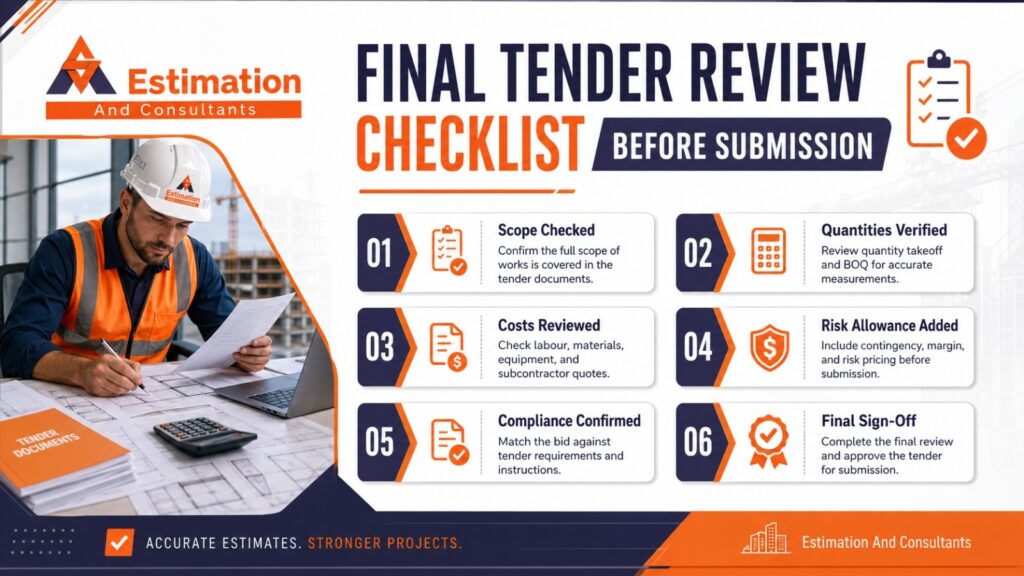
This is the last checkpoint before you lock in your price. A proper final tender review before submission ensures everything is complete, accurate, and aligned with tender compliance requirements. It’s not just a quick glance—it’s a structured check to protect your numbers and your reputation.
With the right tender submission preparation support, contractors can confirm that nothing has been missed. This step improves tender submission accuracy and gives confidence that the bid is ready to go without last-minute surprises.
- Compliance Check: Confirms all tender compliance requirements are met, and nothing is missing.
- Scope Verification: Reviews inclusions to ensure the full scope is covered clearly.
- Cost Accuracy Review: Double-checks pricing to avoid errors or miscalculations.
- Documentation Clarity: Ensures all tender documents are clear, complete, and consistent.
- Submission Checklist Review: Uses a tender compliance checklist to validate readiness.
- Final Sign-Off: Confirms the estimate is accurate and ready for submission with confidence.
What Contractors Should Expect as the Final Outcome
By the end of the process, contractors should have more than just a number—they should have clarity and control. A well-prepared estimate improves tender submission accuracy and builds real contractor bid confidence before committing to the job.

The goal is simple: reduce uncertainty and strengthen decisions. When the process is done right, reducing tender pricing errors before submission becomes consistent, not accidental, while avoiding underquoting in construction tenders protects both profit and reputation.
- Accurate Pricing You Can Trust: A clear, structured estimate that reflects real project costs without hidden gaps.
- Stronger Bid Confidence: Contractors can submit knowing their numbers are checked and reliable.
- Reduced Pricing Errors: A process that focuses on reducing tender pricing errors before submission.
- Better Risk Control: Helps in avoiding underquoting in construction tenders and managing uncertainties.
- Competitive Positioning: Balanced pricing that is both realistic and competitive in the market.
- Higher Chances of Tender Success: A complete and well-reviewed submission improves overall bid outcomes.
How Tender Estimating Services Reduce Risk Before Submission
Risk is always part of construction, but unmanaged risk is what causes losses. Tender estimating services bring structure to decision-making, helping contractors identify gaps early and apply proper variation risk control before submitting their price.
Instead of reacting later, contractors can plan ahead. With the right risk pricing and contingency allowance, they can include a realistic risk allowance before tender submission, improving cost control and avoiding underquoting in construction tenders.
- Early Risk Identification: Spots missing scope items and unclear details before pricing is finalized.
- Structured Risk Pricing: Applies realistic adjustments to reflect uncertainties in the project.
- Contingency Planning: Builds a contingency allowance to handle unexpected changes during execution.
- Variation Risk Control: Reduces exposure to costly variations by reviewing the scope carefully.
- Better Cost Control: Keeps the estimate aligned with actual project risks and market conditions.
- Reduced Financial Surprises: Helps avoid underquoting in construction tenders and protects profit margins.
When Should Contractors Use Tender Estimating Services
Not every project needs external help—but many do. Contractors should consider outsourced estimating support when projects become complex, timelines are tight, or internal resources are stretched. It’s about making better decisions, not just saving time.
Using the right support at the right stage improves accuracy and reduces pressure. Whether it’s commercial tender estimating or smaller residential jobs, knowing when to outsource estimating can protect both pricing and project outcomes.
- Large or Complex Projects: Commercial tender estimating services help manage detailed scope and multiple trades.
- Tight Deadlines: When time is limited, outsourced estimating support ensures nothing is rushed or missed.
- Limited Internal Resources: Helps when in-house teams are overloaded or unavailable.
- High-Risk Projects: Useful when pricing errors could lead to a major financial impact.
- Residential Work with Variations: Residential tender estimating support helps handle changing scopes and details.
- Competitive Bidding Situations: Improves accuracy and positioning when margins are tight.
FAQs
Tender estimating services include everything needed to prepare a complete and accurate bid before submission. This usually covers tender documentation review, quantity takeoff, cost breakdown, subcontractor pricing, and final validation. In simple terms, tender estimating services include building your price step by step so nothing is missed.
Estimating services help avoid underquoting by checking scope, validating costs, and adding proper risk allowances. Instead of guessing, contractors use structured pricing with contingency and risk planning. This is how estimating services help avoid underquoting—by making sure every cost is accounted for before submission.
A pre-submission estimate review is important because it catches errors before they become costly mistakes. It ensures the estimate is accurate, complete, and aligned with the tender documents. In short, a pre-submission estimate review is important because it gives contractors confidence that their price is correct.
Yes, small contractors can benefit from tender estimating services just as much as large firms. Even for smaller jobs, having accurate pricing and proper scope review improves results. So, small contractors benefit from tender estimating services by reducing mistakes and improving their chances of winning work.
Contractors should outsource tender estimating services when projects are complex, deadlines are tight, or internal teams are overloaded. It’s about making better decisions under pressure. So, contractors should outsource tender estimating services when they need accuracy, speed, and confidence before submission.
Conclusion
A strong tender is never built at the last minute—it comes from a clear process and proper preparation. Tender estimating services help contractors move from guesswork to structured pricing, ensuring every detail is reviewed and aligned before submission.
With the right tender submission support and a solid final tender review before submission, contractors can submit with confidence. In the end, tender estimating services for contractors lead to better tender outcomes—more accuracy, fewer risks, and smarter decisions that protect both profit and reputation.