A quantity surveyor is a construction cost consultant who helps you plan, check, and control project costs before and during construction. If you are asking what a quantity surveyor is, think of them as a building cost advisor who checks whether your budget, builder quote, tender, or scope is realistic.
A QS consultant is useful when your project has unclear quotes, tender documents, variations, funding needs, or cost risk. They support cost planning and budgeting, construction financial management, and cost certainty before construction, so you can make better decisions before spending serious money.
What Is A Quantity Surveyor?
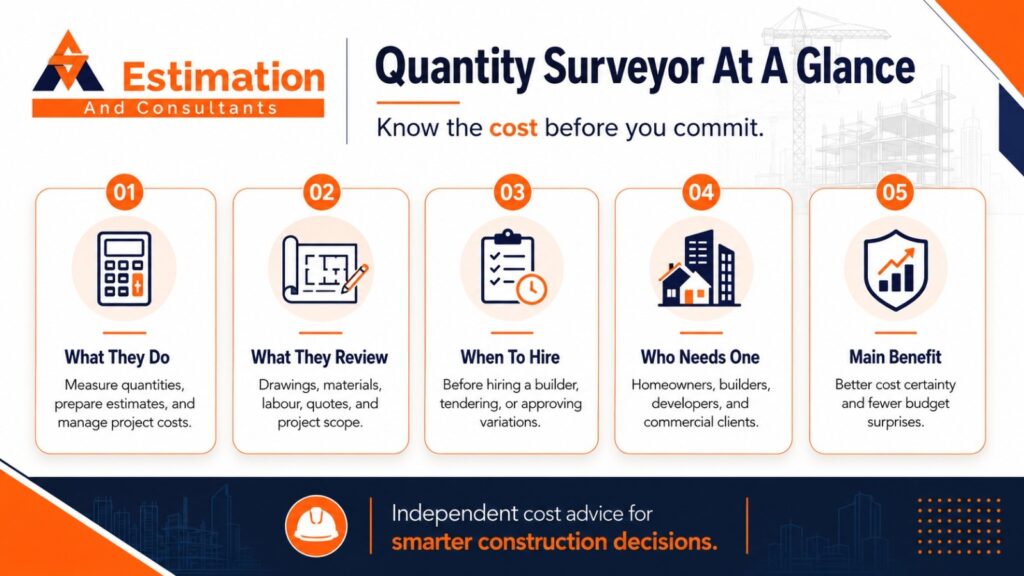
A quantity surveyor is a construction cost consultant who measures, prices, checks, and manages project costs. They do not design or build the project. They help you know if your design, builder quote, tender, or budget is realistic.
In simple terms, the QS role is like a building budget advisor. They review:
- Drawings and quantities
- Materials and labour costs
- Builder quotes and allowances
- Risks, scope gaps, and budget forecasts
What Does A Quantity Surveyor Do?
A quantity surveyor helps manage the money side of a building project. Their main duties include quantity takeoffs, cost estimates, bill of quantities preparation, tender support, contractor quote comparison, cost reports, variation reviews, and final cost advice. In simple words, they help keep the project budget clear, fair, and controlled.
They support construction cost management by checking:
- Project quantities
- Labour and material costs
- Builder quotes
- Tender documents
- Budget risks
- Cost changes during construction
Measuring Quantities From Drawings
A QS measures the work shown in drawings, plans, and specifications. This is called a construction takeoff or material takeoff. They check materials, labour items, trade packages, and project scope so the cost estimate is based on real quantities, not guesses. This helps builders and owners understand the true size of the work.
Preparing Cost Estimates And Budgets
A quantity surveyor prepares early cost estimates, detailed budgets, and updated cost plans as the design develops. This helps owners avoid guessing their project cost. Through cost planning and budgeting, construction budget forecasting, and project budgeting services, the QS shows whether the design fits the budget before major decisions are made.
Preparing A Bill Of Quantities
A bill of quantities, or BOQ, lists the work, materials, quantities, and pricing items needed for the project. It gives builders the same scope to price, which makes tendering clearer and fairer. BOQ preparation also helps reduce missing items, unclear allowances, and confusion during procurement and tender documentation.
Comparing Builder Quotes
Builder quotes can look very different because each contractor may include different materials, allowances, exclusions, or assumptions. A QS helps with contractor quote comparison by checking the scope, documents, quantities, and cost benchmarks. This helps clients compare quotes like-for-like before hiring a builder and improves cost certainty.
Key Quantity Surveyor Services
Quantity surveyor services in Australia cover the main cost checks needed before and during a building project. A QS can help with early cost planning, tender support, budget tracking, and variation reviews. These construction cost consultant services help homeowners, builders, developers, and commercial clients reduce risk and make clearer decisions.
Common QS services include:
- Pre-construction cost planning
- Tender estimating and procurement support
- Bill of quantities preparation
- Contractor quote comparison
- Cost control during construction
- Variation and claims management
Pre-Construction Cost Planning
Pre-construction cost planning helps you know if your project is financially realistic before work starts. A quantity surveyor checks the design, scope, materials, likely labour costs, and risk allowances. This gives you cost certainty before construction, so you can adjust the design, budget, or scope before approaching builders or signing a contract.
Tendering And Procurement Support
Tendering and procurement support helps clients get clearer prices from builders and contractors. A QS can prepare tender documents, support bill of quantities preparation services, compare builder inclusions, and review pricing gaps. This makes the tender process fairer and helps identify hidden cost risks before choosing a contractor.
Cost Control During Construction
Once construction starts, a quantity surveyor helps track the project budget. They review progress claims, check variations, update cost forecasts, and monitor cash flow. These cost control services for construction projects help clients see where the money is going and reduce the chance of budget surprises near the end.
Variation And Claims Review
Variations happen when the design, scope, materials, or site conditions change. A QS reviews the cost of these changes and checks if the claim is fair, supported, and linked to the contract. Variation and claims management services are useful when costs increase, and you need clear, independent cost advice.
Quantity Surveyor For Residential, Commercial, and Builder Projects
A quantity surveyor can support many types of building projects, from home renovations to commercial construction. The main goal stays the same: clearer costs, better planning, and fewer budget surprises. Residential and commercial quantity surveying helps homeowners, builders, developers, and business owners make cost decisions before and during construction.
Typical clients include:
- Homeowners planning new builds, renovations, or extensions
- Builders needing takeoffs, BOQs, and tender support
- Developers checking project feasibility and budgets
- Commercial clients managing larger cost risks

Quantity Surveyor For Homeowners
A quantity surveyor for residential projects helps homeowners understand the real cost before they commit. This is useful for new homes, renovations, extensions, builder quote checks, and budget reviews. A homeowner QS can compare contractor quotes, check allowances, and support risk and contingency planning before signing a building contract.
Quantity Surveyor For Builders
Builders often use quantity surveying services for builders when they need clear takeoffs, BOQs, tender pricing support, and subcontractor quote checks. A QS can review labour and material costs, prepare a bill of quantities, and support project budgeting and forecasting services so builders can price work with better accuracy.
Quantity Surveyor For Commercial Projects
A quantity surveyor for commercial construction helps manage larger cost risks. Commercial projects often involve more trades, contracts, stakeholders, and reporting needs. A commercial QS can support tender estimating, procurement, cash flow forecasting, contract administration, and cost control services for construction projects, helping keep the budget more organised.
Quantity Surveyor Vs Estimator: What Is The Difference?
An estimator usually focuses on pricing the work, while a quantity surveyor supports wider construction cost management. Both roles can overlap, especially on smaller projects, but a QS is usually more involved in cost planning, tender comparison, contract administration, variations, and cost reporting.
| Comparison Point | Estimator | Quantity Surveyor |
| Main role | Prices the work | Manages and checks project costs |
| Best for | Simple pricing, trade estimates, and material takeoffs | Cost planning, BOQs, tender review, variations, and reporting |
| Main focus | Labour, materials, and trade pricing | Full construction budget and financial control |
| Common services | Quantity takeoff services, simple cost estimates, labour and material cost analysis | Cost planning and budgeting, bill of quantities, tender support, and contract administration services |
| Project stage | Mostly before pricing or tender submission | Before, during, and sometimes after construction |
| When to use | When the scope is clear, and you only need a price | When you need cost certainty, risk reduction, or independent cost advice |
| Good for builders? | Yes, for estimating the service and material takeoff service | Yes, for BOQ preparation, tender support, quote checks, and project budgeting |
| Good for homeowners? | Sometimes, for a simple cost estimate | Better for builder quote review, budget checks, and cost planning before signing a contract |
| Cost control during construction | Usually limited | Stronger support through cost reports, variations, claims, and final cost advice |
When An Estimator May Be Enough
An estimator may be enough when the project is simple, the drawings are clear, and you only need a material takeoff, trade price, or basic construction cost estimate.
When A Quantity Surveyor Is The Better Choice
A quantity surveyor is better when the project needs a bill of quantities, tender comparison, quote review, feasibility cost planning, variation checks, or independent reporting. This gives better cost certainty and helps reduce financial risk.
How Much Does A Quantity Surveyor Cost In Australia?
Quantity surveyor costs in Australia depend on the project size, service scope, location, drawings, complexity, and urgency. A small residential review may need less work than a detailed commercial cost report. Instead of looking for one fixed price, it is better to understand how QS fees in Australia are usually calculated.
Costs may change based on:
- Residential or commercial project type
- Number and quality of drawings
- Level of cost detail needed
- BOQ, tender, or quote review scope
- Reporting and revision requirements
What Affects The Cost Of A Quantity Surveyor?
The main QS cost factors are the size of the project, the number of trades, the detail in the drawings, and the type of report needed. A quantity surveyor for residential projects may only review a builder’s quote, while a quantity surveyor for commercial construction may need deeper scope validation, labour and material cost analysis, and detailed reporting.
Quantity surveyor fee factors often include:
- Project size and complexity
- Drawing and documentation quality
- Number of trades involved
- Level of cost benchmarking required
- Whether revisions are included
- Timeframe and urgency
Common Fee Types
Quantity surveyor pricing can be hourly, fixed, staged, or percentage-based. Hourly QS rates may suit small reviews or advice. A fixed QS fee may suit a defined service, such as a cost estimate or bill of quantities. Staged QS fees are often used when cost reporting is needed across several project phases.
When Do You Need A Quantity Surveyor?
You need a quantity surveyor when the cost of a project feels unclear, risky, or hard to compare. A QS helps with cost certainty before construction by checking quotes, scope, risks, and documents. If you are asking, “Do I need a QS?”, the answer is often yes when money decisions feel uncertain.
You may need a construction cost consultant when:
- You are hiring a builder
- You are planning a renovation or extension
- Builder quotes are very different
- The project scope is unclear
- Variations or claims are increasing the budget
Before You Hire A Builder
A quantity surveyor, before hiring a builder, can review the quote before you sign. They check if the price is realistic, if key items are missing, and if allowances are fair. This pre-contract cost check helps with contractor quote comparison, scope validation, and cost certainty before construction, so you avoid surprises later.
Before A Renovation Or Extension
A quantity surveyor for renovations and extensions is useful because these projects often carry hidden risks. Existing structures, unclear site conditions, design changes, and provisional allowances can all affect the final cost. A renovation QS can help with labour and material cost analysis, risk and contingency planning, and extension cost planning before work starts.
When Builder Quotes Are Hard To Compare
If builder quotes are very different, it can be hard to know which one is fair. One quote may exclude important work, while another may include better materials or higher allowances. A QS can compare builder quotes, check inclusions and exclusions, review quantities, and use construction cost benchmarking to find cost gaps.
When Variations Start Increasing The Budget
Variations can quickly push a project over budget. A QS can review variation claims, check rates, compare contract documents, and explain whether the cost change is fair. Variation and claims management services are useful when design changes, site issues, or scope changes start affecting the final construction cost.
How To Choose The Right Quantity Surveyor
Choosing the right quantity surveyor is about fit, not just price. A qualified quantity surveyor should understand your project type, explain the QS scope clearly, and provide practical cost advice you can use.
The best QS in Australia will offer clear reporting, transparent pricing, and strong knowledge of residential and commercial quantity surveying.
- Relevant Project Experience: Choose an experienced QS who has worked on similar projects, such as renovations, new builds, commercial fit-outs, developments, or infrastructure work.
- Clear Service Scope: Ask what is included, such as quantity takeoff services, bill of quantities preparation, assumptions, exclusions, quote comparison, revisions, and final reporting.
- Transparent Pricing: A good QS should explain fees clearly so you know what you are paying for and how the quantity surveyor cost planning process works.
- Practical Cost Reports: The QS report should not just show numbers. It should explain risks, cost gaps, allowances, and budget choices in simple terms.
- Independent Advice: Look for independent quantity surveyor services in Australia if you need unbiased cost checks before hiring a builder or approving a tender.
- Strong Local Cost Knowledge: Choose someone who understands Australian quantity surveying standards, construction cost benchmarking, and current building cost pressures.
FAQs
Quantity surveyor costs in Australia depend on the project size, service scope, location, drawing quality, urgency, and level of reporting needed. Some QS services may be charged hourly, while others may use fixed fees, staged fees, or project-based pricing.
You may need a quantity surveyor for a small renovation if the scope is unclear, the builder’s quote seems high, or the budget is tight. A quantity surveyor for renovations and extensions can help check allowances, materials, labour costs, and possible risks before work begins.
Yes, a quantity surveyor can help compare builder quotes by checking inclusions, exclusions, quantities, allowances, and assumptions. This helps you see whether each builder is pricing the same scope or if one quote is missing important work.
Yes, a quantity surveyor can help with variations and claims by reviewing the cost change, checking contract documents, comparing rates, and confirming whether the claim is fair. This is useful when design changes, site issues, or scope changes start increasing the project budget.
Yes, hiring a quantity surveyor before choosing a builder can help you avoid costly surprises. A QS can review the builder quote, check the scope, identify missing items, and give you better cost certainty before construction starts.
You choose the right quantity surveyor by checking their project experience, service scope, pricing clarity, report quality, independence, and understanding of Australian construction costs. A good QS should give practical advice you can use, not just a list of numbers.
Final Thoughts: Is A Quantity Surveyor Worth It?
A quantity surveyor is worth it when your project has cost risk, unclear builder quotes, changing scope, tendering needs, budget pressure, or possible disputes. Good QS cost advice helps you understand the numbers before you commit to major construction spending.
If you are unsure when you need a quantity surveyor, start with one simple step: get an independent cost review. Independent quantity surveyor services in Australia can help with cost certainty before construction, risk and contingency planning, and better construction budget management services before the project becomes expensive to fix.