Steel overruns usually aren’t caused by one big mistake. They come from a chain of small, repeatable structural steel estimating errors—a missed scope item here, a weak productivity assumption there, and a few logistics costs that never made it into the price. This guide gives you a full system to understand how structural steel cost overruns are explained, and how to stop them before they hit your margin.
We’ll break the errors into clear categories, map each one to a practical prevention control, and highlight early warning signals you can spot before award. The goal is simple: better steelwork cost control through accurate steel estimating methods, so you’re consistently avoiding steel cost overruns. If you’re tired of common steel estimating mistakes turning into claims, delays, and rework, this is the steel estimate overrun prevention approach you can use every time—built on best practices in steel estimating and focused on how to avoid steel estimating errors in the real world.
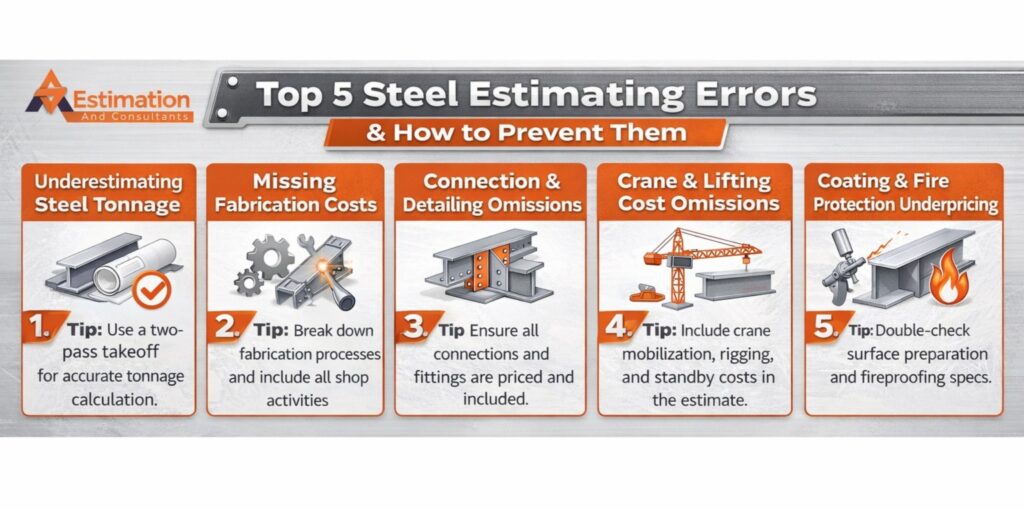
The 5-Category Map of Steel Estimating Errors
The 5-Category Map of Steel Estimating Errors gives you a clear, non-overlapping way to see where steel costs really go wrong. Instead of guessing, it breaks structural steel estimating errors into practical buckets that mirror how estimates are actually built and lost.
This framework helps explain common steel overrun drivers by separating quantity mistakes from scope gaps, productivity assumptions, logistics oversights, and commercial risk decisions—so nothing gets missed or double-counted.
- Quantity Errors
Mistakes in steel tonnage, fittings, or revisions quietly inflate costs later. - Scope Errors
Gaps in scope clarity and exclusions, including missing fabrication, connections, or detailing. - Methods & Production Errors
Unrealistic productivity assumptions for fabrication, welding, bolting, or erection. - Logistics & Plant Errors
Overlooked crane costs, transport planning, site access, and preliminaries and overheads. - Commercial & Risk Errors
Weak risk and contingency allowances, unclear exclusions, or misallocated commercial risk.
Category 1 — Quantity & Measurement Errors (What You Count)
Quantity and measurement errors are where many structural steel estimating errors quietly begin. If steel is counted wrong at the start, every price, labour allowance, and risk decision built on it is flawed. Underestimating steel tonnage, missing plates or fittings, ignoring waste and yield, or failing to track revisions are all common steel estimating mistakes that lead to avoidable cost overruns.
This category covers steel takeoff errors tied to measurement rules and assumptions—what gets counted, how it’s measured, and whether updates are controlled. Even small tonnage mistakes or unpriced connections and fittings, when multiplied across fabrication and erection, can seriously damage steelwork cost control.
Control: Two-Pass Takeoff + Reconciliation
The simplest way to reduce quantity risk is a disciplined two-pass takeoff. The first pass focuses only on primary and secondary members to establish base tonnage. The second pass captures plates, fittings, connections, and other “small” items that are often missed but add up fast. This approach supports accurate steel estimating methods and makes tonnage validation part of the process, not an afterthought.
Reconciliation is what closes the loop. Member quantities should be checked against schedules, drawings, and revisions before pricing is locked. This step is one of the most reliable ways to avoid steel estimating errors and protect margins before tender submission.
Early Warning Signals
Quantity risk often shows up before the award if you know what to look for. Large swings in tonnage compared to benchmarks, inconsistent drawings, or missing schedules are all signs that measurement assumptions may be wrong. Catching these early supports better steelwork cost control and helps in avoiding steel cost overruns.
- Benchmark gaps – Major tonnage differences versus similar projects
- Drawing conflicts – Plans, sections, and schedules don’t align
- Missing information – Incomplete member lists or connection details
These red flags explain how quantity issues turn into real overruns if left unchecked.
Category 2 — Scope & Specification Gaps (What You Forgot to Include)
Scope and specification gaps are some of the most expensive structural steel estimating service errors because they don’t show up until work is already underway. These errors come from scope gaps in steel packages—items assumed to be “included somewhere” but never clearly priced. Fabrication steps, connections, shop drawings, coatings, fire protection, and testing are common examples.
This category explains why missing fabrication costs in steel estimates, connection and detailing omissions, and coating and fire protection underpricing are such frequent steel scope omissions. When responsibilities aren’t clearly defined, costs don’t disappear—they resurface later as variations, delays, and margin loss.
Control: Scope Matrix for Steel Packages
The most reliable way to prevent scope gaps is a simple scope matrix that forces clarity before pricing begins. Instead of relying on assumptions, each part of the steel package is deliberately assigned, priced, or excluded. This approach supports scope clarity and exclusions and strengthens steelwork cost control across the project lifecycle.
A scope matrix works because it removes overlap and blind spots. It aligns with best practices in steel estimating by making inclusions and exclusions visible and defensible.
- Supply – Material supply limits and responsibility
- Fabrication – All shop processes and QA requirements
- Detailing – Shop drawings, revisions, and coordination
- Erection – Site labour, access, and sequencing
- Coatings & Fireproofing – Spec-driven application and touch-ups
- Testing & Temporary Works – Inspection, certifications, and temporary steel
Used consistently, this steel scope checklist closes spec gaps before they turn into costly disputes.
Category 3 — Methods & Productivity Errors (How Long It Takes)
Methods and productivity errors happen when time is priced on hope instead of site reality. Inaccurate productivity assumptions in steelwork—especially around erection rates, welding, and bolting—are a major cause of cost overruns. These steel erection labour miscalculations usually ignore access limits, sequencing clashes, and rework that slow crews down.
This category covers erection labour productivity errors, underestimated welding and bolting, and common access and sequencing issues. When productivity is assumed instead of built up, labour costs escalate quickly and steelwork programmes slip, even if quantities and scope were priced correctly.

Control: Build Productivity from Constraints
The safest way to price labour is to build productivity from real constraints, not generic rates. Start by defining the crew size and skills, then assess access, lifting limits, and how steel will actually be installed. This turns steelwork labour assumptions into defendable logic and supports long-term steelwork cost control.
Constraint-based estimating follows best practices in steel estimating because it reflects how work happens on site, not how it looks on paper.
- Crew definition – Trade mix, experience, and supervision
- Access and lift cycles – Time lost to setup, movement, and repositioning
- Bolt-up and weld workflow – Setup, execution, and inspection time
- Constraint factor – Adjustment for congestion, weather, or sequencing
This productivity build-up approach reduces risk and improves pricing confidence before tender.
Category 4 — Logistics & Plant Errors (How Steel Moves and Lifts)
Logistics and plant errors sit outside labour rates, but they drive some of the largest steel overruns. Crane and lifting cost omissions and transport and logistics cost errors often occur because movement, access, and sequencing are treated as preliminaries instead of priced work. These gaps quickly inflate steel lifting costs once construction starts.
This category covers transport and logistics underestimation, poor lift planning, and ignored site constraints. When deliveries, laydown, or crane time are assumed instead of planned, even a well-priced steel package can lose control due to delays, standby charges, and double handling.
Control: “Lift + Delivery” Mini-Plan in Every Estimate
A simple lift and delivery plan can eliminate most logistics-related estimating risk. Instead of guessing, the estimator defines how steel arrives, where it lands, and how it gets installed. This clarity supports steelwork cost control and keeps preliminaries and overheads from quietly absorbing unpriced scope.
This approach is one of the most practical ways to avoid structural steel estimating errors because it forces reality into the estimate.
- Crane selection – Size, reach, capacity, and setup needs
- Duration – Number of crane days and standby exposure
- Lift cycles – Expected lifts per day under site constraints
- Delivery staging – Phasing, storage limits, and double handling
- Site constraints – Permits, escorts, access windows, and sequencing
This crane plan pricing method makes logistics allowances visible and defensible.
Category 5 — Commercial, Prelims, and Risk Errors (How You Protect Margin)
Commercial and risk errors explain why steel estimates go over budget even when quantities and rates look right. These mistakes come from unclear pricing structure—what sits in trade costs, what belongs in preliminaries and overheads, and what risks are silently absorbed. This is where many structural steel cost overruns are explained.
This category focuses on weak risk and contingency allowances, vague exclusions, and ignored lead-time or escalation exposure. Without clear scope clarity and exclusions, the margin gets consumed by items that were never meant to be carried in the steel price.
Control: Contingency by Design Maturity
Contingency should reflect design certainty, not a flat percentage. Early-stage designs carry unknowns around connections, coatings, access, and detailing effort. As drawings mature, those risks reduce. Tying contingency to real risk drivers supports a smarter steel contingency strategy and improves pricing discipline.
This approach helps avoid steel estimating errors by making risk visible and intentional, rather than accidental.
- Early design stage – Higher allowances for undefined connections and detailing
- Developed design – Reduced risk as scope and access improve
- Issued-for-construction – Targeted contingency only for residual risks
- Risk linkage – Each allowance is tied to a known uncertainty
Clear contingency logic protects margin while keeping bids competitive and defensible.
A Practical “Do This Every Time” Steel Estimating System
This section pulls everything together into a simple, repeatable steel estimating process you can use on every job. It’s built around accurate steel estimating methods that reduce guesswork, improve steelwork cost control, and focus on avoiding steel cost overruns before they happen.
Instead of relying on memory or assumptions, this system follows best practices in steel estimating and creates a clear steel estimate QA workflow that shows exactly how to avoid steel estimating errors.
- Inputs Checklist
Confirm drawings, specifications, design status, and known constraints before starting. - Structured Takeoff
Measure members, plates, and fittings with revision control in place. - Scope Matrix
Define inclusions and exclusions for fabrication, detailing, erection, and finishes. - Productivity Build-Up
Base labour rates on access, sequencing, and real site conditions. - Logistics Plan
Price cranes, deliveries, and laydown using a simple lift and delivery plan. - Risk & Peer Review
Apply targeted risk allowances, then review assumptions before submission.
FAQs
The most common structural steel estimating errors are underestimating steel tonnage, missing fabrication scope, leaving out connections and fittings, using unrealistic erection productivity rates, and forgetting crane, delivery, or coating costs. These issues usually come from scope gaps, weak measurement control, and assumptions that aren’t tested against site constraints.
Steel estimates go over budget when the “extras” are not priced. That includes detailing and shop drawings, connection design complexity, weld and bolt time, coatings or fire protection specifications, lift planning, delivery phasing, and standby time. Tonnage is only one part of the full steel package cost.
To avoid underestimating steel tonnage, use a two-pass takeoff: first count all members, then count plates, fittings, and connection items separately. Lock revision control and reconcile against member schedules and drawing updates. A short tonnage validation step before pricing can prevent most tonnage mistakes.
Missing fabrication costs in steel estimates often include cutting and drilling complexity, coping, cambering, welding preparation, QA checks, shop consumables, rework allowances, and handling time for small parts. These costs rise fast when shop drawings change or when connections become more complex than assumed.
Connections and detailing are a big cost risk because they drive both shop time and site time. If unpriced connections and fittings are not captured as countable items, you will miss plates, stiffeners, cleats, embeds, and special details. The shop drawing and detailing impacts also show up as revision cycles, RFIs, and rework.
Conclusion
Most steel overruns don’t come from bad pricing—they come from missing structure. If you want to prevent steel overruns and strengthen steelwork cost control, focus on three simple controls that consistently remove risk and help in avoiding steel cost overruns.
First, use a scope matrix to clearly define what is included and excluded, so nothing falls through the cracks. Second, apply constraint-based productivity, building labour rates around real access, sequencing, and site conditions instead of assumptions. Third, include a lift and delivery mini-plan so cranes, logistics, and handling are priced deliberately. Together, these best practices in steel estimating help you avoid estimating mistakes that quietly erode margins.