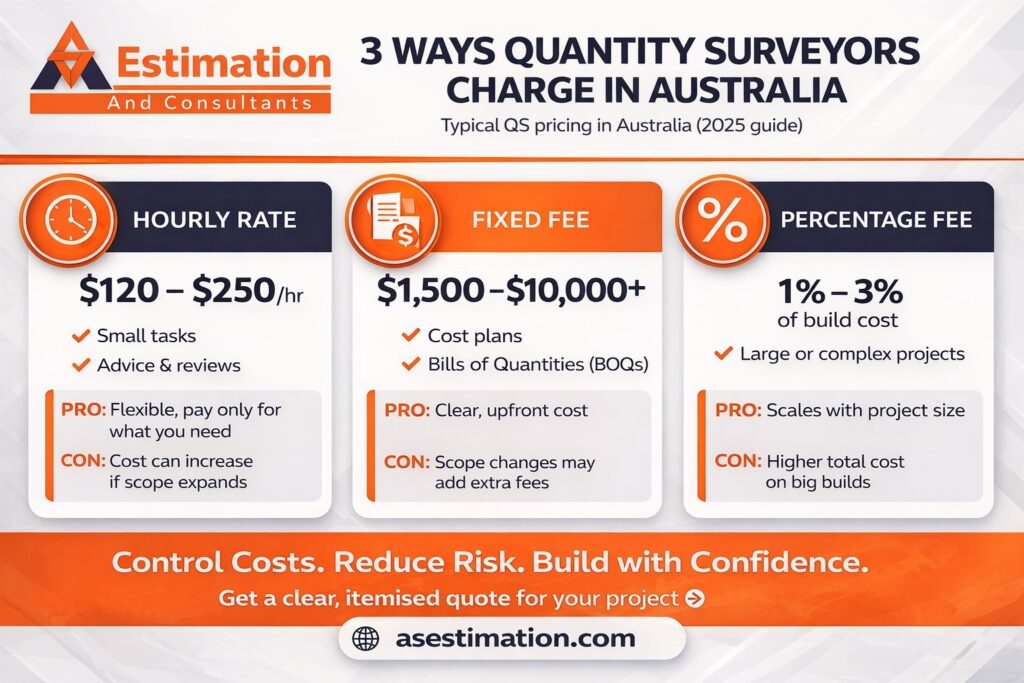
The quantity surveyor cost in Australia can vary depending on the service scope, project type, and pricing model used. If you are wondering how much a quantity surveyor costs, most QS fees in Australia fall into three common types: hourly rates, fixed pricing, or a percentage of construction cost.
In simple terms, QS hourly rates in Australia often range from $120–$250, fixed fees can start from $1,500 and go beyond $10,000 depending on the detail, while QS fee percentage for larger projects usually sits around 1%–3% of total build cost. Residential vs commercial QS cost also differs, with commercial projects generally costing more due to complexity and reporting requirements.
Quantity Surveyor Cost in Australia (Quick Guide)
| Service Type | Typical Cost (AUD) | Pricing Model | When You Need It |
| Feasibility Estimate | $1,500 – $4,000 | Fixed Fee | Early planning and budget check |
| Cost Plan | $3,000 – $8,000 | Fixed Fee | Design stage cost control |
| Bill of Quantities (BOQ) | $4,000 – $10,000+ | Fixed Fee | Detailed pricing before tender |
| Tender Review | $2,000 – $6,000 | Fixed / Hourly | Comparing builder quotes |
| Full QS Service | 1% – 3% of the build cost | Percentage | Large or complex projects |
| Hourly Advisory | $120 – $250/hr | Hourly Rate | Small tasks or expert advice |
What Does a Quantity Surveyor Do and What Are You Paying For?
When people ask what a quantity surveyor does, the answer is simple: they help you plan, check, and control your construction costs. The cost of hiring a quantity surveyor is not just for a number. You are paying for cost planning services, estimating accuracy, risk control, and clear construction financial planning that helps avoid costly mistakes.
In Australia, quantity surveyor services give you a clear QS services cost breakdown so you understand where your money is going. From early feasibility estimating to tender checks and ongoing cost control, their role is to improve accuracy and reduce risk at every stage of the build.
- Pre-Construction Cost Planning:
This is early cost planning before construction starts. It includes feasibility estimating, concept budgets, and pre-construction estimating to test if your project is financially realistic. Good planning at this stage improves cost accuracy and reduces the risk of budget blowouts later. - Bills of Quantities and Tender Support:
Through bill of quantities preparation, the QS breaks the project into measurable parts so builders can price the same scope. They also handle tender cost validation, helping you compare quotes properly and avoid underpriced or incomplete contractor offers. - Budget Monitoring During Construction:
During the build, the QS tracks spending through construction cost monitoring, variation cost review, and payment checks. This ensures strong construction budget control, reduces financial surprises, and keeps your project aligned with your planned budget.
How Quantity Surveyors Charge in Australia
Quantity surveyors in Australia use different pricing models depending on the service and project. The quantity surveyor pricing structure usually includes QS hourly rates, QS fixed pricing, QS fee percentage, or a mix of these. Understanding these QS charging methods helps you read quotes clearly and choose the right pricing model.
- Hourly Rate Pricing:
Used for advice, reviews, or small tasks. You pay a QS hourly rate in Australia based on the time spent. - Fixed Fee Pricing:
A set price for defined work, like cost planning services or BOQ preparation. This gives clarity upfront with a clear QS services cost breakdown. - Percentage-Based Fees:
Common for larger projects. The QS fee percentage is linked to the total construction cost, reflecting project size and complexity. - Staged or Hybrid Pricing:
Combines models across phases like feasibility, tender, and construction, offering flexible pricing aligned with project progress.
Average Quantity Surveyor Costs by Service Type
Not every client needs the same level of help, so the cost of a quantity surveyor by service can vary a lot across Australia. A quick feasibility estimate is usually one of the lower-cost options, while detailed bill of quantities preparation, tender cost validation, and ongoing cost control often sit higher because they take more time, measurement, and review. Australian QS firms commonly price work through fixed fees, hourly rates, or percentages depending on scope and project complexity.
- Feasibility Estimates:
This is early-stage pricing used to test site viability and rough budget fit before design moves too far. It is often one of the more affordable services because it gives a high-level cost view rather than full trade-by-trade detail. - Cost Plans:
Cost planning services become more detailed as drawings improve. These sit in the middle of the pricing range because the QS updates the budget as the design develops, helping improve cost accuracy before tender. - Bills of Quantities (BOQ):
BOQ work is usually priced higher than a basic estimate because it involves detailed measurement and documentation across trades. That extra depth supports clearer builder pricing and a stronger QS services cost breakdown. - Tender Review and Cost Validation:
This service checks contractor quotes, finds pricing gaps, and supports better negotiations. It adds strong value when several bids need to be reviewed side by side, especially on larger or risk-sensitive projects. - Post-Contract Cost Management:
This is ongoing commercial support during construction, including payment checks, variation reviews, and budget reporting. It is usually one of the more involved services because the QS stays engaged throughout delivery, helping reduce financial surprises and improve budget control.
Residential vs Commercial Quantity Surveyor Costs
Residential vs commercial QS cost in Australia can vary a lot depending on project size, complexity, and reporting needs. Smaller home projects usually have simpler scopes, while commercial work involves more trades, documentation, and financial control, which increases the overall quantity surveyor cost per project.
In simple terms, residential quantity surveyor cost is often more predictable, while commercial quantity surveyor fees increase with scale, risk, and detail. Understanding this difference helps you choose the right level of service and budget more accurately.
Residential Projects
For homes, renovations, extensions, and duplexes, costs are usually easier to define because the scope is smaller and more standard.
Typical residential QS fees in Australia:
- Feasibility or basic estimate: $1,500 – $4,000
- Full cost plan: $3,000 – $8,000
- BOQ preparation: $4,000 – $10,000+
Most residential work uses fixed fee pricing, especially for house build quantity surveyor costs and renovation estimating costs. Even though projects are smaller, good cost planning services still play a key role in avoiding budget issues.
Commercial Projects
Commercial projects like offices, retail, industrial builds, and mixed-use developments require more detailed cost control and reporting.
Typical commercial QS pricing:
- Percentage-based fees: 1% – 3% of construction cost
- Large project estimates: $10,000 – $50,000+
Commercial QS rates are higher because they involve tender cost validation, procurement support, and construction budget control across multiple trades and stages. These projects often require ongoing involvement, not just one-time estimates.
Why Commercial Fees Are Usually Higher
Commercial work costs more because it carries more complexity and financial risk.
- Larger project values increase responsibility
- More trades and packages require deeper measurement
- Higher reporting standards and compliance requirements
- Greater need for cost accuracy improvement and budget risk reduction
This is why the cost of hiring a quantity surveyor for commercial work reflects not just time, but the level of detail, coordination, and construction financial planning involved.
What Factors Affect Quantity Surveyor Fees?
Quantity surveyor fees can vary because no two projects are the same. The cost of hiring a quantity surveyor depends on scope, detail, timing, and location. Understanding these factors helps explain why QS quotes vary and gives you a clearer quantity surveyor pricing guide when comparing options.

- Project Size and Construction Value:
Larger projects increase the quantity surveyor’s cost per project. More trades, measurement, and reporting often lead to a higher QS percentage fee for construction costs. - Design Complexity:
Unique or technical designs need more feasibility estimating and detailed work, which raises the commercial or residential construction estimating service cost in Australia. - Scope of Services:
A simple estimate costs less than full cost planning services with ongoing construction budget control. - Documentation & Timeframes:
Poor drawings or urgent deadlines increase effort and risk, raising fees. - Location & Market Conditions:
QS fees in Australia can vary between cities and regions due to demand and project conditions.
Is Hiring a Quantity Surveyor Worth the Cost?
Many people ask, ” Is a quantity surveyor worth it? In most cases, yes. The cost of hiring a quantity surveyor often pays off through better decisions, fewer surprises, and stronger construction budget control. You are not just paying construction cost consultant fees—you are buying clarity, confidence, and cost accuracy improvement.
- Better Budget Accuracy:
A QS provides reliable build cost estimates using construction financial planning, helping you avoid under-budgeting and make smarter early decisions. - Lower Risk of Cost Blowouts:
With proper scope checks and cost control, a QS reduces budget risk and limits unexpected expenses during construction. - Better Tender and Quote Decisions:
Through tender cost validation, a QS helps you compare builder quotes fairly and avoid missing costs or pricing gaps.
How to Compare Quantity Surveyor Quotes in Australia
When you compare quantity surveyor quotes, do not look at price alone. A lower fee may seem attractive, but it can leave out important work. The best QS for your project is the one that offers clear scope, practical advice, and the right level of support for your build.
- Check What Is Included:
Review whether the quote covers bill of quantities preparation, cost planning services, tender cost validation, revisions, and any post-contract support. A clear QS services cost breakdown makes it easier to compare like-for-like. - Review Assumptions and Exclusions:
Cheap quotes can hide gaps. Some may exclude key tasks, updates, or revision rounds, which can increase the real cost of hiring a quantity surveyor later. - Compare Experience and Fit:
Choose a quantity surveyor with the right background for your project. Residential and commercial jobs need different systems, reporting depth, and pricing knowledge.
FAQs
Yes, quantity surveyors charge both hourly and fixed fees depending on the job. QS hourly rates in Australia are usually used for advice, reviews, or small tasks, while QS fixed fee estimates are common for defined work like cost plans or BOQs. It depends on scope clarity.
The difference between a cost estimator and a quantity surveyor is mainly in scope. A cost estimator focuses on pricing, while a quantity surveyor provides broader services like cost planning, tender review, and budget control across the full project lifecycle.
Yes, a quantity surveyor is often worth it for a small residential project. Even for renovations or home builds, they improve cost accuracy, help avoid under-budgeting, and provide better control over spending compared to relying only on builder estimates.
Yes, a quantity surveyor can help reduce construction costs indirectly. They do this through better planning, tender cost validation, and construction budget control, which reduces waste, avoids pricing errors, and lowers the risk of costly surprises during the build.
The cost of a quantity surveyor in Australia depends on the service and project size. Typical QS hourly rates range from $120–$250, while fixed fees can range from $1,500 to $10,000+. Larger projects may use percentage-based fees, usually around 1%–3% of construction cost.
Final Takeaway
Quantity surveyor costs in Australia depend on how the service is priced, what work is included, and the type of project you are planning. The cost of hiring a quantity surveyor should always be seen in terms of value, not just price, because better planning leads to stronger budget risk reduction.
As a final guide to QS fees, focus on comparing quotes based on scope, detail, and outcomes. A clear QS services cost breakdown will help you understand what you are getting, so you can choose the right support for your project with confidence.