Demolition quotes can look random until you break them into two parts: Base Cost and Risk Allowances. In this demolition cost guide, you’ll see the real factors that affect demolition cost and a simple site clearance cost breakdown you can check against any quote. We’ll cover labour and plant rates, waste disposal and tipping fees, permit and approval costs, and contingency allowances, so your demolition cost estimate and site clearance estimating stay grounded in what actually drives price.
Scope That Changes The Price
In a demolition & site clearance cost guide, scope is the first price driver. Most budget surprises happen because “demo and clear” sounds simple, but it hides two big decisions: what you are demolishing and what “clear” means at handover. If you lock these early, your site clearance estimating stays clean, and your quote comparisons make sense.
- Two Scope Switches That Move The Price: Demolition category and clearance finish line.
Demolition Category
This is the “what are we demolishing” decision, and it sets the demolition sequencing and methodology from day one. A full demolition cost usually includes more plant hours, more load-out, and more waste handling than partial demolition pricing. Partial work can still cost more per metre because it often needs careful separation and protection of retained areas. Internal strip-out costs are commonly labour-heavy because you are pulling out partitions, finishes, and services before structural work. Residential cost estimating may be more straightforward, while commercial demolition pricing can rise quickly with building size and construction type, and tighter site controls. A demolition cost estimating only holds up when this category is written clearly.
- Full Demolition: Whole structure removed; usually higher total plant and disposal.
- Partial Demolition: Only part removed; can be slower due to protection and sequencing.
- Internal Strip-Out: Non-structural removal first; labour-heavy even without major plant.
Clearance Finish Line
This is the “what does site clearance include” decision, and it changes the site clearance cost breakdown fast. Cleared to ground level can mean removing loose waste and making the site safe, without touching concrete below. If the scope includes slab and footing removal, the work often needs heavier equipment, more breakout time, and more disposal. Cut and cap services can add time and specialist steps because underground services risk can stop work if it is not managed. Trim and level requirements also matter because they add machine time and may require extra material handling. For site clearance estimating, the simplest rule is to define the finish line in one sentence so everyone prices the same outcome.
- Cleared To Ground Level: Remove loose waste and hazards; minimal below-ground work.
- Slab And Footing Removal: Break out and remove concrete; higher plant and disposal.
- Cut And Cap Services: Service isolation and verification; risk-driven time impacts.
- Trim And Level: Extra machine time to achieve a defined surface outcome.
What Drives Demolition Cost
Demolition prices vary because every job has a different mix of “how much” and “how hard.” That’s the simplest way to explain the factors that affect demolition cost. Even when two buildings look similar, building size and construction type, labour and plant rates, and access constraints demolition costs can shift the final number. This is why demolition quotes vary.
Quantity Drivers (How Much Work)
Quantity is what creates the base hours and tonnes in a demolition cost estimate. The footprint or GFA tells you how much structure you need to remove, while materials tell you how long it takes and what it weighs. Slab thickness, footings, basements, and retaining elements can add serious breakout time and disposal weight. Attached structures like garages, driveways, and sheds also add volume. Rubbish and vegetation volumes matter because they often turn into extra loads and extra tipping. This is where demolition cost per m² and demolition cost per tonne become useful, especially for early budgeting.
- Hours Driver: More structure and harder materials usually mean more labour and plant time.
- Tonnes Driver: Heavier materials and thicker slabs push demolition cost per tonne higher.
Difficulty Multipliers (How Hard The Work Is)
Difficulty is what slows production and grows preliminaries, even if the building is small. Restricted access demolition costs rise when machines can’t reach the work easily, or when load-out space is tight and trucks must queue. Traffic control adds time and money on busy roads, and overhead hazards can limit where equipment can operate. Limited working hours, dust and noise controls, and higher safety and compliance requirements all reduce daily output. The job doesn’t get bigger, it just takes longer and costs more to manage. That’s why access constraints demolition costs can be the difference between a clean estimate and a surprise overrun.
Site Clearance Cost Breakdown
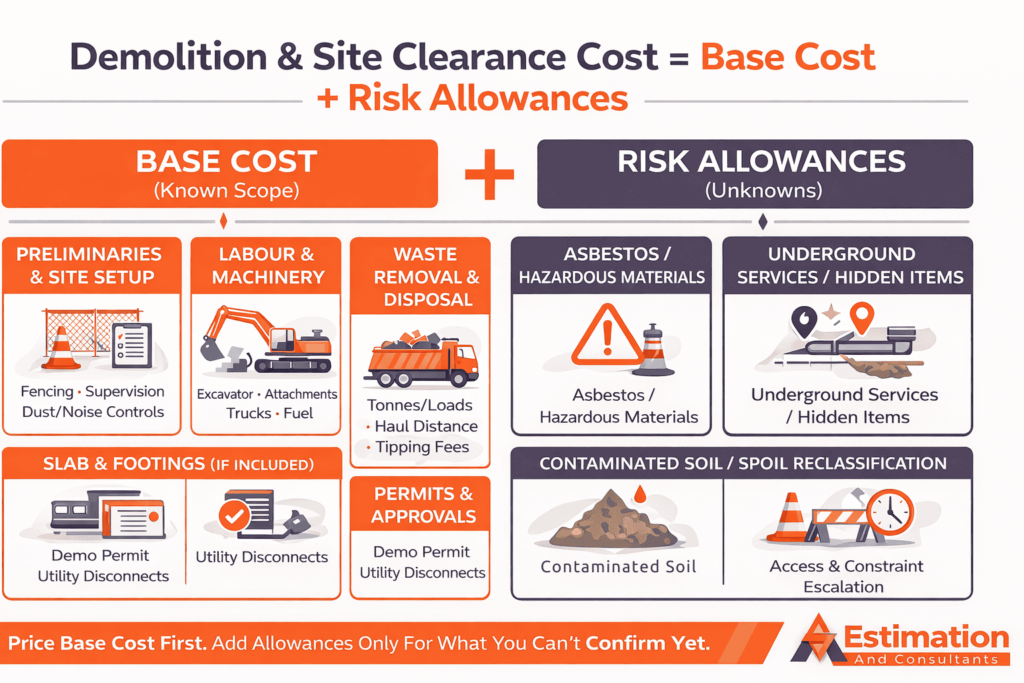
A clean site clearance cost breakdown shows where the money actually goes, using the same buckets you see on real quotes. The goal is audit-friendly pricing: base scope items only, with no risk items hidden inside. When you read a demolition cost breakdown this way, you can spot what’s included, what’s missing, and why two prices can be far apart.
Preliminaries And Site Establishment
Preliminaries are the time-based costs of running the job, not the demolition itself. Think mobilisation and demobilisation, fencing and hoarding, signage, basic supervision, and the controls needed to keep the site safe and compliant. Dust and noise controls can add daily effort, and traffic management can be a big cost where it’s required and known upfront. These overheads and preliminaries often grow when the job takes longer than expected, which is one of the main factors that affect demolition cost. If you want a fair comparison between quotes, check demolition preliminaries and site establishment costs first, because they’re easy to under-allow.
Labour And Machinery (Production)
This is the main spend on most jobs: the crew and the equipment doing the work. Demolition labour and machinery costs depend on the plant size and the attachments needed, like a breaker, shear, or grab. Saw cutting may be required for controlled separation, while a skid steer can handle clean-up and load-out. Trucks and fuel sit right inside this bucket, along with minimum hours and mobilisation allowances. Labour and plant rates matter because productivity changes with access and layout, not just building size. When someone says their price is low, this is usually where corners get cut or assumptions get made.
- Plant Choice: Bigger machines can be faster, but only if the site can handle them.
- Minimum Hours: Short jobs still pay for mobilisation and minimum call-out time.
Waste Removal And Disposal (Tonnes And Fees)
Disposal is priced by loads or tonnes, then multiplied by tipping fees and haul distance. Mixed waste is usually more expensive to tip than separated streams, so the way waste is managed affects the final number. Weighbridge dockets matter because they prove what was actually removed and help avoid disputes later. Tipping fee assumptions can vary a lot by facility and classification, so this is a common reason demolition quotes vary. If your estimate is based on demolition cost per tonne, make sure the expected tonnage is reasonable for the materials and slab thickness, otherwise the demolition waste disposal cost can jump quickly.
Slab And Footing Removal (If Included)
Below-ground concrete should be priced as a separate item because it changes the job plan and equipment needs. Slab and footing removal usually means breakout time, extra load-out, and heavier disposal, which pushes both labour and plant rates and waste disposal and tipping fees. The end condition also matters: rough level is different from backfilled and trimmed, and that difference can add machine time and material handling. If your “clearance finish line” includes concrete removal, make sure the footing removal cost and slab removal cost are clearly stated, not buried inside a lump sum.
Permits And Approvals (Known Items)
Permits and approvals are base compliance items that should be clear and visible in the price. Depending on the job, demolition permits and approvals may include council permits, road occupancy approvals, traffic control permits, and utility disconnect fees. Some sites also require certificates or sign-offs before work can start or before the area can be handed over. These are permit and approval costs that don’t disappear just because the building is small. If one quote includes them and another assumes “by owner,” the prices won’t be comparable, and you’ll wear the surprise later.
Base Cost Vs Risk Allowances
| Item | Base Cost Or Risk Allowance | What To Check In The Quote |
| Preliminaries And Site Establishment | Base Cost | Mobilisation, fencing, supervision, dust/noise controls, traffic controls (if known), working hours assumptions |
| Labour And Machinery (Production) | Base Cost | Plant list (excavator size/attachments), trucks, fuel, minimum hours, standby assumptions |
| Waste Removal And Disposal (Tonnes And Fees) | Base Cost | Tonnes/loads shown, tipping fee assumptions, haul distance, mixed vs separated waste, dockets/weighbridge proof |
| Slab And Footing Removal | Base Cost (Only If In Scope) | Included/excluded is explicit, end condition stated (rough level vs backfill/trim), disposal included or not |
| Permits And Approvals | Base Cost | Who pays permits and utility disconnects, any road occupancy/traffic permits, certificates listed |
| Ground And Compliance Unknowns | Risk Allowance | Who pays permits and utility disconnects, any road occupancy/traffic permits, and certificates listed |
Risk Items In Demolition Projects
Risk items in demolition projects are the main reason estimates blow out after work starts. These are not base costs you can price neatly from drawings. They are “unknowns” that turn into unexpected demolition costs when the site reveals what was hidden. The most practical way to handle them is to make them visible in a simple demolition risk register and apply demolition contingency planning using a repeatable logic: Trigger → Cost Impact → Allowance Approach. That approach cuts down hidden demolition costs and makes quotes easier to compare.
Asbestos And Hazardous Materials
Hazmat is high risk because it changes the method, the program, and the disposal pathway. If the asbestos survey status is unclear, the trigger is usually discovery during strip-out or early demolition. The cost impact includes asbestos removal costs, but also containment, air monitoring, clearance, and hazardous disposal steps that slow the job and add supervision. The allowance approach should be written clearly so it doesn’t become a messy variation.
- Trigger: No confirmed survey, or suspect materials found on site.
- Cost Impact: Containment, monitoring, clearance, and hazardous material removal pricing.
- Allowance Approach: Provisional sum based on survey findings, or price after confirmation with clear exclusions.
Underground Services And Hidden Subsurface Items
Underground services risk can turn a smooth job into stop-start work. The trigger is simple: services are not where you expect, or they were never properly located and pothole-verified. The cost impact is often time and disruption—standby plant, rework, and cut/cap variations. Unknown tanks, pits, and old footings are common unexpected site conditions that force a change in demolition sequencing and methodology. The allowance approach is to price verification where possible and keep a sensible contingency for what cannot be proven before digging.
- Trigger: Incomplete locate, no potholing, or unmarked live services.
- Cost Impact: Stoppages, re-sequencing, standby, and scope changes for cut/cap.
- Allowance Approach: Include locate and pothole work, plus a contingency allowance for discoveries.
Contaminated Soil And Spoil Reclassification
Contaminated soil management becomes expensive when spoil that looked normal gets reclassified after testing. The trigger may be staining, odour, historical land use, or a lab result that changes the disposal class. The cost impact is sharp because waste disposal and tipping fees jump, and you may need segregation, stockpiles, retesting, and multiple haulage streams. This is where site clearance estimating can fail if the job assumes clean spoil without evidence. The allowance approach should be tied to testing and clear disposal assumptions.
- Trigger: Test results or visual signs push spoil into a higher disposal class.
- Cost Impact: Higher tipping fees, segregation time, and specialist disposal requirements.
- Allowance Approach: Early testing plan + provisional sum or contingency for reclassification.
Access And Constraint Escalation
Access constraints demolition costs can rise mid-job when rules tighten or logistics change. The trigger might be reduced working hours, neighbour restrictions, added dust/noise controls, or extra traffic control days. Wet weather downtime can also extend the program. The cost impact usually shows up in overheads and preliminaries—more days on site means more supervision and more plant standby, even if the building doesn’t change. The allowance approach is to state assumptions clearly and add contingency when constraint changes are likely.
- Trigger: Reduced hours, added controls, or tighter access than assumed.
- Cost Impact: Longer program, higher prelims, and lower daily production.
- Allowance Approach: Clear assumptions + contingency allowance tied to constraint likelihood.
How To Estimate Demolition Costs Accurately
If you want to know how to estimate demolition costs accurately, keep it simple and honest. Start with base cost using clear cost buckets, then add risk allowances for what you can’t confirm yet. This approach supports clean site clearance estimating and avoids fake precision that looks good on paper but fails on site. Use demolition cost per m² or demolition cost per tonne only as models, not “the answer.”

Build Base Cost From The Cost Buckets
Base estimate logic is just a structured demolition estimate calculation. Price preliminaries first, because overheads and preliminaries grow with time on site. Then price production using labour and plant rates, machinery hire and fuel, and the demolition labour and machinery costs that match the demolition sequencing and site layout. Add disposal using a site clearance cost breakdown that shows waste disposal and tipping fees and the expected loads or tonnes. Include slab and footing removal only if it’s in scope, because it changes both plant time and disposal weight. Finally, include permits and approvals that are known items. If these buckets are clear, your demolition cost breakdown is easy to audit and compare.
- Base Cost Buckets: Prelims, Production, Disposal, Slab/Footings (If Included), Permits.
Add Risk Allowances Without Guessing
This is where good estimates stay stable when the job gets real. Risk allowances should match investigation maturity, not a random percentage. If asbestos, hazardous materials, or contamination is not confirmed, use provisional sums for those items and state the trigger clearly. For everything else you can’t prove before work starts—like unexpected site conditions or unknown services—use contingency allowances tied to risk identification and mitigation. Demolition contingency planning works best when you separate “known base cost” from “unknown risk.” That way you can explain why the allowance exists, and you can reduce it later when surveys and tests remove uncertainty.
- Allowance Types: Provisional Sums (Specific Unknowns), Contingency (Residual Unknowns).
FAQs
The cost to demolish a building depends on how much structure you’re removing and how hard it is to do the work. Size, construction type, access, and waste disposal and tipping fees usually drive the number. If you also need site clearance, slab removal, or service cut and cap, the price can rise quickly.
Site clearance can mean different things, so it must be written clearly in the scope. For some jobs it only means removing loose rubbish and vegetation and leaving the concrete in place. For other jobs it includes slab and footing removal, cut and cap services, and trim and level to a handover standard. The clearance finish line is one of the biggest cost switches.
Demolition quotes vary because contractors may be pricing different scope, different access constraints, or different disposal assumptions. One quote may include permits and approvals, traffic control, or slab removal, while another excludes them. The biggest differences usually sit in preliminaries, disposal tonnage assumptions, and how risk items are handled.
Both methods are used, and the right choice depends on what stage you are at. Demolition cost per m² can help with early budgeting when details are limited. Demolition cost per tonne becomes more accurate when disposal is the main driver and you have a realistic waste tonnage estimate. For many sites, a hybrid estimate is the most reliable.
The most common hidden demolition costs come from asbestos or hazardous materials, underground services risk, contaminated soil, and access or constraint escalation. These items often do not show up until work starts, which is why they should be treated as risk allowances, not buried inside the base price. A simple demolition risk register makes them visible.
Conclusion
A solid demolition & site clearance cost guide comes down to clear scope, clean cost buckets, and honest risk planning. If you lock the demolition category and the clearance finish line early, you can build a base estimate that’s easy to audit—prelims, labour and machinery, disposal, slab and footings if included, and permits. Then you manage the real budget killers with simple demolition contingency planning for asbestos, underground services, contamination, and access changes. If you want, share your site details and I can map them into a practical estimate structure you can use to compare quotes properly.