Electrical installation costs in Australia can vary widely depending on the type of work, the condition of the property, and how the project is scoped. This guide is designed to help homeowners, builders, and business clients understand electrical installation cost Australia 2026 using practical pricing logic instead of rough guesswork.
It covers the main job categories, including wiring and rewiring cost, switchboard upgrade pricing, residential vs commercial electrical cost, and electrical fit-out systems. The aim is simple: to make estimating electrical installation costs easier by explaining the real cost drivers for electrical installation and helping readers plan a more accurate electrical project cost breakdown.
What Electrical Installation Work Includes
Electrical installation work covers the full setup, upgrade, or replacement of a property’s power and lighting systems. It can include new wiring, rewiring, switchboards, circuits, outlets, lighting, and power installation, fit-out work, and safety upgrades such as RCDs. In simple terms, this section explains how the complete electrical system works needed to make a building safe, usable, and compliant.
It also covers the wiring and cabling cost breakdown that affects pricing from one job to another. Some projects need only a few added circuits, while others need a full electrical system upgrade cost review because of higher loads, old wiring, or compliance issues. That is why the electrical installation scope can vary so much between properties.
Residential Installation Work
Residential installation work covers the electrical needs of homes, whether it is a new build, renovation, extension, or older property upgrade. This can include full house wiring, new power points, lighting and power installation, switchboard replacements, safety upgrades, and complete rewires. House wiring cost in Australia often depends on home size, layout, access, and the condition of the existing system.
For homeowners, domestic electrical work pricing usually changes based on how much of the system must be replaced or upgraded. A small extension may only need a few new circuits and outlets, while an older house may need major rewiring to meet modern standards. This is where residential electrician costs are shaped by labour time, materials, compliance work, and the difference between residential and commercial estimating.
Commercial Installation Work
Commercial installation work is usually broader and more complex because it must support larger loads, more users, and business-specific layouts. It often includes electrical fit-out systems for offices, retail shops, warehouses, and tenancy spaces. Typical work includes lighting, power distribution, data-ready pathways, switchboards, sub-circuits, and circuit and load distribution planned around the way the business will operate.
Commercial electrical installation price is often influenced by fit-out type, building size, access conditions, and tender requirements. For example, office fit-out electrical cost may focus on workstations, lighting zones, and compliance, while retail fit-out wiring cost may include display lighting, signage power, and point-of-sale areas. In many projects, the electrical fit-out cost of commercial buildings is also shaped by contractor pricing methods and electrical tender pricing in Australia.
Electrical Installation Costs By Project Type
Electrical installation costs in Australia are easier to understand when they are grouped by project type. A new home, an older-house rewire, a switchboard upgrade, and a commercial fit-out all use different materials, labour hours, and compliance steps. That is why a project-based electrical costs view is more useful than a flat average for every job.
For this 2026 guide, a practical electrical service pricing breakdown is to treat residential wiring, rewiring, switchboards, and fit-out work as separate cost categories. That gives readers a clearer starting point and matches how electricians and estimators price real jobs in the Australian market.
New House Wiring Cost In Australia
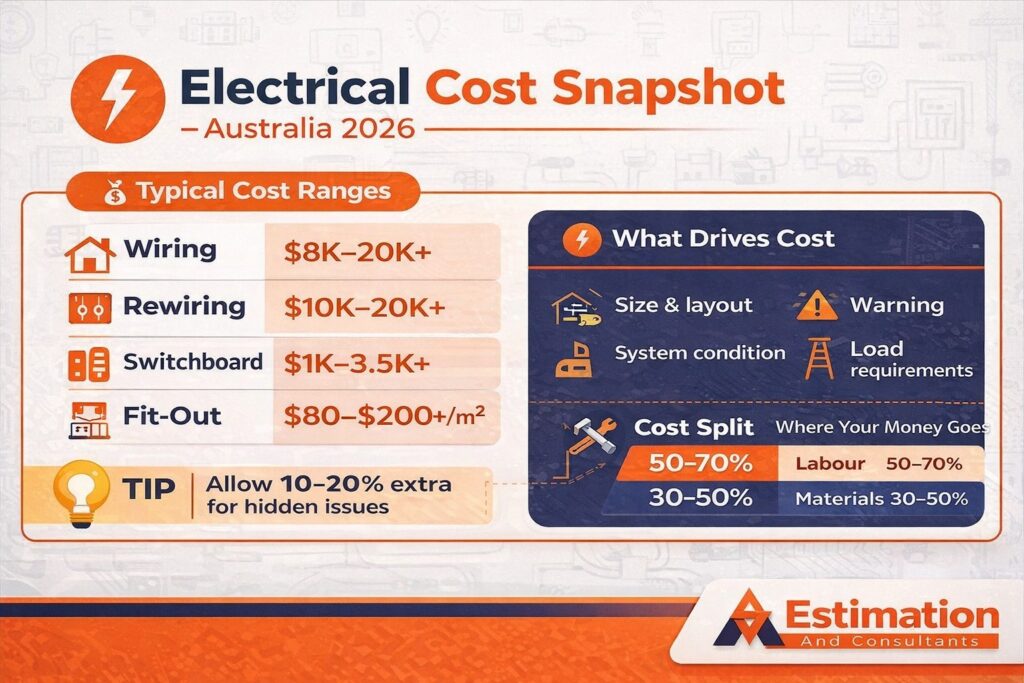
New house wiring usually includes rough-in cabling, circuit setup, switchboard connection, lighting and power installation, and final fit-off once walls and finishes are ready. Based on current Australian contractor guides, a standard new home wiring package commonly sits around $8,000 to $20,000, while smaller, simple homes can fall lower, and larger homes with premium inclusions can move well beyond that. Some guides also place wiring installation broadly at about $30 to $100 per m², which is useful for early budgeting.
What moves the price is not just floor area. Room count, appliance load, air conditioning circuits, oven circuits, EV readiness, outdoor power, and board size all affect circuit and load distribution. A simple single-storey plan is usually cheaper to wire than a larger custom home with more lighting zones, more power points, and higher-end fixtures. That is why a proper wiring and cabling cost breakdown should separate labour and material costs instead of giving one vague lump sum.
Typical Working Range (Australia 2026):
- Small/basic new home: $3,000 to $8,000
- Standard new home: $8,000 to $20,000
- Large / high-spec home: $20,000+
House Rewiring Cost In Australia
House rewiring is usually more expensive than new-build wiring on a like-for-like basis because electricians must work around existing walls, ceilings, finishes, and access limits. Recent Australian guides place full rewiring broadly from about $4,000 to $12,000+ for many homes, while other current contractor sources show larger or older properties often reaching $15,000 to $20,000+ where access is difficult or major upgrades are needed.
This is one section where readers need context, not just numbers. The final electrical rewiring cost per home can rise quickly if the property has brittle insulation, damaged cabling, outdated layouts, poor earthing, old fuse protection, or hidden defects behind walls. Rewiring during a renovation is often more cost-effective than doing it in a fully finished home, because access is easier and patching costs are lower. Safety upgrades such as RCDs, plus electrical compliance and certification costs, can also push the total up.
Typical Working Range (Australia 2026):
- Partial rewire: $3,000 to $8,000
- Full rewire, standard home: $8,000 to $15,000
- Large / older / difficult-access home: $15,000 to $20,000+
Switchboard Upgrade Cost In Australia
Switchboard upgrade pricing depends on the age of the board, the number of circuits, and whether the job only needs safer protection devices or also needs broader electrical capacity upgrades. Recent Australian sources place common switchboard upgrades at roughly $1,000 to $3,500, although smaller simple replacements can come in below that, and bigger jobs involving sub-mains, relocation, or difficult existing conditions can climb higher. Older consumer advice sources also show replacement hardware sometimes costs around $500 to $2,000, excluding installation.
In real homes, this cost changes when the electrician finds ceramic fuses, limited circuit space, non-compliant wiring, asbestos risks, or a need to make the property ready for solar, batteries, induction cooking, or EV charging. That is why the switchboard upgrade cost Australia figures should be treated as a budgeting range, not a flat promise. The more safety and future capacity the owner wants, the higher the final price tends to go.
Typical Working Range (Australia 2026):
- Basic modernisation / small board job: $1,000 to $2,000
- Typical switchboard upgrade: $2,000 to $3,500
- Consumer mains + larger compliance/capacity upgrade: $3,500+
Commercial Fit-Out Electrical Cost
Commercial fit-out electrical cost is best understood in two layers. First, overall office fit-out benchmarks across major Australian cities currently sit around $2,451 to $2,998 per m² in the Cushman & Wakefield 2025 city benchmarks, while JLL reports an Australian average of about $3,220 per m² for a moderate-style, medium-quality office. Second, JLL says mechanical and electrical works account for around 17% of overall fit-out cost, although that M&E allowance includes HVAC, electrical, fire, and UPS rather than electrical alone.
For electrical-only planning, that means office fit-out electrical cost should usually be budgeted as a subset of the broader M&E allowance, not as the full fit-out rate. In plain terms, the price is shaped by lighting layouts, small power, tenancy distribution boards, base-building interface work, emergency lighting, exit signage, and circuit and load distribution. Commercial jobs also carry more coordination, documentation, and compliance pressure than residential work, which is why residential vs commercial electrical pricing is never a fair one-to-one comparison.
Typical Working Range (Australia 2026):
- Full office fit-out benchmark: $2,451 to $3,220 per m²
- M&E allowance within that benchmark: roughly 17% of the total fit-out cost
- Electrical-only budget allowance: best priced from drawings and scope, because it sits inside the wider M&E package and varies sharply by tenancy needs
Cost Breakdown By Component
A proper electrical quote is usually built in layers, not as one random total. In most Australian projects, the price is made up of labour, materials, fixtures, testing, certification, and a small allowance for unknowns. That is what gives clients a clearer quote cost breakdown electrician’s view, and helps them compare one estimate against another on a fair basis.
This matters because two quotes can look very different even when the scope sounds similar. One contractor may separate labour and material breakdown clearly, while another may bundle everything into one figure. Good estimating accuracy comes from showing the real electrical installation cost components, including electrical compliance and certification costs, rather than hiding them in vague wording.

Labour Costs
Labour is usually one of the largest parts of an electrical quote because licensed work is paid for by skill, time, access, and job complexity. Recent Australian cost guides commonly place electrician hourly pricing around $80 to $130 per hour, with city and regional ranges varying by location. For example, Service.com.au lists Sydney at $90 to $130 per hour, Brisbane at $75 to $110, and Perth at $90 to $105 in its city guide.
The labour share of the electrical quote can rise quickly when the job needs more crew time, return visits, fault-finding, difficult roof or wall access, or longer fit-off stages. This is why labour vs material electrical cost is not the same on every project. A clean new-build rough-in is usually faster to price than a renovation or rewire, where electricians must trace faults, work around finished surfaces, or solve hidden problems before the fit-off can begin.
Material And Equipment Costs
Material and equipment costs cover the products needed to complete the installation safely and properly. This usually includes cable, conduits, breakers, switchboards, outlets, light fittings, accessories, and protection devices. In practical terms, this is the part of the quote that supports the wiring and cabling cost breakdown and explains why one job with basic fittings costs much less than a job with upgraded fixtures or extra capacity.
Small items also add up faster than many clients expect. Recent Australian guides place a standard power point installation at roughly $150 to $300 per unit in many common residential jobs, while broader ranges can run from $50 to $500 depending on access, outlet type, and wiring conditions. Basic light fittings are often priced around $70 to $150 per fixture, and LED downlights are commonly quoted around $60 to $110 per light, with more complex lighting work costing more. These are useful markers for understanding electrical materials cost, outlet installation cost, cost per power point in Australia, and lighting installation cost per point.
Compliance, Testing, And Certification Costs
Compliance, testing, and certification are not optional extras. In NSW, electricians must submit certificates to prove compliance and show that installation safety inspections have taken place after electrical work is done. In Victoria, Energy Safe Victoria publishes official Certificate of Electrical Safety purchase fees for 2025–26, including $38.70 for a prescribed electronic certificate and $9.00 for a non-prescribed electronic certificate.
In a real quote, though, the certificate form fee is only one part of the total. The full electrical compliance and certification costs can also include inspection time, testing, defect checks, and any rectification needed before sign-off. Public Australian guides show that a residential electrical safety inspection commonly costs around $100 to $500, depending on scope and property type. That is why the electrical sign-off cost, the electrician certificate fee, and the electrical test and inspection cost should be treated as real line items, not hidden overheads.
Contingency For Hidden Issues
A contingency for hidden issues is a practical risk allowance for conditions that cannot be fully confirmed before work starts. This matters most in rewiring, switchboard upgrades, and older buildings, where electricians may find brittle insulation, overloaded circuits, inaccessible cavities, damaged wall sections, or outdated protection that has to be replaced before the job can be signed off safely.
This part of the cost estimate is not there to make the quote look bigger. It is there to protect estimating accuracy. A rewire or upgrade can become more expensive when access is poor, the existing system is in worse condition than expected, or the board needs broader safety and capacity work. That is why hidden electrical costs and contingency for rewiring should be treated as part of the cost drivers for electrical installation, especially when a project is close to becoming a full electrical system upgrade cost rather than a simple repair.
Cost Per Item Or Point
In many projects, electricians also price work on a per-point basis. This means each outlet, light, or switch is treated as a unit. It helps clients quickly understand electrical cost per point and estimate small jobs without needing a full system quote.
This method works well for lighting and power installation where the scope is clear. It also supports better circuit and load distribution planning, especially when adding new appliances or dedicated circuits. In simple terms, more points mean more wiring, more labour, and a higher total cost.
- Power Point (Outlet) Cost – Typically based on location, access, and wiring needs. Cost per power point in Australia often increases for kitchens, outdoor areas, or retrofits.
- Light Point Cost – Lighting installation cost per point depends on fixture type, ceiling access, and wiring complexity.
- Switch Installation Cost – Includes standard switches, dimmers, or smart controls, with pricing varying by type and setup.
- Dedicated Circuit Cost – Required for high-load appliances like ovens, AC units, or EV chargers, increasing overall system demand.
- Data & Special Points – Includes TV points, internet outlets, or security system wiring, often priced higher due to specific requirements.
- Access & Installation Conditions – Roof space, wall type, and distance from the switchboard can all affect per outlet electrical cost.
The Biggest Cost Drivers In Australian Electrical Projects
Electrical quotes can look very different even when two jobs seem similar at first. That is because pricing is shaped by a mix of access, size, condition, load demand, region, occupancy, and fixture quality. These cost drivers for electrical installation affect both labour time and material use.
In simple terms, electrician prices do not vary by chance. They vary because each property creates different working conditions and different technical needs. That is why factors affecting electrical cost often come down to labour vs material electrical cost, circuit and load distribution, electrical capacity upgrades, and contingency for hidden issues.
Building Size And Layout
Building size and layout have a major effect on electrical pricing because larger spaces need more cable, more points, and more labour hours. A home with extra rooms, longer cable runs, split levels, or detached areas will usually cost more than a compact and simple layout. Even when the finish level is the same, the house size’s effect on wiring cost is hard to ignore.
Layout complexity matters just as much as floor area. A straightforward single-level plan is usually easier to wire than a split-level property or a building with hard-to-reach sections. Slab construction, limited cavity access, and long distances between the switchboard and final outlets can all increase circuit and load distribution complexity. That is why the cost of large home rewiring often rises faster than owners expect.
Condition Of Existing Electrical System
The condition of the existing electrical system is one of the biggest reasons why electrician prices differ from one property to another. Older homes may have brittle insulation, overloaded circuits, outdated switchboards, or legacy work that no longer meets current standards. In these cases, the quote may need to cover more than basic installation. It may need to address risk first.
This is where wiring and rewiring costs can climb quickly. A simple upgrade can turn into a full electrical system upgrade once hidden faults are uncovered. Safety upgrades such as RCDs, switchboard replacement, and electrical compliance and certification costs may all need to be included before the job can be signed off properly. In practical terms, the cost to fix outdated wiring is rarely just about replacing cable.
Access And Site Conditions
Access and site conditions can change a straightforward electrical job into a slow and labour-heavy one. Roof space limitations, tight wall cavities, wall chasing, occupied premises, or the need for after-hours work can all increase installation time. These are real electrical quote variables because difficult working conditions affect how safely and efficiently the crew can complete the job.
This is also where contingency for hidden issues becomes important. A rewire in an empty property is very different from a rewire in a fully occupied home or business. Difficult access electrician cost is often driven by extra labour, slower progress, and the risk of damage to finished areas. In many cases, hidden labour costs in rewiring come from what cannot be seen clearly until the work begins.
Residential Vs Commercial Electrical Pricing
Residential and commercial electrical pricing in Australia differ because the scope, planning, and delivery are not the same. A home project is usually quicker to define and install, while a commercial job involves coordination, compliance, and staged work.
That is why residential vs commercial electrical pricing is not just about size. It is about complexity, downtime, and how the project is managed from start to finish.
Key Differences At a Glance
| Factor | Residential Electrical Work | Commercial Electrical Work |
| Typical Pricing Level | Lower overall cost | Higher due to complexity |
| Pricing Method | Direct quote | Tender-based or staged pricing |
| Planning | Minimal | Requires drawings and coordination |
| Compliance | Standard residential | Stricter + documentation heavy |
| Installation Scope | Basic lighting and power | Full electrical fit-out systems |
| Downtime Impact | Minimal | Must consider business operations |
Typical Pricing Difference
Commercial electrical work can cost 30% to 100%+ more than residential projects, depending on scope, compliance, and coordination requirements. This difference comes from added planning, electrical tender pricing in Australia processes, and business-specific installation needs.
How Electricians Estimate And Price Jobs
Electricians in Australia do not price every job the same way. The method depends on the type of work, level of detail available, and project size. Estimating electrical installation costs can be simple for small jobs, but larger projects need more structured contractor pricing methods.
In practice, estimating accuracy improves when the scope is clear. A small repair may use hourly rates, while a full build or fit-out may follow electrical tender pricing Australia methods. That is why how electrician quotes are prepared can vary from quick estimates to detailed cost build-ups.
- Hourly Rate Pricing – Used for small or unknown jobs. Electrician hourly pricing is applied when the scope is unclear or may change during work.
- Fixed Price Quote – A set price based on a defined scope. Common for home projects where requirements are clear from the start.
- Per Point Pricing – Based on the number of outlets, lights, and switches. Useful for lighting and power installation jobs.
- Schedule of Rates – Pre-defined rates for tasks like wiring, outlets, or upgrades. Often used in ongoing or repetitive work.
- Tender-Based Pricing – Detailed pricing from drawings and documents. Common in commercial projects using electrical tender pricing in Australia.
- Hybrid Method – A combination of methods used together to improve estimating accuracy and manage project risk.
How To Budget For Your Electrical Project In 2026
Electrical estimating work in 2026 starts with understanding your scope and avoiding guesswork. Whether it’s a small upgrade or a full installation, estimating electrical installation costs early helps prevent surprises and keeps your project on track.
A good budget is not just about numbers. It’s about estimating accuracy, planning for compliance and certification costs, and allowing a contingency for hidden issues. That is how you build a realistic electrical installation cost Australia 2026 plan.
- Define Your Scope Clearly – List all required work, like wiring, outlets, lighting, and upgrades, to avoid missing costs later.
- Check Inclusions & Exclusions – Always confirm what the quote covers, including materials, labour, and compliance.
- Compare Multiple Quotes – Compare electrician quotes Australia to understand fair pricing and scope differences.
- Allow Contingency – Set aside 10–20% for hidden issues, especially in rewiring or older properties.
- Plan for Compliance Costs – Include testing, certification, and safety upgrades as part of your total budget.
- Think Long-Term – Consider future needs like EV charging or solar to avoid repeat upgrade costs later.
FAQs
House rewiring cost in Australia depends on the size of the home, access, and the condition of the existing system. On average, the electrical rewiring cost per home can range from a few thousand dollars for partial work to much higher for full upgrades. Costs also increase when safety upgrades, electrical compliance, and certification costs are required.
You may need a switchboard upgrade if your current board is outdated, uses ceramic fuses, or cannot handle modern electrical loads. Switchboard upgrade pricing also becomes necessary when adding appliances like air conditioning, solar, or EV charging. A modern board improves safety, supports capacity, and ensures compliance with current standards.
The cost per power point in Australia usually depends on access, wiring conditions, and the type of outlet being installed. In general, the cost per outlet or power point can vary based on whether it is a new installation or an addition to an existing system. More complex locations or upgrades will increase the final price.
Electrical fit-out costs are calculated based on project scope, layout, and usage requirements. This includes lighting and power installation, circuit and load distribution, and compliance needs. In commercial projects, costs also depend on electrical tender pricing Australia methods, contractor pricing structures, and coordination with other trades.
Electrical compliance and certification costs cover testing, inspection, and official sign-off to confirm the work meets safety standards. These costs are a required part of most projects and may include inspection time, documentation, and any rectification work needed before approval. They ensure the installation is safe and legally compliant.
Conclusion
Electrical installation costs in Australia are never one-size-fits-all. The final price always depends on scope, site conditions, access, and system requirements. That is why estimating electrical installation costs properly means understanding the real cost drivers for electrical installation, not just looking at averages.If you want a reliable budget, focus on cost estimating accuracy, a clear scope, and allowing a contingency for hidden issues. The best step forward is to request an electrical quote based on your actual project. That way, you can plan your electrical installation budget with confidence and compare electrical pricing the right way before work begins.