Before an estimator can price a project, they need more than a few floor plans. They need the right drawings, specifications, schedules, site details, and scope notes to prepare a clear quantity takeoff.
A quantity takeoff service is only as accurate as the information supplied. If key documents are missing, the estimator may need to make assumptions, add exclusions, or ask for more details before pricing can move forward.
This quantity takeoff checklist is for Australian builders who want to send a cleaner project package before pricing starts. It explains what estimators need before pricing a project, including architectural drawings, structural drawings, construction specifications, scope of works documents, and bill of quantities (BOQ) requirements.
At AS Estimation & Consultants, we use these details to prepare faster, clearer, and more reliable construction takeoffs for builders, contractors, and project teams.
Quick Answer: What Should Builders Send for a Quantity Takeoff?
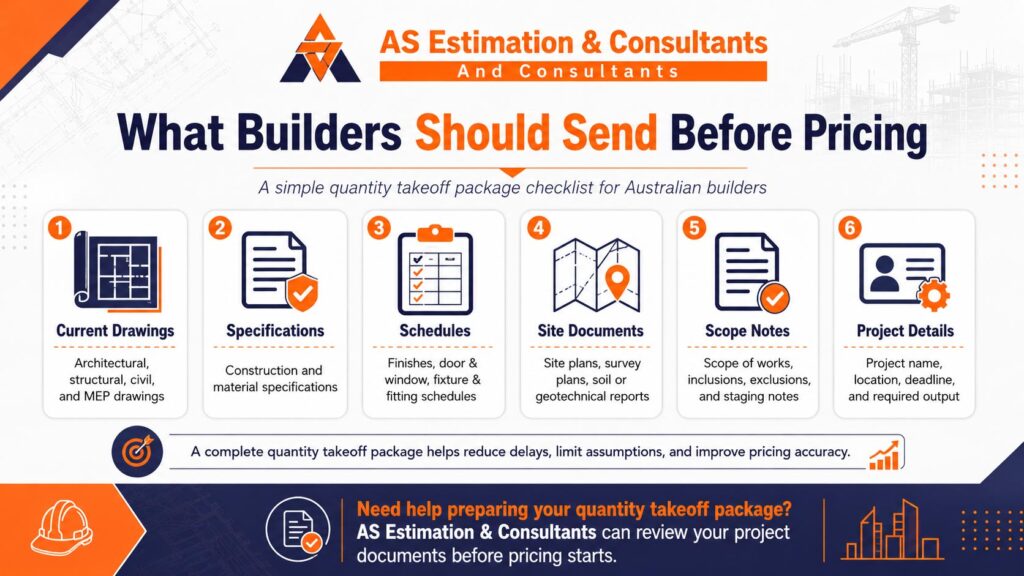
For a quantity takeoff, builders should send a clear set of current project documents before pricing starts. At a minimum, this should include architectural drawings, structural drawings, civil drawings, MEP drawings, construction specifications, schedules, site plans, and a scope of works document.
A complete quantity takeoff package for builders helps the estimator measure the project with fewer gaps. It also reduces pricing delays, missed items, and extra clarification requests.
Here is a simple construction takeoff document checklist to follow before sending your files:
| Document Type | What to Send | Why It Matters |
| Architectural drawings | Floor plans, elevations, roof plans, sections, details | Helps measure walls, floors, ceilings, openings, roof areas, and general layout quantities |
| Structural drawings | Slabs, footings, beams, columns, framing, steel details | Helps measure concrete, steel, reinforcement, timber, and structural items |
| Civil drawings | Site plans, drainage plans, levels, external works | Helps measure excavation, stormwater, driveways, pavements, retaining walls, and siteworks |
| MEP drawings | Electrical layouts, plumbing layouts, HVAC drawings, services layouts | Helps measure services, fixtures, fittings, pipe runs, ductwork, lighting, and equipment |
| Specifications | Construction specifications and material specifications | Shows the material type, quality, finish, and performance requirements |
| Schedules | Finishes schedules, door and window schedules, fixture and fitting schedules | Helps count and price doors, windows, finishes, fittings, fixtures, and equipment |
| Site documents | Survey plans, soil reports, geotechnical reports, demolition plans | Helps confirm site levels, ground conditions, demolition scope, and foundation risks |
| Scope documents | Scope of works, inclusions, exclusions, staging notes | Shows what should be included, excluded, assumed, or priced separately |
This quantity takeoff checklist Australia builders can use is simple: send the latest drawings, the written specifications, all schedules, site reports, and clear scope notes. If any item is missing, tell the estimator early so they can mark assumptions or exclusions before pricing.
Minimum Documents to Send Before Pricing
The minimum documents needed for estimating depend on the project stage. A tender-ready project needs more detail than an early budget estimate. But for most residential and commercial estimating projects, builders should send the following before pricing:
- Current architectural drawings
Send the latest floor plans, elevations, roof plans, sections, and detail drawings. These drawings help the estimator understand the layout, dimensions, room areas, openings, ceiling areas, and roof structure. - Current structural drawings
Send all engineering drawings, including footings, slabs, beams, columns, framing, reinforcement, and steel details. Structural drawings are important for concrete, steel, timber, and foundation quantities. - Construction specifications
Send the construction specifications and material specifications. These documents explain what materials, products, finishes, and standards should be allowed for in the takeoff. - Schedules
Include finishes schedules, door and window schedules, and fixture and fitting schedules. These help the estimator count items correctly and avoid guessing product types, sizes, finishes, or quantities. - Scope of works document
Send a clear scope of works document that explains what should be measured and priced. This should include the work areas, trade scope, inclusions, exclusions, client-supplied items, and any builder notes. - Site documents
Include site plans, survey plans, soil reports, geotechnical reports, drainage plans, and demolition plans if available. These documents can affect excavation, footings, retaining walls, stormwater, access, and external works. - Project details
Tell the estimator the project name, location, project type, pricing purpose, deadline, and required output. For example, you may need a material takeoff, BOQ, trade breakdown, or full construction estimate.
These are the main quantity takeoff requirements before pricing. If the estimator does not have this information, they may need to make assumptions. That can lead to exclusions, provisional quantities, missed items, or extra follow-up questions.
A simple builder pre-pricing checklist should answer these questions:
- Are the drawings current?
- Are all floor plans, elevations, sections, and details included?
- Are the structural drawings included?
- Are the specifications attached?
- Are the finishes, door, window, fixture, and fitting schedules included?
- Is the scope of works clear?
- Are inclusions and exclusions listed?
- Are site reports included?
- Is the pricing deadline clear?
- Is the required output format clear?
If the answer is “no” to any of these, the estimator can still review the project, but the takeoff may need assumptions or clarification notes.
Best File Format to Send
When preparing plans for quantity takeoffs, send your files in a clean and organised format. This saves time and helps the estimator check the documents faster.
The best format is usually PDF. PDFs are easy to open, mark up, measure, and share. Make sure the drawings are clear, scaled, and readable. If a plan is blurry, cut off, or not to scale, the estimator may not be able to measure it accurately.
Use clear file names so the estimator can understand what each file contains. For example:
- Architectural Drawings – Rev C
- Structural Drawings – Rev B
- Civil and Drainage Plans
- MEP Drawings
- Construction Specifications
- Finishes Schedule
- Door and Window Schedule
- Scope of Works
- Soil Report
- Site Survey
Avoid sending mixed files with unclear names such as “final plans,” “new plans,” or “updated drawings” without a revision date. This can create confusion, especially if there are several versions of the same drawing.
For a clean quantity takeoff submission checklist, organise your files into folders like this:
- 01 Architectural
- 02 Structural
- 03 Civil and Site
- 04 MEP and Services
- 05 Specifications
- 06 Schedules
- 07 Reports
- 08 Scope and Tender Documents
Also, remove superseded drawings unless the estimator needs them for comparison. If old drawings must be included, label them clearly as “superseded” or “for reference only.”
If the scope is unclear, send marked-up plans or written notes. For example, you can mark areas that are excluded, staged, client-supplied, or priced by others. This helps the estimator prepare a cleaner quantity takeoff preparation guide for the project and reduces pricing mistakes.
A good estimating file checklist is simple: send current PDFs, use clear names, group files by type, include all schedules, and explain any missing or unclear information before the takeoff starts.
Project Details Estimators Need Before Pricing
Before reviewing the drawings, the estimator needs basic project details. This gives context for the takeoff and helps avoid wrong assumptions.
Send a short project brief that includes:
- Project name
- Project location
- Project type
- Pricing purpose
- Pricing deadline
- Required output format
These details help the estimator understand what needs to be measured, how detailed the takeoff should be, and how the final information should be prepared.
Project Name, Location, and Type
Start with the project name, suburb, city, and state. Also mention whether the job is residential, commercial, renovation, extension, fitout, or new build.
Location matters because site conditions, access, local construction methods, and project requirements can affect the estimate. The project type also helps the estimator understand which drawings, schedules, and trade details are most important.
Pricing Purpose and Deadline
Tell the estimator why the takeoff is needed. For example, it may be for tender pricing, budget planning, subcontractor quotes, procurement, a variation, or an early feasibility estimate.
Each purpose needs a different level of detail. A tender-ready takeoff usually needs more complete documentation than an early budget estimate.
Also include the pricing deadline. This helps the estimator plan the work and flag any missing information early.
Required Output Format
Be clear about what you need back. Some builders only need a material takeoff. Others may need a bill of quantities (BOQ), trade breakdown, subcontractor scope package, or full construction estimate.
This avoids confusion before work starts and helps the estimator prepare the takeoff in the right format for your pricing process.
Construction Drawings Required for Takeoffs
The drawings are the main source for measuring quantities. They show the estimator what needs to be counted, measured, and checked before pricing.
For most projects, send the latest architectural, structural, civil, and MEP drawings. These are the key construction drawings required for takeoffs. If any drawing set is missing, the estimator may need to make assumptions or leave some items as exclusions.
Architectural Drawings
Architectural drawings show the main layout of the building. They help the estimator measure walls, floors, ceilings, doors, windows, rooms, roof areas, and general finishes.
Send the latest:
- Floor plans
- Elevations
- Roof plans
- Reflected ceiling plans
- Sections
- Detail drawings
These drawings are often the starting point for a quantity takeoff checklist for Australian builders because they show the size, shape, and layout of the project.
Structural Drawings
Structural drawings show the load-bearing parts of the building. They help the estimator measure concrete, steel, reinforcement, timber framing, footings, slabs, beams, columns, and other structural items.
Send all engineering drawings, including slab plans, footing details, framing plans, steel details, and structural notes. These documents are important for accurate structural quantities before tender pricing.
Civil, Drainage, and Site Drawings
Civil and site drawings show the external works around the building. They help measure excavation, levels, driveways, pavements, stormwater, drainage, retaining walls, landscaping, and other siteworks.
Send site plans, survey plans, drainage plans, demolition plans, and landscaping plans if they are available. These drawings help the estimator understand the site conditions and avoid missing external work.
MEP and Services Drawings
MEP drawings cover mechanical, electrical, plumbing, HVAC, drainage, and other services. They help the estimator measure pipe runs, electrical points, ductwork, fixtures, fittings, switchboards, lighting, and equipment.
Send electrical layouts, plumbing layouts, HVAC drawings, drainage plans, services layouts, and fixture schedules. These drawings are especially important for commercial projects, fitouts, and jobs with detailed service requirements.
Specifications and Schedules to Include
Drawings show where the work happens. Specifications and schedules show what materials, products, finishes, and fixtures need to be allowed for.
These documents are important because two projects can look similar on drawings but have very different pricing requirements.

Construction Specifications
Send the construction specifications with the drawing set. Specifications help the estimator understand the material quality, product type, installation standards, finish level, and performance requirements.
For example, the drawings may show a wall, floor, or ceiling area. The specification explains what material or finish should be priced for that area.
Finishes Schedule
A finishes schedule helps the estimator measure and price room-by-room finishes more accurately.
This may include:
- Flooring
- Wall finishes
- Ceiling finishes
- Paint
- Tiles
- Cladding
- Wet area finishes
- Joinery finishes
- External finishes
Without a finishes schedule, the estimator may need to make assumptions about material type, coverage, and finish quality.
Door, Window, Fixture, and Fitting Schedules
Door, window, fixture, and fitting schedules help confirm item counts, sizes, types, and product details.
Send schedules for:
- Doors
- Windows
- Glazing
- Hardware
- Tapware
- Sanitaryware
- Appliances
- Light fittings
- Equipment
These schedules support a cleaner BOQ preparation checklist and reduce the risk of missed or wrongly priced items.
Site Reports and Existing Conditions
Site reports help the estimator understand what is already on the block and what may affect the takeoff. They can change excavation, drainage, foundations, demolition, landscaping, and external works quantities.
If these documents are missing, the estimator may need to allow assumptions or exclude some site-related items from the pricing.
Survey Plans and Site Plans
Send the site plan and survey plan if available. These help show site levels, boundaries, access points, existing structures, setbacks, retaining walls, and external works.
They also help the estimator understand how the building sits on the land. This is important for excavation, drainage, driveway works, paving, and other site quantities.
Soil and Geotechnical Reports
Soil reports and geotechnical reports help explain the ground conditions. They can affect footing design, slab design, excavation depth, rock risk, groundwater issues, and foundation pricing.
For many projects, these reports are a key part of the pre-construction quantity takeoff checklist. Without them, foundation and excavation items may need to be treated as assumptions.
Demolition, Drainage, and Landscaping Plans
Demolition plans show what needs to be removed, kept, protected, or changed before construction starts.
Drainage and landscaping plans help measure stormwater, pits, pipes, paving, turf, garden beds, retaining walls, fencing, and other external works.
These documents are not always needed for every job, but they should be sent when they form part of the scope. They help reduce missing items in the construction takeoff document checklist.
Scope of Works, Inclusions, and Exclusions
Drawings show the work, but they do not always show the full pricing scope. The estimator also needs to know what should be included, excluded, staged, or priced separately.
This is important before tender pricing because unclear scope can lead to missed items, double pricing, or too many assumptions.
Scope of Works Document
Send a clear scope of works document with the drawing set. It should explain the trades, work areas, deliverables, and builder responsibilities.
Also include any special project requirements, client-supplied items, or subcontractor scope packages. This helps the estimator understand exactly what needs to be measured.
Inclusions and Exclusions Schedule
An inclusions and exclusions schedule helps prevent pricing confusion.
Use it to show:
- What must be included
- What must be excluded
- What is client-supplied
- What is builder-supplied
- What should be treated as provisional
- What is priced by others
This gives the estimator a cleaner base for the quantity takeoff and reduces the risk of wrong pricing assumptions.
Staging, Access, and Methodology Notes
Send notes on staging, access, and construction method if they affect the work.
This may include restricted site access, occupied buildings, after-hours work, temporary works, staged handovers, or special sequencing.
These details can affect labour, materials, plant, preliminaries, and the way quantities are measured.
Residential vs Commercial Quantity Takeoff Checklist
Residential and commercial projects often need the same basic documents, but the level of detail can be different. A house may only need a smaller drawing set, while a commercial project usually needs full consultant drawings, services layouts, specifications, and trade packages.
| Project Type | Key Documents to Send |
| Residential projects | Floor plans, elevations, roof plans, sections, structural drawings, soil reports, finishes schedules, door and window schedules, drainage plans, and scope notes |
| Commercial projects | Architectural drawings, structural drawings, MEP drawings, reflected ceiling plans, specifications, fire services, hydraulic layouts, electrical layouts, HVAC drawings, staging notes, and subcontractor scope packages |
Residential Builders
For homes, duplexes, townhouses, renovations, and extensions, send the latest floor plans, elevations, roof plans, sections, engineering drawings, soil reports, finishes schedules, and door and window schedules.
Also include drainage plans, fixture details, and scope notes if they apply. These documents help the estimator measure the main building work, external works, finishes, and structural quantities.
Commercial Builders
For offices, retail, industrial, hospitality, education, and mixed-use projects, send the full consultant drawing set. This may include architectural drawings, structural drawings, MEP drawings, reflected ceiling plans, fire services, hydraulic layouts, electrical layouts, HVAC drawings, and detailed specifications.
Commercial takeoffs often need more detail because there are more services, trades, staging requirements, and subcontractor scope packages to check before pricing.
How to Prepare Your Quantity Takeoff Package Before Sending It
A clean file package helps the estimator start faster and reduces back-and-forth. Before sending your documents, check that the files are current, clear, and easy to follow.
Send Current Revisions Only
Send the latest drawing revisions only. Old or mixed revisions can lead to wrong quantities and pricing rework.
If you need to include older drawings for reference, mark them clearly as “superseded” or “for reference only.”
Use Clear File Names and Folders
Use simple file names and group documents by type. For example:
- Architectural Drawings
- Structural Drawings
- Civil and Site Plans
- MEP Drawings
- Specifications
- Schedules
- Site Reports
- Scope Notes
This makes the quantity takeoff package easier to review and helps the estimator find the right information quickly.
Mark Unknowns Clearly
If something is missing or not final, note it upfront. This may include unfinished drawings, missing schedules, unclear finishes, or scope items still under review.
The estimator can still prepare the takeoff, but unclear items may need to be listed as assumptions, exclusions, or provisional allowances.
Final Builder Checklist Before Pricing
Before sending the project for pricing, do one final check. A clean submission helps the estimator complete the quantity takeoff with fewer delays and fewer assumptions.
Documents to Check Before Sending
Make sure you have included:
- Architectural drawings
- Structural drawings
- Civil and site drawings
- MEP or services drawings, if required
- Construction specifications
- Finishes schedules
- Door and window schedules
- Fixture and fitting schedules
- Site plans and survey plans
- Soil or geotechnical reports, if available
- Scope of works
- Inclusions and exclusions
- Project timeline or pricing deadline
This final takeoff checklist helps confirm that the main construction documents are ready before measurement starts.
Questions to Answer Before Pricing Starts
Before the estimator begins, answer these basic questions:
- What is included in the scope?
- What is excluded from the scope?
- What stage is the design at?
- Which trades need to be measured?
- Are there any client-supplied items?
- Are any items provisional?
- What output is needed: material takeoff, BOQ, trade breakdown, or full estimate?
- What is the pricing deadline?
These answers give the estimator a clear starting point and help reduce missing items, pricing gaps, and follow-up questions.
FAQs
The documents you need to send for a quantity takeoff usually include the latest drawings, specifications, schedules, site reports, and scope notes. At minimum, send architectural drawings, structural drawings, construction specifications, finishes schedules, door and window schedules, and a clear scope of works. If you have soil reports, survey plans, drainage plans, or MEP drawings, include those as well.
Yes, you can get a quantity takeoff without a full drawing set, but the result may include assumptions or exclusions. Early-stage drawings can still help with a budget estimate or preliminary takeoff. However, the more complete your plans, specifications, and schedules are, the more accurate the takeoff can be.
Yes, estimators need specifications as well as drawings because drawings show the size and layout of the work, while specifications explain the materials, finishes, product types, and quality standards. For example, a drawing may show a floor area, but the specification tells the estimator whether to allow for tiles, carpet, vinyl, timber, or another finish.
The difference between a quantity takeoff and a BOQ is that a quantity takeoff measures the materials and work items, while a bill of quantities, or BOQ, organises those measured items into a structured pricing format. A takeoff gives the quantities. A BOQ helps builders, contractors, and subcontractors price those quantities in a clearer way.
A quantity takeoff is often slowed down by missing drawings, unclear scope notes, old drawing revisions, missing specifications, incomplete schedules, or no site reports. If the estimator has to keep asking for details, the pricing process takes longer. Sending a clear quantity takeoff package from the start helps reduce delays.
Need Help Preparing a Quantity Takeoff Package?
Before pricing starts, make sure your drawings, specifications, schedules, scope notes, and site documents are ready. A complete quantity takeoff package helps reduce delays, limit assumptions, and give your estimator a clearer base for measurement.
If you are not sure what to send, AS Estimation & Consultants can review your project documents and let you know what is needed before the takeoff begins.
Send your plans, specifications, and scope details to get started with a clear quantity takeoff, construction estimate, or BOQ for your project.