Many cost mistakes in construction start with using the wrong estimate at the wrong time. When people misunderstand estimated accuracy, budget blowouts follow. The difference between preliminary and detailed estimates is not technical jargon—it directly affects cost certainty in construction planning and overall financial control.
Construction budgeting stages evolve as the project planning phase moves from concept to execution. A strong cost management strategy depends on choosing the right construction estimate types at each stage. This cost planning comparison helps with proper budget validation and protects your project from avoidable financial risk.
What Is a Preliminary Estimate?
A preliminary estimate is an early-stage cost projection prepared during the concept and feasibility phase of a project. It gives a high-level cost forecast based on limited drawings or concept plans. This preliminary construction estimate, explained in simple terms, helps with early-stage budgeting and feasibility cost analysis. It acts as a feasibility budget estimate and includes contingency allowance differences to cover unknowns during the project planning phase.
This type of estimate is sometimes called a concept estimate, rough order of magnitude estimate, or initial cost estimate. It supports early-stage cost planning and helps clarify when to use a preliminary estimate before investing heavily in design. At this point, the focus is direction, not precision.
Purpose of a Preliminary Estimate
The main purpose of a preliminary estimate is decision-making before full design begins. It helps with budget validation and feasibility cost analysis so owners can decide whether a project is financially realistic. This early budgeting tool allows stakeholders to test assumptions before spending money on detailed drawings or consultants.
Common feasibility estimate use cases include:
- Go/No-Go Decision: Decide whether to proceed or pause the project.
- Bank Discussions: Present early-stage cost planning figures for financing conversations.
- Investor Feasibility: Show expected investment scale and funding requirements.
- Land Acquisition Evaluation: Check if total development cost supports the purchase price.
In short, it clarifies when to use a preliminary estimate — at the stage where strategy matters more than exact numbers.
Accuracy Level and Risk Exposure
A preliminary estimate comes with a wider estimate accuracy percentage range because the scope is not fully defined. The estimate accuracy ranges explained at this stage often fall within a broader accuracy band due to limited information. Since drawings are incomplete, risk identification is still developing.
There is usually higher contingency in preliminary estimates to manage uncertainty. These contingency allowance differences protect the budget from early surprises. The cost variance range is wider because quantities are assumed, not measured. At the concept stage, risk exposure is naturally higher, and the numbers should guide direction — not be treated as final pricing.
What Is a Detailed Estimate?
A detailed estimate is fully itemized pricing prepared after design development is complete. It is based on complete drawings and specifications, not assumptions. This detailed construction estimate breakdown includes a full quantity takeoff process and a clear labour and material breakdown. The goal is contract-ready pricing that supports procurement readiness and tender submission pricing.
Unlike a rough concept number, this is often called a BOQ estimate, itemized estimate, or pre-tender estimate. Every measurable component is calculated through a quantity takeoff for detailed estimate preparation. A tender-ready detailed estimate gives stakeholders confidence because it reflects real quantities, a defined scope, and realistic execution costs.

Purpose of a Detailed Estimate
The purpose of a detailed estimate is simple: pricing for construction execution. It is prepared when the project is ready to move forward. This is when to prepare a detailed estimate — after drawings are finalized and before contracts are signed. It supports contractor bidding and ensures tender submission pricing is aligned with the actual scope.
Key execution-stage pricing functions include:
- Contractor Bidding: Builders price the work accurately using measured quantities.
- Final Budget Confirmation: Owners confirm funding before construction begins.
- Procurement Readiness: Materials and trades are scheduled based on real numbers.
- Contract Negotiations: Pricing is supported by contract-ready pricing documentation.
This stage improves cost certainty and supports risk management through detailed and accurate estimating.
Accuracy and Cost Certainty
A detailed estimate delivers higher pricing precision because the scope is clearly defined. With full drawings available, the estimate accuracy percentage improves significantly compared to early-stage budgeting. There is less reliance on assumptions, and contingency is usually lower because quantities are measured, not guessed.
Scope definition clarity reduces financial surprises during construction. This is where cost certainty improvement becomes visible. Risk management through detailed estimating helps control overruns and supports cost certainty in construction planning. A high-accuracy estimate provides stronger confidence before contracts are signed and work begins.
Key Differences Between Preliminary and Detailed Estimates
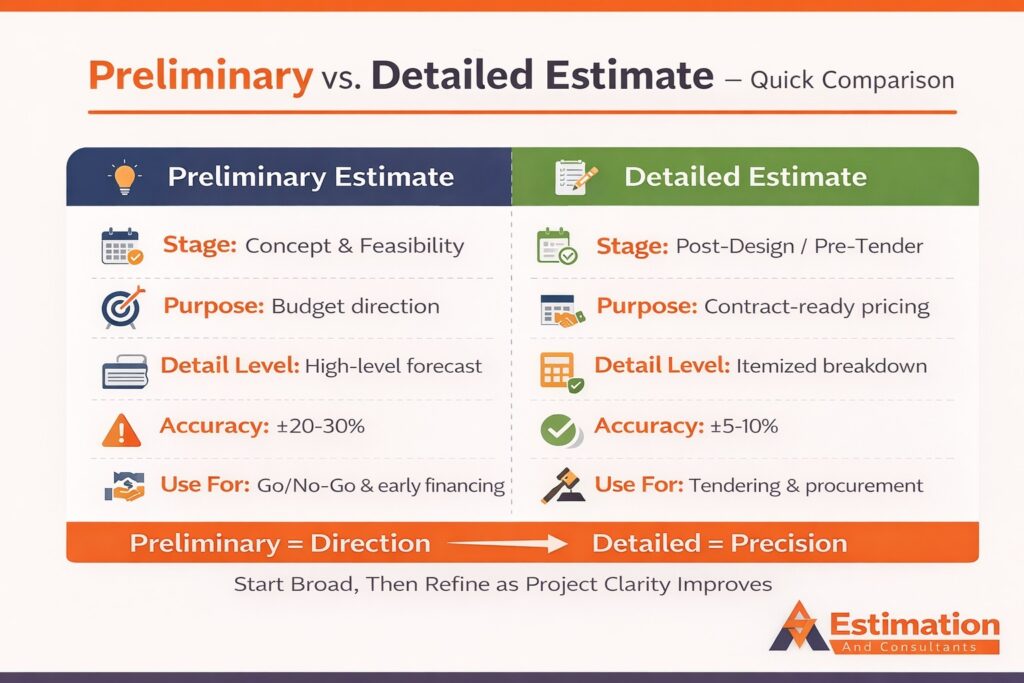
The difference between preliminary and detailed estimates becomes clearer when you compare them side by side. Each serves a different role in the project planning phase. The level of scope definition clarity, the estimate accuracy percentage, and the contingency allowance differences change as the project moves forward.
| Factor | Preliminary Estimate | Detailed Estimate |
| Project Stage | Concept & feasibility phase | Post-design development |
| Purpose | Early-stage budgeting & feasibility cost analysis | Contract-ready pricing & tender submission |
| Level of Detail | High-level cost forecast | Full labour and material breakdown |
| Basis of Pricing | Limited drawings or assumptions | Complete drawings & specifications |
| Accuracy Range | Wider estimate accuracy ranges explained | Narrower, higher accuracy percentage |
| Contingency | Higher due to unknown scope | Lower due to scope definition clarity |
| Risk Exposure | Higher financial uncertainty | Reduced risk through detailed estimating |
| Intended Users | Developers, investors, banks | Contractors, procurement teams, project managers |
When Should You Use Each Estimate?
Choosing the right estimate type depends entirely on where you are in the project planning phase. Construction budgeting stages move from uncertainty to clarity. Early-stage budgeting helps you decide if the project is viable. Detailed pricing helps you execute it with confidence. This is your practical estimate selection guide.
When a Preliminary Estimate Is Needed
A preliminary estimate is used during early-stage cost planning, when design information is still limited. It supports feasibility and strategic decisions before major money is spent.
- Concept Stage: When you only have sketches or basic plans.
- Feasibility Cost Analysis: To check if the project is financially realistic.
- Budget Validation: To test affordability before committing to consultants.
- Land or Investment Evaluation: To assess if numbers support acquisition.
- Early Financing Conversations: When discussing funding before final drawings.
This is when to use a preliminary estimate — direction first, precision later.
When a Detailed Estimate Is Needed
A detailed estimate is required once the design is complete and the project is moving toward execution. Scope definition clarity improves, and procurement readiness becomes the priority.
- After Design Completion: When drawings and specifications are finalized.
- Tender Stage: To support contractor bidding and tender submission pricing.
- Contract Negotiations: To justify contract-ready pricing.
- Procurement Planning: To schedule materials and trades accurately.
- Construction Start Approval: To confirm final funding before breaking ground.
This is when to prepare a detailed estimate — execution demands precision.
What Happens If You Use the Wrong Estimate?
Using the wrong estimate at the wrong time creates avoidable construction budgeting mistakes. If you rely on early numbers for execution decisions, you increase cost estimation risks. The estimated accuracy ranges explained at the feasibility stage are wide for a reason. Ignoring that can weaken cost certainty in construction planning and damage budget validation.
The result is usually financial stress. Poor risk identification leads to funding pressure, strained contractor relationships, and reactive decision-making. Choosing the correct estimate type is not technical—it’s practical protection for your project.
- Underbudgeting Risk: Relying on a preliminary estimate for construction can leave major scope items unfunded.
- Overconfidence in Early Numbers: Treating concept figures as final pricing creates false financial security.
- Tender Pricing Gaps: Contractors may price higher than expected when the scope becomes clear.
- Funding Shortfalls: Banks and investors may question budget validation if numbers shift late.
- Cost Overruns: Weak cost certainty in construction planning leads to variation claims and budget blowouts.
- Delayed Decisions: Poor risk identification slows approvals and impacts project timelines.
How Both Estimates Work Together in a Smart Cost Management Strategy
Preliminary and detailed estimates are not competing tools—they play complementary roles in the project lifecycle. A strong cost management strategy uses both at the right construction budgeting stages. One provides direction; the other provides execution control. Together, they strengthen cost certainty in construction planning and reduce financial surprises.
Think of it as progressive residential or commercial estimating within a clear cost planning workflow. You start broad, then refine as information improves. This step-by-step approach supports design-stage cost control and steady cost certainty improvement.
- Preliminary for Direction: Sets early budget expectations and tests feasibility before major commitments.
- Detailed for Execution: Converts approved design into contract-ready, buildable pricing.
- Progressive Cost Refinement: Numbers become more accurate as drawings and scope develop.
- Design-Stage Cost Control: Allows adjustments before construction locks in costs.
- Improved Cost Certainty: Reduces risk by tightening budgets over time.
- Stronger Financial Confidence: Supports informed decisions at every stage of the project.
FAQs
A preliminary estimate is an early, high-level cost forecast used during concept and feasibility. A detailed estimate is an itemized, contract-ready pricing document prepared after design development. The big difference is scope clarity: early estimates guide direction, while detailed estimates support execution and tendering.
You should use a preliminary estimate during the project planning phase when you have limited drawings and need early-stage budgeting. It’s most useful for feasibility cost analysis, budget validation, and deciding whether the project should move forward before you spend heavily on design.
You should prepare a detailed estimate after design completion, when drawings and specifications are clear enough to measure quantities. This is the stage where tender submission pricing, procurement readiness, and contract discussions need accurate numbers that reflect the full scope.
A preliminary estimate usually has a wider accuracy range because many items are still assumptions. A detailed estimate is more accurate because it is based on complete drawings, measured quantities, and a labour and material breakdown. In simple terms, accuracy improves as design clarity improves.
A preliminary estimate includes a higher contingency because the scope is not fully defined and risks are not fully visible yet. This contingency buffer helps cover unknowns during early-stage cost planning, where changes to design, finishes, and site conditions are common.
Conclusion
The difference between preliminary and detailed estimates is simple when you look at their purpose. A preliminary estimate is a feasibility decision tool used early, while a detailed estimate is a contract-ready pricing tool used before construction begins. Each supports a different stage of your cost management strategy.
Accuracy improves as design clarity improves. That’s why knowing when to use a preliminary estimate and when to prepare a detailed estimate matters. Smart developers treat this as a construction estimate comparison guide: start broad for direction, then refine for execution. Used together, both estimates protect your budget and strengthen financial control from concept to contract.