Office fit-out cost per m² is one of the quickest ways to compare budgets across Australia, but it only works well when it is used the right way. A benchmark helps you plan early, compare cities, and set a realistic starting point before the design becomes more detailed.
This guide is built for business owners, tenants, project managers, and property decision-makers who need a clearer office fit-out budget by city. It explains office fit-out cost estimating per square metre in Australia in a practical way, shows why city-based pricing variation matters, and helps improve estimating accuracy for commercial interiors without relying on misleading averages.
In simple terms, workplace fit-out cost benchmarks 2026 are helpful for early planning, but they are not a final quote. The real value comes from understanding what changes the rate, how Sydney, Melbourne, Brisbane, and Perth differ, and how to approach the 2026 workplace project budgeting with more confidence.
Executive Summary of Office Fit-Out Costs in Australia
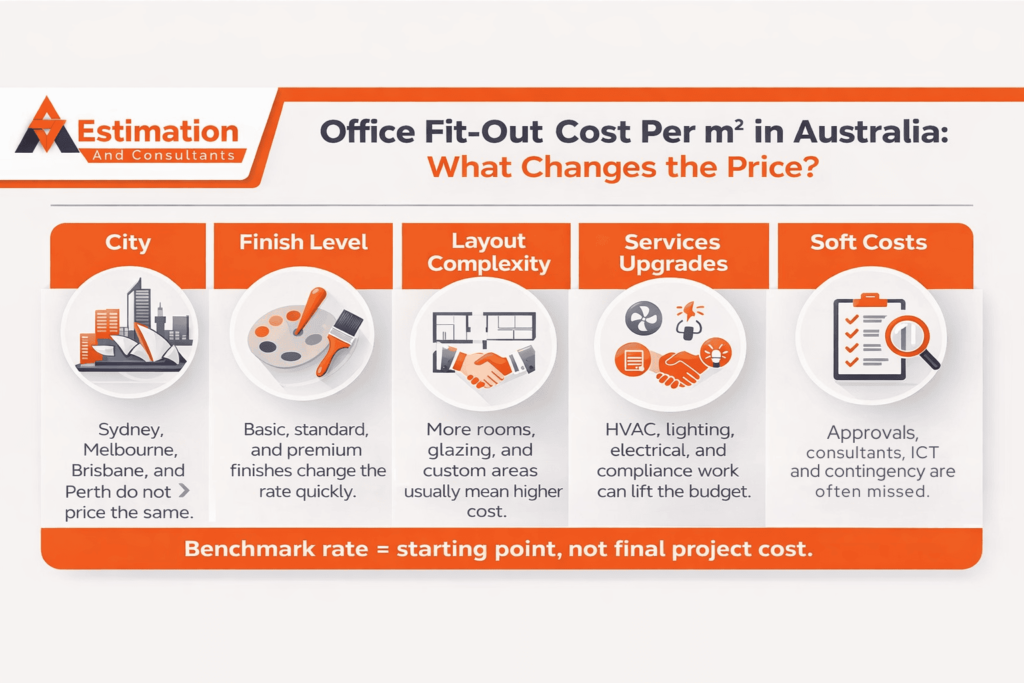
Office fit-out cost per m² in Australia can change a lot depending on the city, finish level, and project scope. Sydney usually sits higher, while Brisbane and Perth may offer more flexibility depending on labour, supply, and building conditions.
Before setting a budget, compare workplace fit-out cost benchmarks 2026, check city-based pricing variation, and decide whether you need standard vs premium finishes. That gives you a clearer office cost overview in Australia and helps avoid rough guesses.
- City Matters First
Office fit-out cost per square metre in Australia is not the same in every market. Sydney, Melbourne, Brisbane, and Perth each have different labour rates, supply conditions, and delivery pressures. - Finish Level Changes the Budget
Standard vs premium finishes can shift your budget fast. Better materials, custom joinery, upgraded lighting, and stronger design details all increase the final rate. - Scope Drives the Real Cost
A simple refresh costs less than a full workplace rebuild. Partitions, service changes, flooring, ceilings, and joinery all affect the final office fit-out cost per m². - Benchmark Before You Commit
Start with workplace fit-out cost benchmarks 2026, then adjust for your city, size, and level of finish. This gives you a more useful starting point. - Regional Gaps Are Normal
Regional variation in office fit-out costs is normal across Australia. Trade availability, freight, approvals, and building conditions can all change what you pay. - Use Rates as a Guide Only
Benchmarks help, but they are not a final quote. The best way to budget well is to use the rate as a guide, then test it against your actual budget.
2026 Office Fit-Out Cost Per m² by City
| City | Typical Benchmark Rate (AUD/m²) | Market Position | What Usually Pushes Costs Up |
| Sydney | From $2,665/m² | Highest | CBD access limits, labour pressure, premium finishes, stronger services and compliance requirements |
| Melbourne | From $2,607/m² | High | Design quality, refurbishment complexity, upgraded finishes, mixed building stock |
| Brisbane | From $2,548/m² | Mid | CBD access limits, labour pressure, premium finishes, stronger services, and compliance requirements |
| Perth | From $2,453/m² | More Competitive | Trade availability, logistics, procurement timing, programme risk |
What Office Fit-Out Cost Per m² Actually Covers
When people look at office fit-out cost per m², they often assume it covers the full project from start to finish. In reality, that rate usually reflects only part of the total spend. It helps as a planning benchmark, but it does not always include every item needed to deliver a ready-to-use workplace.
This section works best when it clears up three common mix-ups early: base build vs fit-out cost, fit-out vs refurbishment, and the hidden items often left out of commercial office interiors pricing. That structure is useful because it helps readers understand what is included in the office fit-out cost before they trust any rate too quickly.
Base Build vs Tenancy Fit-Out
A lot of budget confusion starts here. Base build vs fit-out cost is not the same thing, and mixing the two can throw off the whole budget. Base build usually refers to the building elements delivered by the landlord, such as the structure, common areas, main services, lifts, and sometimes a basic internal shell. Tenancy fit-out is the work done inside the leased space to make it usable for the tenant.
In simple terms, landlord works vs tenant fit-out comes down to who is responsible for what. A shell and core vs office fit-out comparison helps readers see that the office fit-out cost per m² usually applies to the internal workspace, not the entire building package. Compliance and approvals can also sit across both sides, which is why project teams need a very clear scope before setting a budget.
Fit-Out vs Refurbishment
This is another area where cost planning can go wrong. A new fit-out usually starts with a relatively blank tenancy and builds the workplace around a fresh layout and new finishes. A refurbishment, on the other hand, works with an existing office and may include demolition, strip-out, upgrades, reuse, and selective replacement. That means office refurbishment cost in Australia is often shaped by what stays, what goes, and what needs fixing first.
The cost logic is different because refurbishment can look cheaper at first, but hidden issues inside the space can push the budget higher. Old services, damaged finishes, outdated layouts, and access limits all affect office refurbishment pricing. At the same time, reuse can support sustainability and ESG requirements, which may reduce waste and improve value. That is why office renovation cost per sqm should never be judged the same way as a fresh fit-out.
What Is Usually Excluded From m² Rates
This is the part many readers miss, and it is often where budgets start to drift. Even when a rate looks clear on paper, office fit-out exclusions can still sit outside the headline number. These may include consultant fees, ICT and AV systems, statutory charges, relocation costs, reinstatement obligations, and finance or holding costs during delivery. These are real costs, even if they are not always included in the rate.
For that reason, estimating office fit-out costs accurately means treating the per-square-metre rate as a starting point, not the whole answer. Hidden fit-out costs can make a major difference to the final number, especially on larger projects or in buildings with stricter approval needs. A practical fit-out scope guide should always separate construction costs from soft costs so decision-makers can see the full picture before approving the budget.
Common Items Often Excluded
- Consultant Fees
Design, project management, engineering, certifier, and specialist consultant fees are often separate from the main fit-out rate. - ICT and AV Systems
Data setup, meeting room technology, screens, security systems, and communications infrastructure may not be covered in the base cost. - Statutory Charges and Approvals
Compliance and approvals can include permits, authority fees, certifications, and other project sign-off costs. - Relocation and Move Costs
Moving teams, storing furniture, temporary space, and downtime costs are easy to overlook during early budgeting. - Reinstatement Obligations
At lease end, some tenants may need to return the tenancy to an agreed condition, which adds a future cost many budgets ignore. - Finance and Holding Costs
Delays, longer programmes, and staged approvals can create indirect costs that do not appear in basic commercial office interiors pricing.
2026 Office Fit-Out Cost Tiers in Australia
This section helps readers understand that not every office fit-out sits in the same cost band. Some projects are simple and practical, while others involve stronger design, better materials, and more complex services. That is why office fit-out pricing tiers matter when comparing rates across Australia.
The structure of this section is useful because it moves from the lowest practical tier to the highest-value workplace outcome. It gives readers a clear way to read premium vs standard office fit-out pricing without mixing basic upgrades with high-spec spaces. It also makes commercial office interiors pricing easier to compare in a realistic way.
Budget / Basic Fit-Out
A budget or basic fit-out is the lowest practical cost tier for a functional office. It usually focuses on the essentials needed to make a space usable without adding too many custom features. This may include fresh paint, carpet tiles, basic partitions, standard lighting, and only minor changes to existing services. In many cases, the goal is speed, control, and a clean finish rather than visual impact.
This tier suits businesses that want a workable office with limited upfront spend. Even so, basic office fit-out costs can still move depending on ceilings and flooring costs, lighting and electrical allowance, and how much work is needed around partitions and glazing costs. A budget office fit-out rate is never only about size. It also depends on how much of the existing space can be kept in place.
Standard / Mid-Range Fit-Out
The standard or mid-range tier is where many office projects sit. It gives businesses more balance between cost, comfort, and presentation. This level often includes a mix of meeting rooms, collaboration zones, standard joinery, better finishes, and a more polished staff and client experience. It is not overdone, but it feels complete and more intentional than a basic refresh.
This is also the tier where commercial office interiors pricing becomes more sensitive to design choices. Joinery and furniture integration, standard vs premium finishes, and ceilings and flooring costs all start to play a larger role. Mid-range office fit-out pricing is often the most practical benchmark because it reflects what many modern businesses actually want: a good-looking, functional office that supports daily work without pushing fully into premium spend.
Premium / High-Performance Fit-Out
A premium or high-performance fit-out is built for businesses that want more than a simple workplace. These projects usually include branded spaces, stronger acoustic control, high-end joinery, specialist lighting, upgraded services, and better staff experience features. In many cases, they also respond to wellness goals, sustainability, ESG requirements, and more demanding operational needs.
This is where premium office interiors pricing rises because the project involves more detail, more coordination, and more technical delivery. HVAC and services coordination often becomes more complex, lighting and electrical allowance increases, and joinery and furniture integration become more tailored. The sustainable office fit-out cost impact can also be more visible here, especially when clients want better energy performance, lower-emission materials, or a stronger long-term workplace standard.
City-by-City Office Fit-Out Cost Benchmarks
Office fit-out cost by city can vary more than many clients expect. A national average is useful at the start, but it does not reflect local trade pressure, delivery conditions, approvals, building quality, or procurement timing. That is why Sydney, Melbourne, Brisbane, and Perth should each be judged on their own benchmark range.
This section works because it compares each market on the factors that really shape cost: price level, service complexity, finish expectations, programme risk, and where budgets often drift. For anyone planning an office in 2026, this gives a more practical view of office fit-out cost per m² than relying on one flat Australian average.
Sydney Office Fit-Out Cost Per m²
Sydney usually sits at the top end of the market. As a working benchmark, many projects fall around AUD 2,665 per m², and higher-spec workplaces can move beyond that when the scope becomes more services-heavy or design-led. Sydney office fit-out cost estimating per m² is often pushed up by CBD access limits, tighter programmes, stronger landlord requirements, and more demanding compliance and approvals.
In practical terms, Sydney tends to reward early planning. Lighting and electrical allowance, services coordination, and programme pressure can all shift the final cost quickly. That means a Sydney office fit-out cost should be treated as a premium-city benchmark rather than a simple square metre rate. If the brief includes upgraded meeting spaces, feature lighting, or major service changes, the office fit-out budget by the city needs a healthy margin from the beginning.
Melbourne Office Fit-Out Pricing 2026
Melbourne generally sits just behind Sydney and remains one of the higher-cost office fit-out markets in Australia. A useful benchmark is around AUD 2,607 per m², with premium spaces often rising above that depending on finish quality, tenancy condition, and scope complexity. Melbourne office fit-out cost estimating 2026 is shaped by a strong design culture, higher expectations around presentation, and a broad mix of new and older office stock.
Melbourne also has more refurbishment-driven opportunities than many clients expect. That can create savings in the right space, but office refurbishment costs in Australia are never just about keeping what is already there. Existing services, demolition needs, layout constraints, and finish upgrades can all change the number. For that reason, Melbourne office fit-out cost should be assessed against both the design brief and the condition of the existing tenancy.
Brisbane Office Fit-Out Cost Guide
Brisbane is often more cost-competitive than Sydney and Melbourne, but it should not be treated as a low-risk market. A solid benchmark sits around AUD 2,548 per m², although project-specific rates can still rise with faster delivery, stronger finishes, or more complex service work. Brisbane office fit-out cost guide figures are usually helped by lower headline pricing, but buildability and sequencing still matter.
The key point in Brisbane cost estimating is that lower starting rates do not always mean an easier project. HVAC and services coordination, supply chain timing, and local delivery pressure can still affect the total spend. If the office has tighter deadlines, higher occupancy density, or extra meeting-room infrastructure, the office fit-out budget by the city should allow for those pressures instead of relying on the cheapest benchmark.
Perth Office Fit-Out Cost Per m²
Perth is often presented as one of the more affordable office fit-out markets, with a useful benchmark around AUD 2,453 per m². Even so, the Perth office fit-out cost estimating per m² can be less predictable than it first appears. Trade availability, logistics, and procurement timing can have a bigger effect here, especially where specialist finishes or service upgrades are involved.
That is why Perth office interiors pricing should be handled carefully. On paper, the rate may look competitive, but labour market pressure and programme risk can still push costs upward if the scope is tight or the project depends on specific trades and equipment. In Perth, regional variation in office fit-out costs is not just a theory. It can show up clearly once delivery conditions are tested against the actual brief.
Quick View of Benchmark Rates
- Sydney: around AUD 2,665 per m²
- Melbourne: around AUD 2,607 per m²
- Brisbane: around AUD 2,548 per m²
- Perth: around AUD 2,453 per m²
These rates are best used as early planning benchmarks, not final quotes. The real cost will still depend on the city, level of finish, service changes, approvals, and how much complexity sits inside the brief. That is the real value of a city-by-city view: it gives clients a more honest starting point before the detailed estimating begins.
Elemental Breakdown of Office Fit-Out Pricing
This section is important because it shows where the money really goes. A square metre rate can feel simple, but it is only a summary of many smaller work packages. When readers understand the physical cost stack, the office fit-out cost breakdown becomes easier to trust and easier to question.
The structure of this section works well because it breaks the fit-out into practical line items instead of speaking in broad averages. That helps readers see how elemental office pricing is built through partitions and glazing costs, ceilings and flooring costs, joinery and furniture integration, lighting and electrical allowance, and HVAC and services coordination.
Partitions, Glazing, and Doors
This is the part of the budget that shapes the internal layout of the office. Partitions, glazing, and doors decide how much of the space stays open and how much is divided into meeting rooms, private offices, quiet rooms, and support areas. A simple open-plan office usually has a lower office partition cost than a layout with many enclosed rooms, acoustic upgrades, and glazed fronts.
That is why partitions and glazing costs can rise quickly even when the total floor area stays the same. More rooms usually mean more framing, more glass, more door hardware, and more labour. In practical terms, office partition and ceiling costs are strongly linked to planning decisions. The more complex the layout, the more this part of the fit-out starts to shape the final rate.
Ceilings, Flooring, and Finishes
This part covers the visual layer that people notice first when they walk into the office. It includes carpet tiles, vinyl, feature finishes, painting, wall treatments, and ceiling systems such as exposed ceilings or acoustic suspended ceilings. These items may seem straightforward, but ceilings and flooring costs can vary a lot depending on design quality, material choice, and how much preparation the existing tenancy needs.
This is also where standard vs premium finishes become easy to see in the budget. A simple finish schedule may keep office flooring cost and office ceiling cost under control, while upgraded surfaces and feature details can push the number higher. Office flooring and joinery pricing often start to move together here because the finish level sets the overall tone for the workspace and affects how every other detail is judged.
Joinery, Storage, and Furniture Integration
Joinery is one of the clearest signs of how basic or refined a fit-out will feel. This part includes reception desks, tea points, storage walls, credenzas, lockers, and other built elements that support daily use. Some offices need very little custom work, while others depend on detailed joinery and furniture integration to support branding, workflow, and space efficiency.
This area can have a big effect on commercial office interiors pricing because custom work is rarely cheap. Office joinery cost depends on the material, finish, detailing, and level of integration with the rest of the space. A simple off-the-shelf setup will cost less, but custom office joinery pricing rises when the design calls for a stronger front-of-house look, better storage planning, or more seamless built-in furniture solutions.
Lighting, Power, Data, and AV Readiness
This is the layer that supports how the office actually works day to day. It includes general lighting, feature lighting, power outlets, data points, meeting room readiness, and the AV setup needed for modern work. In many projects, the lighting and electrical allowance can change fast once the team decides how many workstations, screens, collaboration areas, and private meeting spaces the office needs.
The reason this matters is simple: office electrical fit-out cost is not only about switches and cables. It is about how the office is expected to perform. Office lighting cost can stay modest in a basic workspace, but feature lighting, dense power layouts, and stronger meeting room technology can add real cost. Compliance and approvals can also affect this area, especially when changes connect back to base-building systems or code requirements.
HVAC, Fire, and Services Coordination
This is often one of the least visible but most important parts of the fit-out. HVAC, fire systems, and services coordination affect comfort, safety, approvals, and the way different building systems work together. A small layout change can sometimes trigger larger mechanical or fire-related adjustments, especially in older buildings or more complex tenancies. That is why office HVAC fit-out cost should never be treated as a minor afterthought.
HVAC cost in office fit-outs can rise when a project needs supplementary air-conditioning, relocation of existing services, fire interface changes, or closer coordination with base-building systems. This part of the budget is also tied closely to estimating office fit-out costs accurately because it can be one of the biggest sources of late surprises. When the services coordination office fit-out work is not understood early, the final cost can move well beyond the original benchmark.
What Causes Office Fit-Out Costs to Rise or Fall
Office size is only one part of the story. In reality, the final number is shaped by decisions around design, layout, building condition, and how easy the project is to deliver. That is why two offices with the same area can have very different costs.
This section is structured to focus only on the main cost drivers, not the physical items already covered earlier. It helps explain factors affecting office fit-out costs like finish level, planning efficiency, services capacity, and market conditions. These are the real reasons behind premium vs standard office fit-out pricing and regional variation in office fit-out costs.
Design Ambition and Finish Quality
Design ambition is one of the biggest cost drivers. A simple workspace with standard finishes will always cost less than a branded office with custom joinery, feature lighting, and high-end materials. The more detailed and refined the design becomes, the more time, labour, and coordination it needs.
This is where premium vs standard office fit-out pricing becomes clear. Fit-out finish quality cost is not just about materials. It includes installation details, design coordination, and how many custom elements are involved. That is why the office design cost difference can be significant, even when the floor size stays the same.
Floorplate Efficiency and Density
The way a space is planned has a direct impact on cost. Open layouts with fewer enclosed rooms are usually more efficient and cost less to build. In contrast, offices with many meeting rooms, private offices, and high desk density need more partitions, services, and coordination.
From a budgeting point of view, office density cost increases when the layout becomes more complex. Floorplate efficiency fit-out cost is not about size, but about how hard the space needs to work. More walls, more doors, and more service points mean more cost per square metre.
Services Capacity and Existing Building Condition
The condition of the building can either support the project or work against it. If the tenancy already has strong services and a clean layout, costs are easier to control. But if upgrades are needed, the budget can shift quickly before any visible work starts.
HVAC and services coordination often becomes the key issue here. HVAC cost in office fit-outs rises when extra cooling, electrical upgrades, or fire system changes are required. At the same time, compliance and approvals can add pressure. This is where base build vs fit-out cost becomes important, as existing building limits can trigger unexpected upgrades.
Labour and Supply Chain Conditions
Even with a clear design, the delivery environment can still change the final cost estimate. Labour market pressure affects how easily trades can be secured and how stable pricing remains. When demand is high, labour costs tend to rise, and programme risks increase.
Supply chain timing is just as important. Delays in materials, imported finishes, or specialist items can slow down progress and increase costs. This is a major reason behind regional variation in office fit-out costs across Australia. Fit-out labour costs and supply delays can both push a project beyond its original estimate if not planned early.
Why These Variables Matter
These cost drivers matter because they explain what really moves a budget. A square metre rate is only a starting point. The final number is shaped by design ambition, layout complexity, building condition, and delivery conditions. Understanding these factors helps clients make better decisions and avoid surprises during the project.
Sustainability, ESG, and Wellness Requirements
Sustainability, ESG, and wellness goals can change an office fit-out budget in both directions. Some choices increase upfront spend, especially when they involve better materials, smarter systems, or added coordination. But they can also reduce waste, improve energy use, and support lower running costs over time.
This section matters because responsible workplace design should not be judged only by day-one cost. The real value often sits in lifecycle thinking. When planned well, sustainable office fit-out pricing can support better long-term performance, healthier spaces, and stronger 2026 workplace project budgeting from the start.
- Better Materials Can Lift Upfront Cost
Low-emission finishes, recycled content, certified products, and more durable materials can raise the starting budget. Even so, they often improve quality, reduce replacement needs, and support a better long-term result. - Energy Systems Can Improve Long-Term Value
Lighting and electrical allowance may increase when the design includes efficient lighting controls, sensors, or upgraded systems. The upfront spend may be higher, but energy savings can help reduce lifecycle cost. - HVAC Decisions Matter More Than Many Expect
HVAC and services coordination often plays a big role in the cost of a green workplace. Better ventilation, zoning, control systems, and comfort-focused upgrades can increase capital cost, but they may improve efficiency and workplace comfort. - Wellness Features Add Purpose, Not Just Cost
Wellness-led design can include better air quality, acoustic control, lighting quality, and more comfortable shared spaces. These features may raise the fit-out budget, but they also support staff experience and daily usability. - Smarter Planning Can Reduce Waste
Reusing parts of the existing tenancy, keeping serviceable finishes, and limiting unnecessary demolition can lower waste and reduce total spend. This is one of the clearest ways to manage sustainable office fit-out cost impact. - Lifecycle Thinking Supports Better Budgeting
ESG office fit-out cost should be judged over the life of the office, not just at handover. Workplace fit-out cost benchmarks 2026 are more useful when they consider operating efficiency, future maintenance, and long-term value.
Soft Costs, Approvals, and Other Budget Items Often Missed
Many office budgets look fine at the start because they focus only on construction. The problem is that a real project includes more than what gets built on site. Consultant fees, approvals, ICT, moving costs, and contingency can all sit outside the main fit-out number.
This section matters because office fit-out hidden costs are often the reason budgets drift later. If these items are missed early, the total project cost can feel higher than expected. Good 2026 workplace project budgeting depends on seeing both the visible build cost and the less visible support costs around it.
- Consultant Fees Add Up Early
Design consultants, engineers, certifiers, and project advisors are often needed before construction begins. These costs support planning and delivery, but they are easy to miss in early estimates. - Approvals Can Affect Both Cost and Timing
Compliance and approvals may include permits, authority reviews, building approvals, and certification steps. These are not always large on their own, but they can affect both cash flow and programme. - Project Management Is Part of the Real Budget
PM fees are often left out of simple benchmark rates. Even so, project management supports coordination, decisions, and delivery control, which makes it a real part of office fit-out soft costs. - ICT and Technology Are Often Separate
Data setup, AV, security systems, meeting room tech, and communications work may not be included in the builder’s number. These items can make a noticeable difference to the final spend. - Move Management and Reinstatement Matter
Relocation costs, temporary arrangements, storage, and end-of-lease reinstatement are common budget items that many teams forget to allow for at the start. - Contingency Protects the Budget
Estimating office fit-out costs accurately means allowing room for unknowns. A sensible contingency helps cover scope gaps, site issues, and small changes without putting the full project under pressure.
How to Estimate Office Fit-Out Costs Accurately in 2026
Estimating an office fit-out is not about picking one rate and moving forward. It is a step-by-step process. You start with a benchmark, adjust it based on city conditions, then refine it based on scope and delivery factors.
This structure works because it keeps the estimate realistic. It helps improve estimating office fit-out costs accurately by turning a rough number into a practical office fit-out budget by city that reflects real project conditions.
Start With a Benchmark Range
Begin with a broad office fit-out cost per m² range. This gives a starting point before design details are confirmed. A benchmark office fit-out cost should never be treated as final.
Use it as a guide only. Office fit-out cost per square metre in Australia varies based on city-based pricing variation and project type, so keeping it flexible early helps avoid tight or unrealistic budgets.
Adjust for City and Delivery Conditions
Next, adjust the benchmark based on location. Sydney, Melbourne, Brisbane, and Perth all have different cost levels and delivery challenges.
Labour market pressure, approvals, and procurement timing can all affect pricing. Regional variation in office fit-out costs means a city-adjusted fit-out cost is always more reliable than a national average.
Add Scope-Specific Cost Uplifts
Now match the estimate to your actual brief. Features like boardrooms, custom joinery, higher services demand, or ESG upgrades will increase cost.
Joinery and furniture integration, HVAC and services coordination, and sustainability requirements all add to the total. These scope changes should be planned early, not discovered later.
Add Soft Costs and Contingency
Finally, include soft costs and contingency. Items like compliance and approvals, consultants, and ICT are often missed but still affect the final budget.
A small contingency helps protect the project from changes or unknowns. This step is key to building a complete and reliable fit-out cost planning guide.
Simple Way to Remember
- Start with a range
- Adjust for the city
- Refine the scope
- Add soft costs and buffer
This keeps the estimate practical and easier to control.
FAQs
The average office fit-out cost per m² in Australia usually depends on the city, finish level, and scope of work. In simple terms, a basic fit-out sits lower, a standard workplace sits in the middle, and a premium office with custom features, services upgrades, and stronger design quality sits higher. That is why average rates should be used as a guide, not as a final quote.
Office fit-out cost is often higher in Sydney because Sydney projects usually face more delivery pressure, tighter access, stronger compliance requirements, and higher trade demand. In a natural sense, Sydney is not just charging more for space. It is also a market where labour, timing, and project complexity can lift the final budget more quickly than in some other cities.
Melbourne is often a little cheaper than Sydney for office fit-outs, but the gap is not always large. Melbourne can still be a high-cost market, especially when the project includes strong design ambition, upgraded finishes, or refurbishment work in older office stock. So yes, Melbourne may come in lower than Sydney, but it still needs a careful budget.
Two offices of the same size can have different fit-out costs because size is only one part of the price. The real difference usually comes from layout, finish quality, joinery, service upgrades, and building condition. In other words, one office may be simple and open plan, while another may include boardrooms, acoustic rooms, custom details, and more technical work.
Office fit-out cost per m² usually includes the internal works needed to make the tenancy usable, such as partitions, ceilings, flooring, lighting, power, joinery, and some services coordination. What is included can still vary from project to project, so the rate should always be checked against the actual scope before it is used as a working budget.
Final Takeaway
Workplace fit-out cost benchmarks 2026 are useful because they give you a starting point, but they should never be treated as the final answer. A benchmark can guide early planning, yet real project costs depend on the city, fit-out level, building condition, service needs, approvals, and the full scope behind the brief.
The best budgeting decisions come from estimating office fit-out costs accurately at the project level, not from relying on one average rate alone. In simple terms, benchmarks help you start, but project-specific costing helps you plan with confidence. That is the real value behind a strong 2026 workplace project budgeting and a practical office fit-out planning conclusion.