Material takeoff and cost estimation are closely connected, but they are not the same. A takeoff measures the scope by listing quantities from drawings and specifications. Cost estimation takes those quantities and turns them into money for budgeting, pricing, and construction cost planning.
People often confuse the two because both sit inside the same estimating workflow and both support better project decisions. The real difference between takeoff and estimate is simple: one measures the work, and the other prices it. That is why both takeoff and estimation are needed for cost accuracy, better budgeting, and stronger project control.
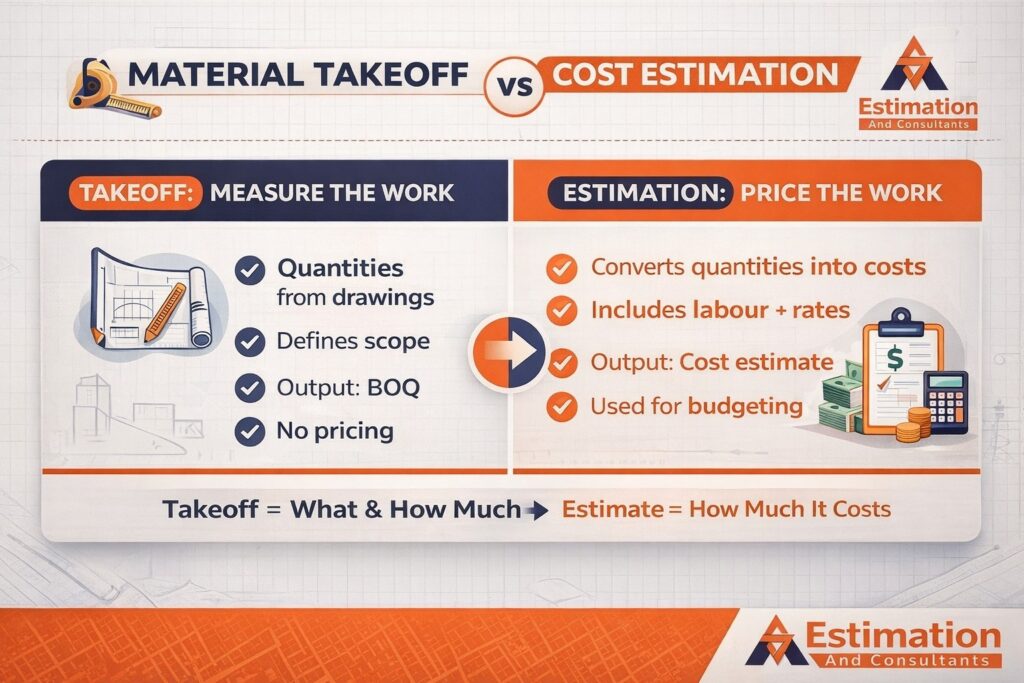
Quick Answer: Material Takeoff Measures Quantities, Cost Estimation, and Prices the Work
Material takeoff focuses on quantity measurement—what and how much is needed. Cost estimation takes those quantities and handles converting quantities into costs using rates, labour, and pricing. In simple terms, it’s takeoff vs pricing in construction.
Why People Often Mix Them Up
Both are part of the construction estimating workflow and are used by the same estimator during preconstruction. Since they support budgeting and bidding together, this creates confusion, even though one measures scope and the other handles cost planning.
What Is Material Takeoff in Construction?
Material takeoff is the process of measuring materials from drawings and specifications. It defines the project scope using quantities, units, and allowances, helping build a clear bill of quantities and ensuring quantity measurement accuracy before any pricing or cost estimation begins.
What a Takeoff Includes
A takeoff includes measured quantities such as materials, lengths, areas, volumes, and waste factors. It focuses on capturing every required item accurately so nothing is missed. This step directly improves estimating quality because strong quantities reduce errors later in the estimating workflow.
What a Takeoff Does Not Include
A takeoff does not include labour costs, pricing, overhead, profit, or rate build-up. It is a quantity-only process. This highlights the difference between material takeoff and cost estimate—takeoff defines scope, while cost estimation converts those quantities into actual project costs.
What Is Cost Estimation in Construction?
Cost estimation is the process of turning measured quantities into money. It builds the total projected project cost using unit rates, labour, equipment, overhead, profit, and contingencies. In simple terms, a construction estimate is the pricing step that supports budget planning, control, and smarter decisions before work starts.
Main Components of a Cost Estimate
A cost estimate includes direct and indirect costs. That means materials, labour, plant, subcontractors, overhead, contingency, and margin all sit inside the pricing model. This is where converting quantities into costs happens, and it is the main difference between takeoff and pricing in construction for real project planning.
What an Estimate Is Used For
A project cost estimate helps with tendering, budgeting, approvals, procurement planning, and financial forecasting. It gives teams a clear pricing estimate before construction begins. That is why both takeoff and estimation are needed: one measures the work, while the other supports cost planning, bid pricing, and commercial control.
Material Takeoff vs Cost Estimation: The Core Differences
Material takeoff and cost estimation are closely linked, but they serve different roles in the estimating workflow. A takeoff measures quantities from drawings and defines the scope. Cost estimation takes those quantities and converts them into costs using rates, labour, and pricing logic. This is the core difference between material takeoff and cost estimate.
Quantities vs Costs
Material takeoff focuses on quantity measurement—how much material is required. Cost estimation focuses on cost planning—how much the project will cost. One defines the scope in measurable units, while the other handles converting quantities into costs through pricing and rate build-up.
Output Documents and Deliverables
A takeoff produces quantity sheets or a bill of quantities that outline the measured scope. A cost estimate produces a pricing document, such as a cost plan or bid estimate, used for budgeting and decision-making. Both outputs are needed to move from measurement to financial planning.
Risk If Either Step Is Weak
If the takeoff is inaccurate, quantities can be missed, leading to procurement issues and scope gaps. If the estimate is weak, poor pricing or incorrect rates can cause underbidding or budget overruns. Strong quantity accuracy and cost planning together improve overall project cost control.
Quick Comparison: Material Takeoff vs Cost Estimation
| Aspect | Material Takeoff | Cost Estimation |
| Purpose | Measure quantities | Calculate total cost |
| Focus | Quantity measurement | Cost planning and pricing |
| Output | BOQ, quantity sheets | Cost estimate, bid price |
| Input | Drawings, specifications | Quantities, rates, and labour |
| Role | Defines scope | Converts scope into cost |
| Risk | Missing quantities | Incorrect pricing or rates |
How Estimators Turn a Takeoff Into a Cost Estimate
Australian Estimators move through a clear workflow. They start with drawings, measure quantities, apply unit rates, and then build the final price. This step-by-step process connects material takeoff to cost estimation and shows how estimators use takeoffs for real budget planning, tender pricing, and practical cost control.
- Step 1 — Review Drawings and Scope: The estimator checks plans, specifications, exclusions, and assumptions first. This sets the scope clearly and reduces the risk of missing quantities before the material takeoff process begins.
- Step 2 — Measure Quantities Accurately: Next, quantities are counted, measured, verified, and grouped by trade or system. This is where quantity accuracy matters most, because weak takeoff data leads to weak estimating.
- Step 3 — Apply Unit Rates and Cost Logic: After that, the estimator adds supplier quotes, labour productivity, waste, equipment cost, and markups. This is the pricing stage where quantities are converted into costs.
- Step 4 — Build the Final Estimate: Finally, indirect costs, overhead, contingency, and profit are added. The result is a complete cost plan that supports budgeting, bidding, and stronger project decisions.
Why the Difference Matters for Budgeting, Bidding, and Cost Control
Knowing the difference between material takeoff and cost estimation helps teams plan with more confidence. Accurate quantities support better material ordering, while accurate pricing supports stronger budgeting, tendering, and cost control. That is why both takeoff and estimation are needed for project cost certainty, smoother delivery, and better business decisions.
- Better Tender Accuracy: Clear takeoff data and sound pricing logic improve bid pricing accuracy. This helps estimators avoid underpricing, overpricing, and weak tender assumptions.
- Better Procurement Planning: Reliable quantity data supports material ordering, scheduling, supplier coordination, and waste reduction before site work begins.
- Better Budget Control During Delivery: A solid estimate supports forecasting, variance tracking, and change control, which improves budget planning and cost monitoring throughout the project.
Common Mistakes When People Confuse Takeoff With Estimation
A lot of estimating mistakes start when people treat takeoff and estimation as the same thing. A takeoff measures quantities, but a cost estimate prices the work. If that difference is missed, budgets get weak, bids lose accuracy, and cost planning becomes harder to trust.
- Thinking a Takeoff Is Already a Full Estimate: A detailed quantity takeoff is not a full estimate. Quantities alone do not cover labour, pricing, or budget planning and control.
- Ignoring Labour, Overheads, and Risk Allowances: Good pricing must include labour and material cost calculation, overheads, markups, and contingencies. This is where takeoff vs pricing in construction becomes clear.
- Using Weak Quantities to Build a Strong Price: Poor measurement leads to poor pricing. If quantities are wrong, the estimated quality drops, and the risk of missing quantities grows fast.
When You Need a Takeoff Only and When You Need a Full Cost Estimate
Not every project needs the same level of estimating support. Sometimes, you only need clear quantities to plan materials or check the scope. In other cases, you need full pricing to support budgeting, tendering, or approvals. That is why both takeoff and estimation are needed, but not always at the same stage.

When a Takeoff Only May Be Enough
A takeoff-only service works best when the goal is quantity clarity, not full cost planning. It helps teams understand what materials are needed, how much work is involved, and whether the documented scope is complete before moving into pricing.
- Material Planning: Useful when you need accurate quantities for ordering and scheduling materials.
- Scope Review: Helps confirm what is included in the drawings and specifications.
- Procurement Checks: Supports early supplier discussions before full pricing is built.
- BOQ Preparation: Helps create a clear quantity-based document for later estimating.
When a Full Estimate Is Necessary
A full estimate is needed when the project requires real pricing and commercial decision-making. It goes beyond quantities and builds a complete cost picture using labour, rates, overheads, and allowances. This is the better choice when budget planning and control are important from the start.
- Tendering: Needed when preparing bid pricing for a contractor or client submission.
- Client Budgeting: Helps set realistic cost expectations before work begins.
- Funding Approval: Supports lenders, owners, or stakeholders who need full project pricing.
- Feasibility Review: Helps test whether the project makes financial sense.
- Construction Cost Planning: Gives teams a stronger base for cost control during delivery.
FAQs
The difference between material takeoff and cost estimation is simple. Material takeoff measures quantities from drawings and specifications, while cost estimation turns those quantities into money using labour, rates, overheads, and other cost factors.
No, a material takeoff is not the same as a cost estimate. A material takeoff is a quantity-based document, while a cost estimate is a pricing-based document that builds the full project cost.
You can do cost estimation without a detailed material takeoff in some early-stage cases, but the result is usually less accurate. A proper material takeoff gives the estimate a stronger base and helps reduce missing items and pricing errors.
You need a material takeoff only when the main goal is to understand quantities, review scope, prepare a bill of quantities, or plan material ordering without building a full price.
You need a full cost estimate when the project requires budgeting, tendering, funding approval, or feasibility review. A full cost estimate is necessary when decision-makers need a clear picture of the total project cost.
Conclusion
Material takeoff and cost estimation work best when used together. Takeoff defines the scope through accurate quantities, while estimation converts those quantities into costs for real project decisions. This clear difference between takeoff and estimate improves construction cost planning and supports better cost accuracy.
In simple terms, takeoff tells you what and how much, and estimation tells you how much it will cost. When both are done right, projects gain stronger cost certainty, better budgeting, and more confident bidding outcomes.