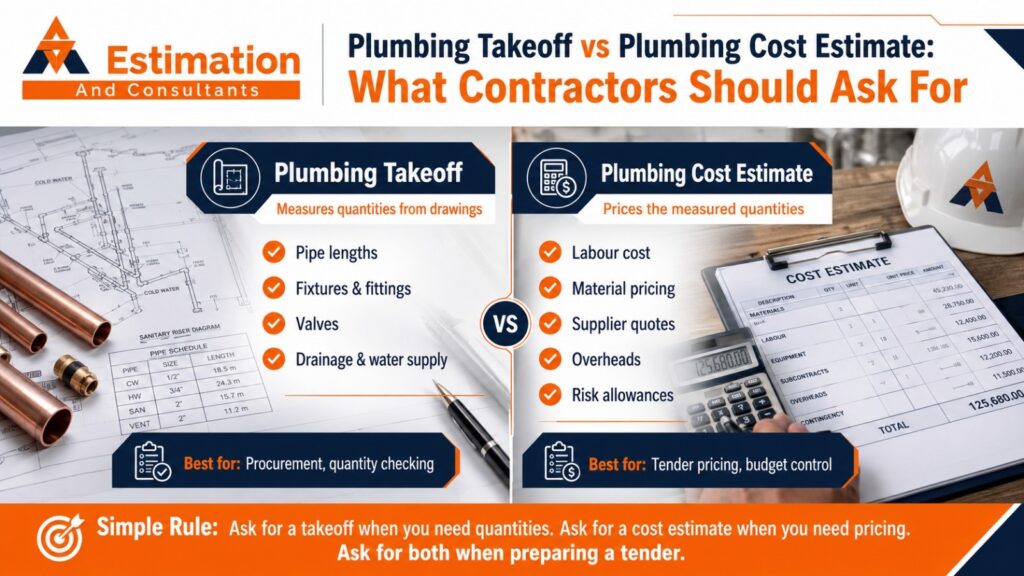
Plumbing takeoffs and plumbing cost estimates are connected, but they are not the same service. A plumbing takeoff follows the quantity takeoff process and measures what is shown in the drawings. A plumbing cost estimate follows the cost estimating process and prices those quantities for tender pricing support.
The main difference between plumbing takeoff and plumbing estimate is the output. If contractors ask for the wrong deliverable, they may get quantities when they need pricing, or pricing without enough quantity detail. Knowing what contractors should ask for in plumbing estimates helps improve construction budget accuracy and reduce tender risk.
What Is a Plumbing Takeoff?
A plumbing takeoff is the quantity takeoff process used to measure and list plumbing items from hydraulic services drawings, project plans, and specifications. It focuses on material quantity extraction, pipework quantity measurement, and plumbing drawings quantity extraction. In simple terms, a plumbing takeoff answers, “How much material is required?” not “What will it cost?”
What a Plumbing Takeoff Should Include
A good plumbing material takeoff should include every key item shown in the drawings. This helps contractors prepare a clear plumbing material schedule before pricing starts.
- Pipework Quantities: Measured pipe lengths for drainage, water supply, gas lines, and other hydraulic services.
- Fixtures and Fittings: Count for basins, toilets, sinks, taps, floor wastes, connectors, bends, and similar items.
- Valves and Accessories: A clear valves and fittings schedule for isolation valves, control valves, backflow devices, and related parts.
- Drainage Systems: Sanitary drainage takeoff and stormwater drainage takeoff based on drawing details.
- Water and Gas Systems: Cold water and hot water systems, plus gas line quantity measurement where required.
When Contractors Should Ask for a Plumbing Takeoff Only
Contractors should ask for plumbing quantity takeoff services when they already have labour rates, material pricing, supplier quotes, margins, and internal pricing systems. In this case, they only need a plumbing quantity list or plumbing BOQ for procurement, contractor quote comparison, quantity checking, and cost control through accurate quantities before moving into full pricing.
What Is a Plumbing Cost Estimate?
A plumbing cost estimate is the cost estimating process used to price the plumbing scope. It uses measured quantities, labour rate calculation, material pricing and supplier quotes, labour productivity assumptions, overheads, preliminaries, and risk allowances. In simple words, a plumbing cost estimate answers, “How much will the plumbing work cost?”
What a Plumbing Cost Estimate Should Include
A proper plumbing estimate breakdown for contractors should show where the money goes. It should not give one lump sum without details. A clear plumbing cost breakdown helps contractors check labour, materials, risk, and scope before they submit a price.
- Material Costs: Supplier prices for pipes, fixtures, fittings, valves, drainage items, and other plumbing materials.
- Labour Costs: Labour hours, labour rates, and plumbing labour productivity are estimated based on project difficulty.
- Allowances and Wastage: Wastage and allowance calculations for cuts, offcuts, damage, and practical site use.
- Overheads and Preliminaries: Site costs, supervision, admin, access, temporary works, and business overheads.
- Risk and Contingency: Contingency and risk pricing for unclear drawings, tight access, missing details, or tender risk.
- Assumptions and Exclusions: Clear scope inclusions and exclusions so contractors know what is priced and what is not.
When Contractors Should Ask for a Plumbing Cost Estimate
Contractors should ask for plumbing cost estimating services when they need tender pricing, budget checks, subcontractor pricing support, or feasibility review. It is also useful for estimating validation before tender, plumbing subcontractor bid review, and plumbing cost benchmarking. A good plumbing pricing estimate improves construction budget accuracy before submission.
Plumbing Takeoff vs Plumbing Cost Estimate: The Main Difference
The main difference is simple: a plumbing takeoff measures quantities, while a plumbing cost estimate prices those quantities. The quantity takeoff process focuses on material quantity extraction from drawings. The cost estimating process then adds labour rate calculation, supplier pricing, overheads, and risk allowances to turn those quantities into a working project price.
A takeoff is the base of the estimate. Without accurate quantities, the final plumbing cost estimate can be weak, even if the rates look right. This is how plumbing takeoffs support cost estimates and improve plumbing estimating accuracy before tender pricing, procurement, or final bid submission.
Simple Comparison Table
A clear plumbing takeoff comparison helps contractors know what they are actually asking for. If they need a plumbing BOQ, procurement-ready materials list, or quantity check, a takeoff may be enough. If they need a plumbing cost estimate for tender submission, they should ask for a full pricing breakdown.
| Item | Plumbing Takeoff | Plumbing Cost Estimate |
| Main Purpose | Measures quantities from plumbing drawings | Prices for the plumbing work |
| Main Question Answered | How much material is needed? | How much will it cost? |
| Main Output | Quantity list, plumbing BOQ, or material schedule | Plumbing estimate breakdown for contractors |
| Includes Labour? | Usually no | Yes, through labour rates and productivity assumptions |
| Includes Supplier Pricing? | Usually no | Yes, if material pricing and supplier quotes are requested |
| Best For | Procurement, quantity checking, and plumbing BOQ preparation for contractors | Tender pricing, budget control, and estimate validation |
| Contractor Benefit | Helps check quantities and prepare procurement-ready materials lists | Helps review scope inclusions and exclusions before submission |
How Plumbing Takeoffs Support Cost Estimates
A cost estimate is only as reliable as the takeoff behind it. If pipe lengths, fittings, fixtures, drainage, or water supply quantities are wrong, the final price can be wrong too. This is how plumbing takeoffs support cost estimates, improve plumbing estimate accuracy, and support cost control before submission.
- Accurate Quantities: The takeoff gives measured pipework, fixtures, fittings, drainage, and water supply quantities for quantity-based pricing.
- Better Cost Control: Cost control through accurate quantities helps contractors avoid underpricing or overpricing the plumbing scope.
- Stronger Budget Accuracy: Reliable takeoff data improves construction budget accuracy because the estimate is built on real, measured quantities.
- Lower Variation Risk: Clear quantities support variation risk reduction by reducing missed items, gaps, and unclear scope.
- Improved Tender Confidence: Good takeoff work gives contractors more plumbing tender submission confidence before sending their final price.
- Cleaner Estimate Review: A detailed takeoff supports estimate checking, plumbing tender risk reduction, and plumbing estimating accuracy improvement.
What Contractors Should Ask For Based on Their Goal
The right plumbing estimating checklist depends on what the contractor needs at that stage. Some jobs only need a plumbing takeoff request for quantities. Others need a plumbing cost estimate request for pricing. For tender pricing support, contractors should also check scope inclusions and exclusions before submission.
Ask for a Plumbing Takeoff If You Need Quantities
Ask for plumbing quantity takeoff services when you only need measured quantities from drawings. This is useful for material quantity extraction, pipework quantity measurement, plumbing BOQ preparation, and plumbing procurement planning with takeoffs. It helps contractors prepare a plumbing quantity list, plumbing material schedule, or procurement-ready materials list before pricing.
Ask for a Plumbing Cost Estimate If You Need Pricing
Ask for plumbing cost estimating services when you need more than quantities. This is the right choice when you need labour rate calculation, material pricing and supplier quotes, overheads and preliminaries, and contingency and risk pricing. A clear plumbing labour and material cost estimate gives you a useful plumbing cost breakdown by system.
Ask for Both If You Are Preparing a Tender
For most tender work, contractors should ask for both a takeoff and a cost estimate. The takeoff gives quantity certainty, while the estimate gives pricing confidence. This supports plumbing tender estimating services, plumbing cost estimate for tender submission, plumbing tender risk reduction, and better plumbing tender submission confidence before the final bid.
Ask for Estimate Validation If You Already Have a Price
If you already have an internal price or subcontractor quote, ask for estimate validation before tender. This helps with plumbing cost benchmarking, contractor quote comparison, plumbing subcontractor bid review, and plumbing scope gap identification. It can also show weak assumptions, missing items, or pricing gaps before they become cost problems.
What Deliverables Should Contractors Request?
Contractors should ask for clear plumbing estimating deliverables before work starts. This avoids confusion between a takeoff, a plumbing BOQ, and a full cost estimate. Good deliverables should show material quantity extraction, scope inclusions and exclusions, and enough detail for estimate validation before tender or final pricing.

Takeoff Deliverables to Request
For takeoff work, contractors should ask for outputs that are easy to check and use for procurement. These may include marked-up hydraulic services drawings, Excel quantity sheets, plumbing BOQ preparation, pipe lengths, fixture counts, fittings, valves, drainage quantities, water supply quantities, and plumbing materials lists from drawings.
- Marked-Up Drawings: Clear plumbing drawings quantity extraction showing what has been measured.
- Excel Takeoff Sheet: A structured plumbing takeoff sheet with pipe lengths, fittings, valves, and fixture and fitting quantities.
- Plumbing BOQ: A clean plumbing BOQ output for quantity checking, pricing, or supplier review.
- Material List: A plumbing material list that supports procurement-ready materials planning.
- System Quantities: Separate drainage and water supply takeoff details for easier checking.
Cost Estimate Deliverables to Request
For pricing work, contractors should ask for a clear plumbing estimate breakdown. It should include labour and material cost estimate details, cost by system, supplier pricing, labour productivity assumptions, wastage and allowance calculations, overheads and preliminaries, contingency and risk pricing, assumptions, inclusions, and exclusions.
- Cost by System: A plumbing cost breakdown by system, such as drainage, water supply, gas, and fixtures.
- Labour Pricing: Labour hours, labour rates, and plumbing labour productivity estimating assumptions.
- Material Pricing: Material pricing and supplier quotes were used to prepare the plumbing pricing breakdown.
- Allowances and Risk: Wastage, preliminaries, overheads, contingency, and risk allowances.
- Scope Notes: Clear inclusions, exclusions, and assumptions for tender review.
- Tender Output: A final plumbing tender estimate output suitable for pricing checks before submission.
Common Mistakes Contractors Make When Asking for Plumbing Estimating Support
Many plumbing estimating mistakes happen before pricing even starts. If contractors do not confirm scope inclusions and exclusions, complete drawings and specifications review, or labour productivity assumptions, the estimate can miss key items. A clear plumbing scope review before pricing supports variation risk reduction and better plumbing tender risk reduction.
Mistake 1: Asking for a Takeoff When You Need a Tender Estimate
A takeoff is useful, but a takeoff is not enough for tender when the contractor needs full pricing. Quantity-only support will not usually include labour rate calculation, material pricing and supplier quotes, overheads and preliminaries, or contingency and risk pricing. For submission, ask for a plumbing cost estimate for tender submission with a clear plumbing labour and material cost estimate.
Mistake 2: Requesting Pricing Without a Scope Review
Pricing without a proper plumbing scope review before pricing can lead to missed items, weak assumptions, and future claims. Contractors should ask for drawings and specifications review, project documentation analysis, scope inclusions and exclusions, and addenda checks before pricing. This helps with plumbing scope gap identification, variation risk reduction, and cleaner estimate inclusions and exclusions.
Mistake 3: Ignoring Labour Productivity Assumptions
Labour cost is not only about hourly rates. A plumbing labour estimate also depends on labour productivity assumptions, access, project type, rough-in and fit-off scope, installation difficulty, and programme conditions. Good plumbing labour productivity estimating helps contractors prepare a stronger plumbing rough-in cost estimate, plumbing fit-off cost estimate, and commercial estimating review.
Questions Contractors Should Ask Before Ordering a Plumbing Takeoff or Estimate
Before ordering support, contractors should ask clear plumbing estimating questions. This helps them know what is included, what is excluded, and what the estimator will review. A good plumbing takeoff checklist or plumbing estimate checklist should cover documents, quantities, pricing, and estimate validation before tender.
Questions About Drawings and Documents
Contractors should ask if hydraulic services drawings, specifications, schedules, addenda, and scope notes will be reviewed before work starts. This matters because plumbing drawings quantity extraction depends on complete project documentation analysis. A proper plumbing scope review before pricing helps reduce missed items, unclear inclusions, and weak tender documents.
- Drawing Review: Will all plumbing and hydraulic drawings be checked before the takeoff starts?
- Specification Check: Will the estimator review specifications, schedules, and project notes?
- Addenda Review: Will updated drawings or tender addenda be included?
- Scope Notes: Will scope inclusions and exclusions be clearly listed?
Questions About Quantities
For takeoff accuracy, contractors should ask what quantity of items is included. A strong plumbing quantity checklist should cover pipework quantity measurement, fixture and fitting quantities, valves and fittings schedule, sanitary drainage takeoff, cold water and hot water systems, gas lines, and BOQ formatting for easier pricing.
- Pipework: Are pipe lengths measured by size, system, and location?
- Fixtures and Fittings: Are fixtures, fittings, valves, and accessories counted separately?
- Drainage and Water Supply: Are drainage and water supply takeoff items clearly separated?
- BOQ Format: Will the quantities be provided in a clear BOQ for contractor review?
Questions About Pricing
For estimate transparency, contractors should ask if the price includes labour rate calculation, material pricing and supplier quotes, wastage and allowance calculations, overheads and preliminaries, contingency and risk pricing, assumptions, inclusions, and exclusions. A clear plumbing estimate breakdown for contractors makes the final plumbing labour and material cost estimate easier to trust.
- Labour Pricing: Are labour hours, rates, and productivity assumptions shown?
- Material Pricing: Are supplier prices or material rate assumptions included?
- Allowances: Are wastage, preliminaries, overheads, and contingency clearly separated?
- Scope Clarity: Are inclusions, exclusions, and assumptions listed in the estimate deliverables?
FAQs
No, a plumbing takeoff is not the same as a plumbing cost estimate. A plumbing takeoff measures quantities from drawings, such as pipe lengths, fittings, fixtures, valves, and drainage items. A plumbing cost estimate uses those quantities to calculate labour, material pricing, overheads, preliminaries, and risk allowances.
The difference between a plumbing takeoff and a plumbing estimate is that a takeoff focuses on quantity, while an estimate focuses on cost. A plumbing takeoff answers, “How much material is needed?” A plumbing estimate answers, “How much will the plumbing work cost?”
A plumbing quantity takeoff includes the measured plumbing items shown in the drawings. This can include pipework quantity measurement, fixture and fitting quantities, valves, sanitary drainage takeoff, stormwater drainage takeoff, cold water and hot water systems, gas lines, and a plumbing BOQ or material quantity list.
A plumbing cost estimate includes the pricing details needed to understand the full cost of the plumbing scope. It may include material pricing, labour rate calculation, labour productivity assumptions, supplier quotes, wastage allowances, overheads, preliminaries, contingency, assumptions, inclusions, and exclusions.
Contractors should ask for a plumbing takeoff only when they already have their own labour rates, supplier prices, margins, and pricing system. A plumbing takeoff is enough when the main need is a plumbing quantity list, procurement-ready materials list, plumbing BOQ, or quantity check from drawings.
Final Recommendation: What Should Contractors Ask For?
Contractors should ask for plumbing quantity takeoff services when they need measured quantities, plumbing cost estimating services when they need pricing, and both when they need plumbing tender estimating services. For tender pricing support, a plumbing takeoff and estimate together improve construction budget accuracy, reduce pricing risk, and build plumbing tender submission confidence.
The simple rule is this: ask for a takeoff when you need quantities, ask for a cost estimate when you need costs, and ask for both when the job is going to tender. Independent plumbing estimating services or a hydraulic services estimator can also help with plumbing tender risk reduction before submission.