What’s Included in a Landscaping/Hardscaping Estimate? It should do more than give you one total. A proper landscaping estimate or hardscaping estimate shows what a landscaping quote includes, what’s excluded, and why the price is built the way it is. Two quotes often differ because of cost drivers like materials, access, and ground conditions. In this quick landscaping estimate breakdown, you’ll learn what to check, how to spot gaps in landscaping quote inclusions, and what hardscape estimate line items should look like before you sign.
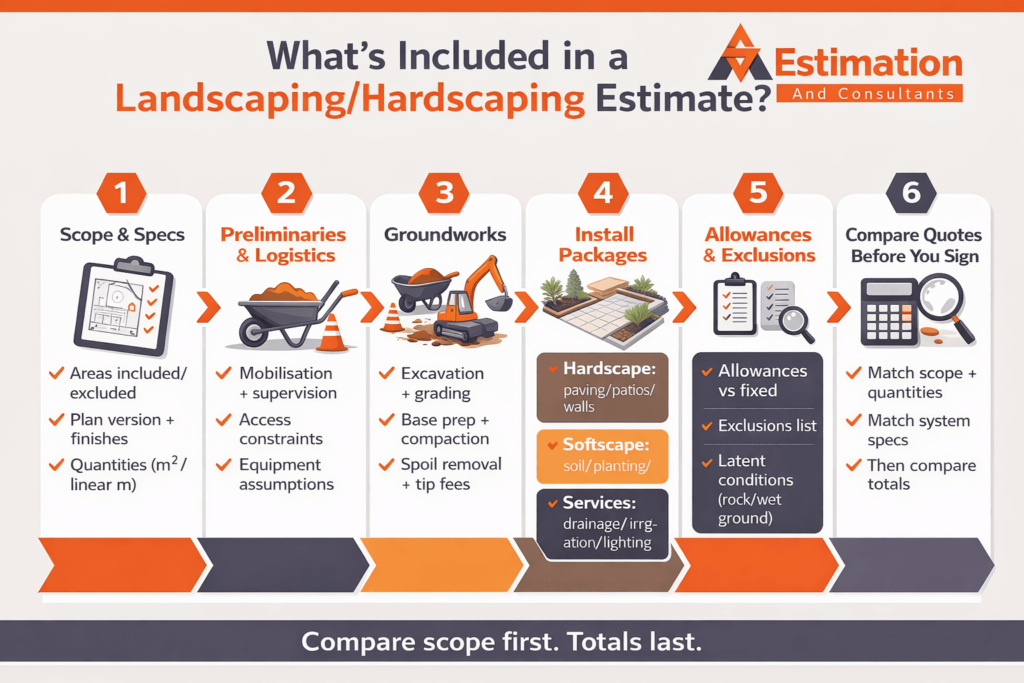
Scope and specifications (what you’re actually pricing)
Your estimate starts with the landscape quote scope—the page that defines the job. It lists what’s in and out, the drawing version, and the areas covered. It also shows finishes, material quantities, and whether pricing is supply only or supply-and-install. This is the backbone of any landscaping estimate breakdown today.
- Areas Included (and Not Included): Confirm the exact zones—front yard, side path, backyard, driveway edges—plus clear scope inclusions and exclusions so you don’t pay for work you didn’t ask for.
- Plans, Version, and Staging: The quote should name the drawing/version and note any staged landscaping works (Phase 1, Phase 2). If staging isn’t stated, timelines and costs can drift.
- Measurements You Can Check: Look for m² and linear metres for each item—paving area, garden bed length, edging runs. Solid material quantities make estimates easier to compare.
- Product Names and Finish Levels: “Concrete pavers” is vague. You want brand/range, size, thickness, and finish. This keeps the paving quote inclusions honest and prevents downgrades.
- System Details for Paving and Patios: A proper paving and patio cost estimate should state base thickness, bedding layer, compaction, and edge restraints—not just the visible paver.
- Retaining Wall Basics: For any wall, confirm type, wall height, and what’s included for structure. These basics drive the retaining wall cost breakdown and stop surprise add-ons later.
2) Preliminaries and site logistics (setup, access, equipment)
Preliminaries are the real setup costs that make the job possible, even if you can’t “see” them later. A good quote lists mobilisation, supervision, deliveries, and site protection. It also prices access limits and whether the crew can use machines or must do handwork—big drivers of access and equipment costs in landscaping.
- Mobilisation and Setup: Covers getting people, tools, and machinery to site, plus initial set-out and safety prep. This is a key part of landscaping preliminaries.
- Supervision and Site Management: Includes the foreman’s time, coordination with other trades, and daily job control. It protects quality and keeps downtime down.
- Deliveries and Handling: Accounts for drop-offs, forklift needs, manual carrying distances, and stacked deliveries. Poor access usually increases labour time.
- Protection and Temporary Works: Think driveway protection, fencing, covering lawns, and keeping paths usable. These are typical overhead and preliminary items.
- Access Constraints and Allowances: Quotes should state any access allowance landscaping—narrow gates, stairs, shared driveways, or no machine access.
- Machine vs Handwork (Productivity Impact): If machines can’t get in, labour hours rise. That’s a labour productivity issue, and it changes the price fast.
3) Groundworks (site prep, excavation, grading, disposal)
Groundworks are where budgets can jump, because you only see the full picture once you start digging. A clear earthworks landscaping quote spells out excavation, cut and fill, base prep, and compaction. It also lists spoil removal, tip fees, and any assumptions around ground conditions—key excavation and site preparation costs.
- Site Prep and Strip-Out: Covers removing old turf, roots, rubble, or existing pavers before new work starts. This is part of site preparation and excavation.
- Excavation and Cut/Fill: Includes digging to set depths, moving soil around the site, and balancing levels. It’s a common source of surprise in grading costs for landscaping.
- Soil Preparation and Grading: Focuses on shaping falls, levelling for turf, and preparing garden beds. Good quotes describe soil preparation and grading costs clearly.
- Base Prep and Compaction: Paving and patios need the right base thickness and compaction. If the base is vague, the hardscape may fail later.
- Spoil Removal and Cart-Away: States how much material is removed, where it goes, and whether the price includes loading and hauling. These are disposal and cart-away costs.
- Tip Fees and Unknowns: Tip fees can vary, and rock or wet ground can add time. Quotes should state what’s assumed and what becomes a variation.

4) The install packages: hardscape, softscape, and services
This section is where most of the budget usually sits. A solid quote groups the main landscaping installation pricing into clean install packages so you can see what’s included and compare it properly. It should also make the hardscape vs softscape cost differences obvious, because those two buckets behave differently on cost, labour, and risk.
Hardscape: paving, patios, retaining walls
Hardscape should be priced as a system, not just a surface finish. A proper hardscaping cost estimate spells out how the paving and patio systems are built—base layers, bedding, compaction, edge restraints, and jointing—because that’s what controls durability. For retaining wall construction, the quote should state wall type and height plus drainage and backfill assumptions. If those are vague, the retaining wall cost breakdown can change quickly once work starts.
- Paving/Patio System Build-Up: Base thickness, bedding layer, compaction standard, edge restraints, and jointing (this is the backbone of a paving and patio cost estimate).
- Retaining Wall Inclusions: Wall type, height, footing/base details (where applicable), drainage behind the wall, and backfill materials (clear retaining wall estimate inclusions).
Softscape: soil, planting, turf
Softscape pricing is mostly about preparation and specification. Clear garden landscaping pricing includes soil preparation and grading, soil blends, and mulch depth before planting and turfing. It should list plant sizes and densities, plus what “installed” means (staking, fertiliser, initial watering). For turf, a good turf installation estimate calls out turf type, base prep, levelling, and whether any replacement policy or establishment allowance is included. This is where turf and planting costs vary widely between quotes.
- Soil Prep and Grading: Levels, falls, imported soil quantities, and how areas are finished (ties back to long-term turf performance).
- Planting Spec Detail: Plant sizes, spacing/densities, mulch depth, and install inclusions (strong planting quote inclusions reduce disputes).
- Turf Scope Clarity: Turf variety, base prep, levelling, supply vs install, and establishment expectations.
Services: drainage, irrigation, lighting (if included)
Services must be clearly defined or clearly excluded—no grey area. Drainage and subsoil works should specify drain type (surface vs subsoil), pits/grates, pipe runs, and discharge location. That’s what makes drainage installation pricing real, not a placeholder. Irrigation installation should list zones, controller, trenching, connections, and commissioning; otherwise an irrigation system cost estimate is hard to compare. If outdoor lighting is included, the quote should separate fixtures from cabling and transformer allowances so you know what’s actually covered.
- Drainage Scope: Drain type, pit/grate locations, pipe runs, outlet/discharge assumptions (clear drainage cost landscaping terms).
- Irrigation Scope: Zone count, controller, trenching, connection assumptions, and commissioning (solid irrigation quote inclusions).
- Lighting Allowances: Fixture allowance vs cabling, transformer, trenching, and testing (clean outdoor lighting cost estimate details).
Before we get into allowances and exclusions, here’s a quick mid-job checklist you can use to sanity-check any landscaping or hardscaping quote.
| Estimate section | What should be included | What to ask / common gaps |
| Scope and specifications | Areas included: drawing/version, finishes, material quantities, supply vs install, staging notes | Is this priced off the latest plan/version? Are m²/linear metres shown? Are product specs clear (thickness, wall height, edge restraints)? |
| Preliminaries and site logistics | Mobilisation, supervision, deliveries, protection, access, and equipment allowances, productivity assumptions | What access is assumed (gates, stairs, shared driveway)? Machine access or handwork? Any remobilisation or multiple-visit costs? |
| Groundworks | Site preparation and excavation, cut/fill, base prep, compaction, spoil removal, tip fees | How much disposal is included? Are excavation depths/base thicknesses stated? What happens if rock, wet ground, or soft spots are found? |
| Hardscape (paving/patios/retaining walls) | Paving and patio systems (base, bedding, compaction, edge restraints, jointing), retaining wall construction, plus drainage/backfill assumptions | Is the base build-up included or treated as an allowance? Are falls/levels included? For walls: type, height, drainage, and backfill included? |
| Softscape (soil/planting/turf) | Soil preparation and grading, soil blends, mulch depth, planting and turfing specs (sizes/densities, turf type) | What does “installed” include (staking, fertiliser, initial watering)? Is the topsoil depth stated? Any establishment or replacement policy? |
| Services (if included) | Drainage and subsoil works, irrigation installation, lighting allowance, commissioning/testing | Is the drainage type and discharge point defined? Are irrigation zones/controllers included? Is commissioning/testing included or excluded? |
| Allowances and exclusions | Scope inclusions and exclusions, allowances vs fixed prices, contingency allowances, latent conditions, variation process | Is the drainage type and discharge point defined? Are irrigation zones/controllers included? Is commissioning/testing included or excluded? |
5) Allowances, exclusions, and how to compare quotes
This is the “fine print” section, and it decides whether two prices are truly comparable. A clear quote separates fixed prices from contingency allowances, lists scope inclusions and exclusions, and calls out weather and site condition risks. If you skip this, you can’t fairly compare landscaping quotes or trust the total.
- Allowances vs Fixed Prices: An allowance is a placeholder, not a final cost. Ask what it covers, what rate applies if it changes, and how it will be measured (this is the heart of allowances and exclusions in landscaping quotes).
- Clear Exclusions List: Look for landscaping quote exclusions like electrical upgrades, council approvals, repairs to unknown services, or reinstatement beyond the work area. Missing exclusions usually become surprises later.
- Latent Conditions (Rock and Unknown Ground): Quotes should state what happens if rock, wet soil, or soft spots show up. These are common weather and site condition risks, and they can change time and machinery needs.
- Contingency Allowance (Budget Safety): A landscaping contingency allowance is there to protect you from known unknowns. It should be clearly labeled and not blended into other line items.
- Apples-to-Apples Comparison Checklist: To compare landscaping quotes, match them on scope, quantities, product specs, base build-ups, drainage/irrigation inclusions, and who carries disposal and tip fees. This is how you do real comparing landscaping estimates.
- Variation Rules in Writing: The quote should explain how changes are priced and approved (rates, margins, and sign-off). If the variation process is vague, costs can creep up without control.
FAQs
Most do, but you need to confirm whether it’s supply-only or supply-and-install. A proper landscaping estimate breakdown should clearly show labour and material costs for landscaping, plus any access and equipment allowances that affect time on site.
A fixed price is locked in for a defined scope. An allowance is a placeholder used when the exact product, quantity, or site condition isn’t confirmed yet. If the allowance is too low, you pay the difference later, so always ask what it covers and what rate applies if it changes.
Common landscaping quote exclusions include council approvals, repairs to hidden services, electrical upgrades for lighting, removal of contaminated soil, and fixing damage outside the work zone. If exclusions aren’t written down, it’s harder to hold the scope inclusions and exclusions steady.
Most differences come from scope detail, material quantities, and assumptions about ground conditions and access. One contractor may include full excavation and disposal, and another may only allow a small amount. Differences in paving and patio systems or retaining wall construction details also change the hardscaping cost estimate.
Start by matching the scope page line by line. Make sure both quotes include the same earthworks, base prep, disposal, and cart-away costs, and the same product specs for paving, turf, and plants. Then compare allowances and exclusions in landscaping quotes, because that’s where hidden gaps usually sit.
Yes, a landscaping contingency allowance is normal when weather and site condition risks exist, like unknown rock or poor drainage. The right amount depends on how many unknowns are still in play. The key is that it should be clearly labelled, not buried inside other line items.
Conclusion
Before you sign, take one last minute to confirm the scope and the numbers match what you think you’re buying. Read the scope inclusions and exclusions line by line, check that key quantities are stated, and make sure allowances are clearly separated from fixed prices. Then confirm drainage and irrigation are either included with clear detail or clearly excluded. If you’re comparing landscaping quotes, align scope, quantities, allowances, and exclusions first—only then compare totals, so you’re comparing landscaping estimates properly. If you want a second set of eyes before you commit, AS Estimation & Consultants can review your landscaping/hardscaping estimate, flag missing items, and help you compare quotes like-for-like so you can sign with confidence.