Most people use carpentry cost per m² because it gives a simple way to plan a budget and compare quotes. It shows the real mix of labour and materials pricing, and helps homeowners and builders understand what they’re paying for.
In 2025–26, prices have shifted with inflation and material changes, so having an updated carpentry cost estimate matters. Using m² rates makes it easier to check typical costs for residential carpentry jobs across Australia and avoid surprises later.
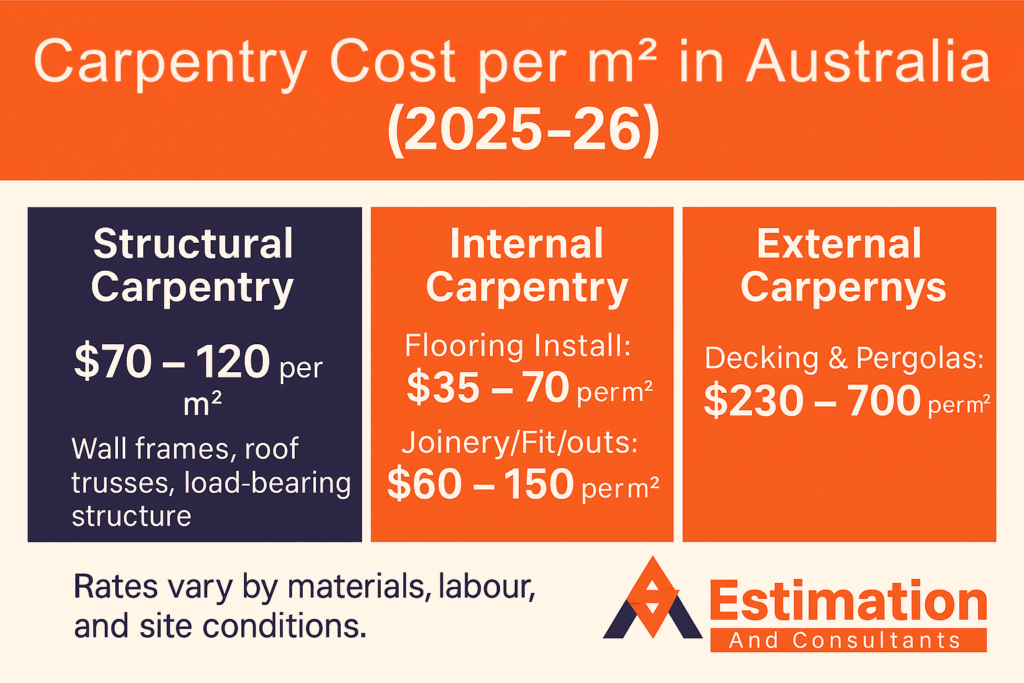
National Average Carpentry Costs per m²
National averages help you understand what typical carpentry work costs across Australia. These m² rates give a simple baseline for planning a project in 2025–26, especially when labour and material prices change from region to region. A clear table makes it easier to compare different types of carpentry work before requesting quotes.
Carpentry m² pricing usually falls into three groups: structural framing, internal finish carpentry, and external work like decks or pergolas. Each group has its own cost pattern because the materials, labour hours, and level of detail vary.
Structural Carpentry (Framing)
Structural carpentry covers the main framework of a building, including load-bearing wall frames, roof trusses, and structural supports. These jobs rely on skilled labour and steady material prices, so m² rates often stay consistent across most regions. The phrase framing carpentry cost per m² is commonly used because it gives a clear estimate for early-stage construction work.
This section typically includes the frame installation cost, which can shift based on timber type, layout complexity, and the size of the build.
Internal Carpentry (Flooring, Joinery, Fit-outs)
Internal finish carpentry includes the work that completes the inside of a home, such as skirting boards, door installations, timber flooring, and basic joinery. These tasks vary in price depending on the level of finish and the materials chosen. Many people search for the cost to install timber flooring per m² because flooring is one of the biggest internal expenses.
Internal m² rates also cover work listed under joinery and finish carpentry cost, making it easier to estimate fit-out stages during a renovation or new build.
External Carpentry (Decks, Pergolas, Cladding)
External carpentry involves building outdoor structures like decks, pergolas, and cladding, all of which must handle weather exposure. This is why m² rates for outdoor work are usually higher. Homeowners often compare the deck carpentry rate per m² when choosing between hardwood, softwood, or composite decking.
You’ll also see terms like external carpentry cost estimate or outdoor carpentry cost, which help set expectations for labour, treatment materials, and weatherproofing work.
2025–26 Australia-Wide Estimated Ranges
| Carpentry Work Type | Estimated Cost per m² (Australia 2025–26) | What This Covers |
| Structural Carpentry (Framing) | $70 – $120 per m² | Wall frames, roof trusses, load-bearing structures; based on timber type + layout complexity. |
| Internal Carpentry – Flooring (Install Only) | $35 – $70 per m² | Labour for timber flooring install; excludes cost of materials. |
| Internal Carpentry – Joinery & Fit-outs | $60 – $150 per m² | Skirting, doors, trims, simple cabinetry, internal finish carpentry. |
| External Carpentry – Timber Decking (Labour + Material) | $250 – $450 per m² (treated pine) | Standard deck on flat ground, basic framing, basic fixings. |
| External Carpentry – Timber Decking (Premium Hardwood) | $350 – $700 per m² | Hardwood decking, stronger framing, oil/seal finish. |
| External Carpentry – Composite Decking | $300 – $700 per m² | Composite boards, upgraded fixings, subframe variations. |
| External Carpentry – Pergolas / Outdoor Structures | $230 – $450 per m² | Timber pergolas, posts, rafters, simple roofing sheets. |
Renovation vs New Build Carpentry Costs
Renovation carpentry almost always costs more per m² because the work happens inside an existing structure, where carpenters must remove old materials, work around limited access, and fix hidden issues before new work can start. New builds, on the other hand, are done in open, empty spaces with no demolition or rework, so the labour moves faster and stays more predictable.
- Renovations: Access Limits — Tight hallways, lived-in rooms, and existing walls slow workers down and raise renovation carpentry m² rates.
- Renovations: Old Material Removal — Floors, trims, framing, or damaged sections must be stripped out before new work begins.
- Renovations: Rework & Corrections — Uneven old framing, outdated DIY work, or hidden damage add extra labour.
- New Builds: Clean Work Environment — Carpenters start on blank frames, making installation faster and cheaper per m².
- New Builds: Predictable Workflow — No demolition, no surprises, and consistent measurements keep costs steady.
- Renovations: Extra Waste Handling — Pulling out old materials means more waste and more disposal costs.
State-by-State Carpentry Cost Variation (Australia-Wide Breakdown)
Carpentry costs vary across Australia because each state has different labour availability, transport distances, and supply conditions. Metro areas generally sit at the higher end of residential carpentry rates, while regional towns can be cheaper but may have fewer skilled carpenters and slower material delivery.
Eastern States — NSW, VIC, QLD
Carpentry m² rates in the eastern states are usually higher because these areas have strong demand, dense metro zones, and busy renovation markets. Cities like Sydney, Melbourne, and Brisbane rely heavily on skilled labour, which pushes up residential carpentry rates Australia-wide, especially compared to regional centres.
- Higher Metro Rates — Large cities charge more due to demand, traffic, and higher labour pressure.
- Regional Price Gaps — Smaller towns often have lower costs but limited carpenter availability.
- Stable Material Supply — Better transport routes keep material prices more predictable.
- Heavy Renovation Demand — Older suburbs increase renovation workloads and hourly rates.
- Competitive Market — Many contractors mean pricing varies widely from suburb to suburb.
- Faster Lead Times — Carpenters are easier to find in metro areas, but at a higher price.
Western & Southern States — WA, SA, TAS, NT
These states often face higher carpentry costs in regional and remote areas due to long transport routes and lower labour availability. Residential carpentry rates Australia-wide rise sharply in places where materials must travel further or where skilled trades are limited, especially in the NT and remote WA.
- Long Transport Routes — Materials shipped long distances increase overall m² rates.
- Labour Shortages — Fewer carpenters means higher hourly and project pricing.
- Remote-Area Costs — Travel, freight, and accommodation add to carpentry project costs.
- Limited Supplier Options — Fewer timber and hardware suppliers reduce price competition.
- Climate Impacts — Harsh weather slows external carpentry work and raises labour hours.
- Higher Freight Charges — Decking, framing timber, and fixings often cost more due to shipping.
Key Factors That Influence Carpentry m² Costs
Carpentry m² rates vary because every project has different materials, labour needs, and site conditions. The quality of timber, the skill level required, and how easy the site is to work on all play a major role in the final carpentry labour and materials cost Australia for both standard and custom carpentry cost per m² work.
- Material Quality & Timber Choice — Higher-grade timber, hardwood, or specialty materials increase cost due to quality and durability demands.
- Labour Skill Level — Complex designs or detailed finishing work require more experienced carpenters, raising overall labour and materials pricing.
- Project Complexity — Custom layouts, unusual shapes, or precision joinery often push m² rates higher.
- Site Conditions — Uneven floors, tight access, or multi-storey worksites slow progress and increase labour hours within the project scope.
- Accessibility Issues — Limited entry points, stairs, or occupied spaces make installations more time-consuming.
- Preparation & Fixing Work — Extra tasks like levelling, correcting old framing, or fixing hidden damage act as major cost influencers in carpentry.
How to Estimate Your Own Carpentry Cost per m² (Step-by-Step Method)
Estimating your own carpentry cost per m² is simple when you break the job into clear steps. By measuring the area, choosing your materials, and applying realistic unit rates, you can build a reliable carpentry cost estimate and understand exactly how to estimate carpentry cost per m² for any project.
- Measure the Area — Start by measuring the full length and width of the space to calculate total square metres.
- Select Materials — Choose your timber type or finish level, since materials have the biggest impact on DIY cost estimating carpentry.
- Apply Unit Rates — Use current m² rates for your job type, such as framing, flooring, or decking.
- Add Labour Costs — Include realistic labour rates based on task complexity and state pricing.
- Include Waste Allowance — Add 5–15% for offcuts, mistakes, or unusable materials.
- Add Margin & Extras — Small items like fixings, sealants, and delivery fees help complete your carpentry cost estimate accurately.
FAQs
The average carpentry cost per square metre in Australia usually falls between $70 and $700 per m², depending on the type of work. Structural framing is on the lower end, while decking, pergolas, and external timber work sit at the higher end because they require more labour, stronger materials, and weatherproofing.
Carpentry prices change because each project needs different materials, labour skills, and preparation work. Timber quality, layout complexity, site access, and whether the job is a renovation or new build all affect the final cost. Harder-to-reach work areas or custom designs usually raise the m² rate.
Yes, framing carpentry is usually cheaper because it’s structural work completed early in the build with fewer finishing details. Internal work like joinery and flooring takes more precision, while external work like decking requires weather-resistant materials—so those m² rates are higher.
Renovation carpentry costs more because carpenters need to work around existing walls, tight spaces, and hidden issues. They often remove old materials, fix uneven framing, manage dust, and work in lived-in spaces. All these slow down labour and increase the per-m² rate compared to a clean new build.
A basic treated-pine deck normally costs $250 to $450 per m², while hardwood ranges from $350 to $700 per m². Composite decking often sits between $300 and $700 per m². The final price depends on board type, height above ground, subframe strength, and fixing choices.
Conclusion
Understanding carpentry cost per m² gives you a clearer picture of what your project will realistically require in materials, labour, and time. With prices shifting across Australia in 2025–26, having accurate numbers upfront helps you avoid surprises and plan with confidence.
If you want a precise, project-specific carpentry cost estimate—not a rough average—AS Estimation & Consultants can prepare a detailed breakdown for you. Our estimates are tailored to your scope, location, materials, and budget so you can move forward with clarity.Need an accurate carpentry estimate for your project?
Get in touch with AS Estimation & Consultants and we’ll calculate it properly for you.