Structural steel pricing continues to shift across Australia, and most teams now work with a cost range rather than a fixed number. The current structural steel cost per tonne in Australia sits within a band shaped by material supply, fabrication load, and transport conditions. Trends from late 2024 into 2025 show steady increases in mill pricing and workshop rates, which now form the base for 2025 structural steel pricing. These inputs also shape early expectations for the steel price per tonne in Australia 2026, where mild escalation is more likely than a major change. Using a flexible range helps set safer budgets and reduces cost risk on new projects.
Breakdown of ALL Inputs That Drive Cost Per Tonne
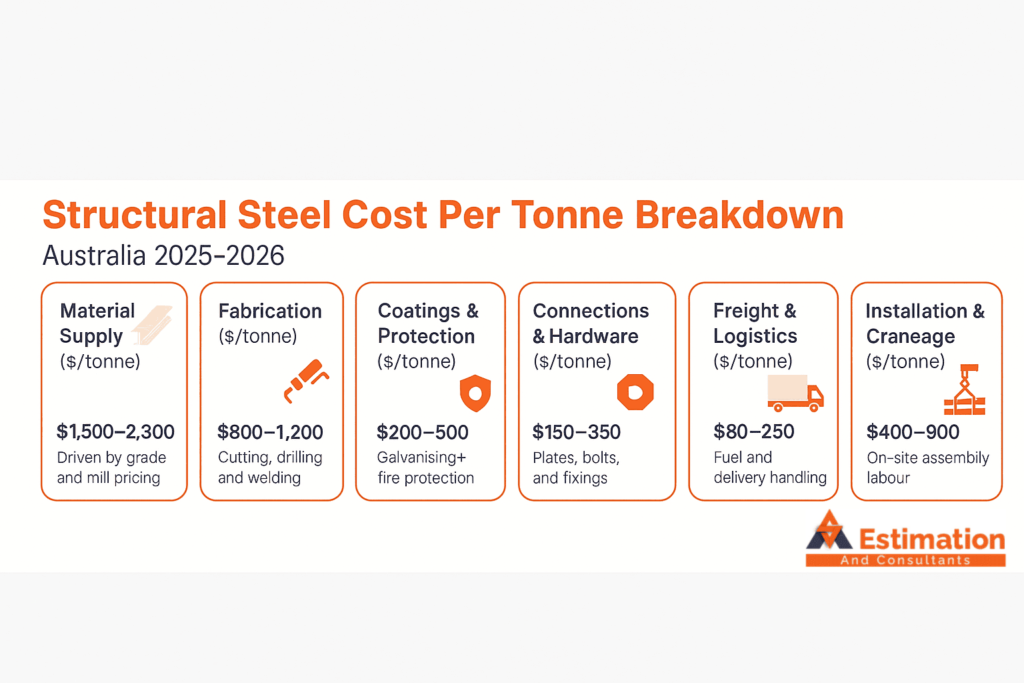
Each of the items below is a real cost contributor for structural steel pricing in Australia. We separate them so you see exactly what adds to the cost per tonne — no overlap, no noise.
Base Steel Material Cost ($/Tonne)
Base material cost is the starting point for any steel estimate. In recent industry data, raw structural steel in Australia ranged roughly from AUD $1,500 to $2,300 per tonne for mild steel, with higher grades or corrosion-protected versions costing more. Higher strength or specialised steel attracts a premium, and mills adjust their price based on international commodity indexes, input costs, and supply conditions. These steel grade cost differences form the foundation of the material cost portion of the total rate.
Fabrication & Workshop Processing Cost ($/Tonne)
Once the material is on site, fabrication turns it into usable components. Workshops charge for cutting, drilling, profiling, and welding. Complex shapes and tight tolerances increase labour hours, which raises the fabrication cost per tonne. In Australia, fabricators also balance labour availability and workshop utilisation, which affects quoted rates and lead times. These processes add a significant amount to the raw material price and should always be included in your per-tonne estimate.
Coatings & Fire Protection Cost ($/Tonne)
Coatings protect steel from corrosion and meet fire-rating requirements. Galvanising and specialised coatings such as intumescent paint carry additional cost per tonne. Galvanising typically increases the cost relative to uncoated steel, and real-world pricing must reflect this. Coastal or harsh environments generally require higher specifications, which pushes the coatings and corrosion protection costs higher per tonne.
Connections, Plates, Bolts & Hardware ($/Tonne Equivalent)
Fittings and hardware might seem small, but they add up across a structural package. Bolts, brackets, plates, and gussets all contribute to the overall weight and labour associated with installation. These items are tracked under steel connection components cost and often increase the effective cost per tonne when fully loaded into an estimate.
Delivery, Freight & Logistics Cost ($/Tonne)
Transport cost varies by region, load size, and handling needs. Freight and logistics costs can be higher in regional areas and for oversized structural pieces. These transportation charges are an important part of the delivered freight and logistics cost for steel and change what you pay per tonne on site. Each kilometre and handling step adds to the total.
Installation, Craneage & Site Labour ($/Tonne Installed)
Bringing steel into place adds another layer of cost. Crane time, riggers, site access, and weather delays all affect the final installed rate. These charges are part of fabrication and installation pricing, and they vary by city versus regional locations as well as by project complexity. This installation cost per tonne can be one of the largest contributors beyond material and fabrication.
Domestic vs Imported Steel: Cost Per Tonne Comparison
In Australia’s current steel market, choosing between locally made and imported steel changes what you pay per tonne. Imported products often appear cheaper at first, but real landed costs and compliance requirements adjust that figure quickly. Knowing how these costs stack up helps you budget more accurately under the structural steel cost estimating per tonne in Australia lens.
Base Price Difference ($/Tonne: Local vs Offshore)
The basic price gap between Australian and imported steel is real. Imported steel is often quoted at lower direct mill prices because overseas producers can leverage bigger supply chains and lower labour or energy costs. That can translate into a lower domestic vs imported steel cost baseline before any extra expenses are added. But in many cases, the local market has suffered from competition with low-priced imports, and peak industry groups have raised concerns about cheap fabricated steel undercutting Australian producers’ viability.
Local producers such as BlueScope and InfraBuild operate with strict regulatory, safety, and quality regimes that can make raw prices higher but reduce risk for projects needing consistent compliance and shorter lead times.
Freight, Shipping & Currency Effects ($/Tonne Landed Cost)
Cheap base prices don’t tell the whole story. Once steel arrives in Australia, landed costs can increase due to shipping, port fees, and customs handling — all part of the freight and logistics cost for steel. Bigger shipping rates, slower unloading, or inland transport to regional sites push costs up quickly.
Exchange rates also matter. Imported steel and its feedstocks are priced internationally, so fluctuations in the value of the Australian dollar influence the final landed cost. When the dollar weakens, more money is needed to pay for imported tonnes, eroding the initial price advantage.
Compliance & Rework Risk Added to Cost Per Tonne
Imported steel must comply with Australian standards and safety requirements. Meeting AS/NZS codes means checking chemical composition, structural performance, testing, and certification. If imported stock fails any test, rework or replacement is required — and that adds to the real price per tonne.
Compliance risks come from regulatory differences overseas and incomplete documentation on arrival. These hidden costs are often overlooked when comparing raw prices. Factoring them into your structural steel estimating guide produces a more accurate total cost per tonne for your project.
Structural Steel Cost Forecast (2025–2026): Cost Per Tonne Outlook
Structural steel prices in Australia are expected to remain firm through 2025 and into 2026. Market conditions show steady demand across commercial and industrial work, combined with ongoing pressure from labour, freight, and energy costs. These factors influence the final cost per tonne and shape the ranges that estimators now use when preparing budgets.

Variables That Will Change Cost Per Tonne
Several inputs will affect structural steel pricing over the next 18 months. Movements in iron ore and global steel supply affect mill rates, while labour conditions and fabrication capacity shape local workshop pricing. Freight, shipping delays, and exchange rates also influence final material costs. These inputs are tracked across market price indices (2025–26) and work together to guide the 2026 steel price forecast used in early estimating.
For most projects, the key drivers will be workshop utilisation, coating requirements, fuel costs, and overall demand from infrastructure work. When any of these rise, the cost per tonne increases. When they stabilise, pricing moves within a narrower band.
Price Range Scenarios (Low / Base / High) for 2025–2026
Based on current market conditions, the forecast for structural steel cost per tonne in Australia can be grouped into three practical scenarios. These ranges help project teams plan for real outcomes rather than fixed numbers, because steel pricing shifts with supply and labour changes.
- Low Scenario: AUD $1,900–$2,300 per tonne
This assumes stable supply, lower freight pressure, and adequate fabrication capacity. - Base Scenario: AUD $2,300–$2,800 per tonne
This reflects the most common pricing seen across Australian fabricators in 2024–2025 and is the safest range for planning. - High Scenario: AUD $2,800–$3,400+ per tonne
This applies when labour shortages, high freight costs, or limited supply increase workshop rates.
These ranges support early design budgets and reduce the risk of underestimating costs. Using the steel price forecast Australia scenarios ensures your estimate stays aligned with market behaviour as conditions change.
How to Accurately Estimate Structural Steel Cost Per Tonne for Your Project
Estimating structural steel costs begins with knowing your actual tonnage, then applying each cost input in a clear stack. Material, fabrication, coatings, logistics, and installation each add to the per-tonne figure. Using structured allowances and escalation helps keep budgets safe as market conditions shift.
Key Steps to Build an Accurate Cost-Per-Tonne Estimate
- Identify the Correct Tonnage
Accurate tonnage estimation is essential. Even small weight errors change the final rate, which affects how to estimate structural steel cost for early budgets. - Start With Material and Supply Costs
Base your estimate on current steel supply cost ranges and match the grade to your project. Material shifts impact every tonne. - Add Fabrication Requirements
Cutting, drilling, and welding shape the fabrication cost. Complex members or tight tolerances increase per-tonne pricing. - Include Coatings and Protection
Galvanising or fire protection adds to structural steel supply and fabrication costs and must be included per tonne. - Allow for Freight and Installation
Delivery distance, crane hire, and site labour add real weight to the tonne rate and must be built in from the start. - Apply Risk and Escalation Margins
Use estimating risk allowances to cover labour changes, freight pressure, and market shifts. This follows a practical structural steel estimating guide.
Quick Reference Table: Cost Per Tonne Breakdown (Australia 2025–2026)
Understanding where money goes in a steel estimate helps you set a reliable budget quickly. This breakdown shows how material, fabrication, and other key cost inputs contribute to the structural steel cost per tonne you will use in tendering or feasibility.
| On-site assembly, riggers, and cranes. | Typical $/Tonne (AUD) | Notes (Australia Market) |
| Material Supply | $1,500 – $2,300 | Mild steel; raw steel pricing varies with global supply and mill costs. |
| Fabrication (Workshop) | $800 – $1,200+ | Standard fabrication labour and processing. Complex jobs can exceed this. |
| Coatings (Galvanising, Paint) | $200 – $500 | Protective finishing adds to the base rate. |
| Connections & Hardware | $150 – $350 | Bolts, plates, brackets, gussets and fixings. |
| Freight & Logistics | $80 – $250 | Transport from workshop to site; regional premiums. |
| Installation & Craneage | $400 – $900 | On-site assembly, riggers, cranes. |
How These Numbers Work Together
- Material Supply represents the base steel you buy from mills or distributors. In Australia, this is typically quoted around $1,500–$2,300 per tonne for mild structural steel, depending on market movements.
- Fabrication adds the cost of cutting, drilling, welding, and shaping your steel — for standard structural packages this is commonly $800–$1,200 per tonne.
- Coatings and hardware (like bolts and plates) don’t add much weight, but they add cost — often hundreds of dollars per tonne when included in totals.
- Freight & Logistics depends on location; moving heavy steel around Australia adds real cost per tonne.
- Installation & Craneage represent labour and equipment on site, which often pushes the installed $/tonne into the $3,000–$5,000 range when fully delivered and erected.
FAQ
Most projects in 2025 use a working range of $2,300–$2,800 per tonne for material plus standard fabrication. Costs vary by grade, workshop load, and coatings. Regional delivery or complex fabrication can shift this range upward when planning early budgets.
Current signals suggest mild escalation into 2026. Expected movement is generally 3–7%, driven by labour rates, energy pricing, and freight. No major drops are forecast unless global steel supply increases or shipping costs fall. Most estimators keep a small escalation allowance per tonne.
Fabrication adds cutting, drilling, welding, and shaping, which requires significant labour time. When workshops are busy, labour rates increase, raising the per-tonne fabrication cost. Complex members or tighter tolerances amplify these hours, making fabrication one of the largest contributors to the total cost per tonne.
Imported steel can have a lower base price, but freight, currency shifts, port delays, and compliance testing often increase the landed cost per tonne. Local steel is usually more predictable and may be more economical once these additional risks and handling costs are included.
Coatings such as galvanising or fire protection add $200–$500 per tonne on average. Requirements depend on exposure, durability, and project standards. More demanding environments or thicker protective systems increase the cost. Coatings also add handling steps, which slightly increase labour and turnaround times.
Conclusion
Understanding the structural steel cost per tonne helps you plan with confidence as the market moves through 2025 and into 2026. While prices change with material supply, fabrication demand, coatings, freight, and installation, working with clear cost ranges keeps your budget steady. Using realistic assumptions, allowing for escalation, and basing estimates on accurate tonnage will reduce risk and prevent cost shocks later in the project. A structured cost estimating approach is the best way to manage steel pricing in a market that continues to shift.