If you’re trying to budget a repaint in 2026, this guide gives you clear benchmark rates and a simple way to estimate your own costs. You’ll get practical ranges for interior, exterior, and ceilings, plus an easy method to compare quotes without getting lost in vague wording.
This is for homeowners, investors, and small builders who want a reliable starting point. Every painting cost per m² Australia figure depends on assumptions—prep level, access, coats, and finish—so we’ll spell out estimator guidelines and scope inclusions/exclusions as we go. Use this as your 2026 painting pricing guide for painting cost per square metre Australia, then confirm your final number with itemised quotes from local painters.
2026 Snapshot Rates Per m² (Interior, Exterior, Ceilings)
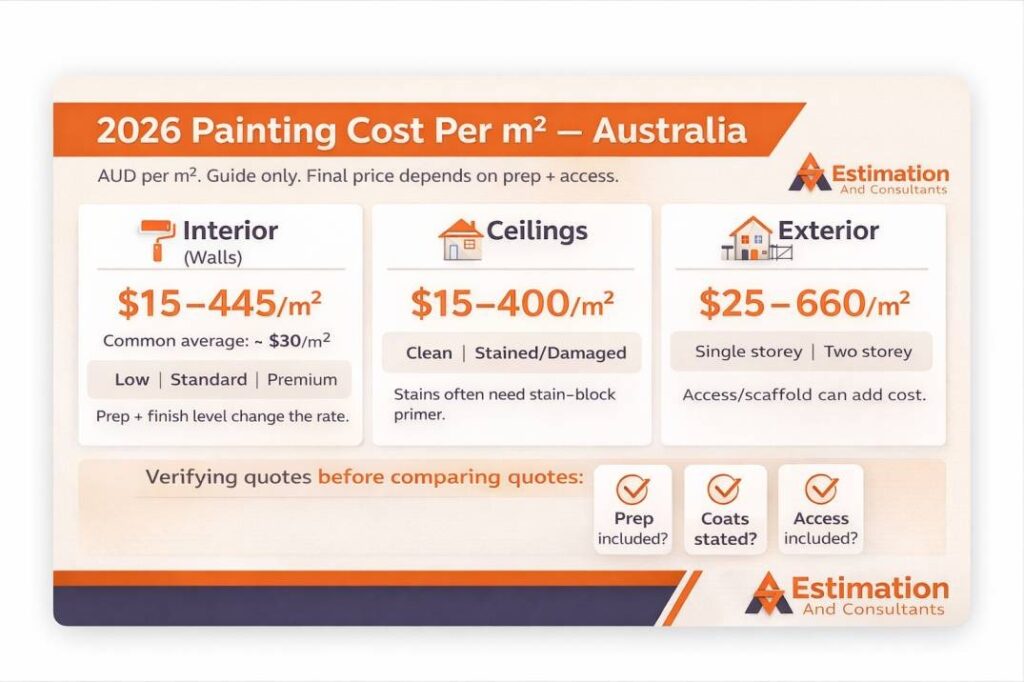
This is the quick “reality check” section—benchmark bands you can use to sanity-check any quote. In the Australian market, interior painting costs often range from $15 to $45 per m² (with many jobs averaging near $30 per m²), while exterior painting costs commonly sit around $25–$60 per m² when height and weather exposure start to matter. Ceiling painting cost is often $10–$30 per m², depending on cutting-in, stains, and access. Use these as guide numbers only, because contractor rates change fast once scope changes.
Assumptions Behind the Rates (So You Don’t Misread Them)
These rates only work if the assumptions match your job. Most “average painting cost per sqm” figures assume a fairly normal repaint: reasonable wall condition, standard ceiling height, and straightforward access. If your place needs extra filling, sanding, stain blocking, or safe access gear, the surface prep and patching cost and time go up—and so does the rate. Also, “supply and install painting rates” can mean different things between painters. One quote might include floor protection and furniture shifting, while another treats those as extras. That’s why the cheapest “painting price per square metre” can end up costing more once variations appear.
Guardrails to check (before you trust the m² rate):
- Coats Included: Are you getting two proper topcoats, or a lighter spec?
- Prep Grade: Light sanding vs heavy patching and peeling paint repair (this is a major cost driver).
- Ceiling Height & Access: High ceilings, stairwells, or second storey work can push access and height factors (and scaffold needs).
- What’s Included in the Painting Quote: Protection, masking, moving items, minor repairs—get it written as inclusions/exclusions.
Interior Painting Cost Per m² (2026)
In Australia, interior painting cost per m² is usually priced as a “walls baseline,” then adjusted for prep, detail work, and the finish you choose. Recent 2026 cost guides commonly place interior wall painting around $15–$45 per m², with many projects clustering near $30 per m² when the job is straightforward.
Use this as a guide only. Your final rate depends on labour productivity (how quickly painters can work in your space), finish quality differences (standard vs premium), and paint brand impact (coverage and durability). Also note: trims and doors are often priced separately, so don’t assume the wall rate covers everything.
- Walls Baseline (What You’re Really Paying For)
Most quotes start with the interior wall painting cost per sqm for clean, reachable walls. The rate rises when painters spend more time cutting-in, masking edges, or working around furniture. - Prep Level (The Quiet Cost Driver)
If walls need patching, sanding, or stain sealing, productivity drops and the per-m² rate climbs. Light prep keeps costs closer to the lower band; heavy prep pushes you toward the upper end. - Finish Tiers (Standard vs Premium)
This is where paint quality and finish impact shows up. Premium finishes often need better prep and more careful application, even if the paint itself isn’t the main cost. - Trims and Doors (Often Separate Line Items)
Skirting, architraves, doors, and frames can be priced per item or per linear metre. If your quote looks “cheap,” check whether these are excluded or treated as extras. - Paint Brand Impact (Coverage and Recoat Time)
Better paints can cover more evenly and hold up longer, but they can also require specific primers or extra coat discipline depending on the surface. Ask what brand/line is allowed in the price. - Labour Productivity (Access and Site Setup)
Tight rooms, lots of cutting-in, high ceilings, and working around occupants slow the job. Slower output usually means a higher per-m² rate, even with the same paint.
Ceiling Painting Cost Per m² (2026)
In Australia, ceiling painting cost per m² is usually priced differently from walls because ceilings are slower, messier work and need more setup. A “normal” ceiling (clean, flat, standard height) often sits in the same broad market band as general interior rates, with many guides putting walls/ceilings together around $10–$30 per m² for typical interior work. If the ceiling is stained or damaged, the price jumps because you’re paying for extra prep plus primer and topcoat costs, not just paint.
The big split is simple: normal vs stained/damaged. Stains from water, smoke, or mould usually need a stain-block primer, and that adds time and materials. That’s where surface preparation cost becomes the deciding factor. Some pricing guides also show higher “all-in” rates depending on inclusions and finish level, so always match the quote scope before comparing per-m² numbers.
- Normal Ceiling (Baseline Rate)
This assumes a clean ceiling, light sanding if needed, and straightforward rolling. If the room is empty and access is easy, labour stays efficient and your per-m² rate stays closer to the baseline. - Stains and Damage (Where Costs Rise Fast)
Water marks, nicotine stains, or patchy repairs need extra steps. Painters often seal first, then repaint. That extra step is why the ceiling repaint cost per sqm climbs. - Stain-Block Primer (The “Don’t Skip This” Cost)
A stain-block primer is not optional when stains can bleed through. You’re paying for the product and for the extra pass on the ceiling—both show up in primer and topcoat costs. - Prep Work (Surface Preparation Cost)
Scraping flaking paint, sanding rough joins, and patching cracks slows the job. More prep means less labour productivity, and that pushes the per-m² rate up even if the paint is the same. - Height and Cutting-In (Time You Don’t See in m²)
Higher ceilings, stairwells, and detailed cornices reduce speed. Cutting in around edges can take longer than the rolling itself, especially in older homes with uneven lines. - What’s Included (Materials vs Labour in the Quote)
Some quotes bundle everything (prep, primer, paint, protection), while others keep allowances vague. Before you compare “per m²,” confirm coats, primer use, and protection as written inclusions.
Exterior Painting Cost Per m² (2026)
In Australia, exterior painting cost per m² is usually higher than interior because the work is harder to access and the surfaces need more prep. As a rough benchmark, many 2026-style cost guides put exterior painting in the $15–$60 per m² range, and some tradie guides narrow common jobs to roughly $25–$60 per m², depending on condition and complexity.
Treat this as a guide only. The exterior house painting cost per sqm moves mainly with substrate type, height, and safety setup. Once you add scaffold and access cost, weather delays, and repair allowances, two homes with the same m² can price very differently.
- Substrate Type (What You’re Painting Over)
Brick, render, and timber don’t prep the same way. Pricing often shifts by surface because sanding, sealing, and adhesion needs change. - Second Storey Access (Where Costs Jump)
Double-storey work usually needs more safety setup and slower production, which increases the per-m² rate even if the paint spec stays the same. - Scaffold and Access Cost (The Big Add-On)
Ladders are cheaper, but not always safe or practical. Scaffold, EWP, and extra edge protection can add real cost and time. - Surface Condition and Repairs (Prep Is Everything)
Flaking paint, cracks, rotten timber, or chalky surfaces mean more prep, more primer, and slower output—so the rate rises. - Weather Risk (Stop–Start Work Adds Hours)
Exterior jobs depend on dry windows for washing, drying, priming, and topcoats. Weather delays don’t show in m², but they show in price. - Detail and Masking (Edges Cost Time)
Eaves, fascia, gables, downpipes, and lots of windows increase cutting-in and masking time. That reduces productivity and pushes the per-m² rate up.
The 2026 Cost Drivers
If you’re looking at two quotes and thinking, “How can both be right?”—this is usually why. In Australia, painters price jobs based on the real effort on site, not just the floor area. So the same number of square metres can land at very different totals once prep, access, and finish expectations change.
In 2026, the biggest swings still come from surface condition, what finish you want, and how easy the areas are to reach. When you understand these drivers, you can spot missing scope fast and compare quotes properly—without guessing.
- Prep Level (Surface Preparation Cost)
Repairs, patching, sanding, peeling paint, and stain sealing can add a lot of time before painting even starts. More prep usually means a higher rate, even if the paint brand stays the same. - Spec and Finish (What You’re Asking For)
Two coats, sharp cut-ins, feature colours, and premium finish expectations push time up. Some guides note that premium systems cost more because they change both materials and how carefully the job needs to be applied. - Access and Height (Scaffold and Access Cost)
High ceilings, stairwells, slopes, and multi-storey exteriors slow the work and may require extra equipment or safer access planning. Industry rate guides flag access and protection as key variables that change pricing. - Site Constraints (How the Job Runs on the Day)
If painters must work around furniture, tight rooms, limited hours, or lots of windows and doors, productivity drops. That shows up as a higher per-m² figure or more labour days. - Region (Regional Pricing Variation)
Location affects availability, travel, and demand. Metro areas can price differently to regional areas, even with the same scope, because contractor rates and scheduling pressure change. - Labour vs Material Cost Split (Why “Small Changes” Move the Price)
Most pricing models start from labour time (hours per m²) and then add paint and consumables. That’s why extra prep or harder access can move your total more than swapping one paint line for another.
How to Estimate Painting Costs (Template + Example)
If you want a number you can trust, you need a repeatable method—not guesswork. The simplest way to learn how to estimate painting costs is to measure the surfaces, choose a realistic rate band, then add the two things most people forget: prep and access. Finish by adding a small contingency allowance so you’re not caught out by minor repairs or touch-ups.
This approach follows practical estimator guidelines: keep line items clear, write down scope inclusions/exclusions, and total the job the same way you’d compare quotes. A good painting cost estimating template Australia also helps you spot when a quote is missing prep, protection, or access assumptions.
Painting Cost Estimate Template (Australia)
A painting cost estimate template Australia works best when it’s simple and copy/paste friendly. You list each surface type, apply a rate band, and add allowances that reflect real conditions on site. This makes your estimate easy to update when you change the finish tier, add doors, or discover extra patching. It also makes quote comparisons fair because you can match your template to what each painter includes.
Use this as a painting quote template for Australia. It keeps your estimate clean, and it forces the important questions: “What’s included?” and “What’s excluded?” so you don’t compare a full-scope quote against a cut-down one.
Copy/Paste Table Format (edit the numbers):
- Walls (Interior): m² × rate band = subtotal
- Ceilings: m² × rate band = subtotal
- Trims/Doors (If Included): allowance (or per item) = subtotal
- Prep Allowance: patching/sanding/stain sealing = subtotal
- Access Allowance: high ceilings/stairwells/scaffold note = subtotal
- Protection/Cleanup: floors, masking, tidy-up = subtotal
- Contingency Allowance: small % for unknowns = subtotal
- Total Estimate: add all subtotals
Worked Example (One Simple Scenario)
Here’s a simple painting estimate example so you can see the math once and reuse it. Let’s say you’re doing a small interior repaint where access is normal, but there’s some patching. You measure 120 m² of interior walls and 60 m² of ceilings. You choose a “standard” rate band based on condition and finish expectations, then you add prep as its own allowance because surface preparation cost is rarely the same from one home to the next.
Example math (illustrative, adjust to your job):
- Interior walls: 120 m² × $30 = $3,600 (interior painting cost baseline)
- Ceilings: 60 m² × $20 = $1,200
- Prep allowance: patching + sanding = $600 (surface preparation cost)
- Protection/cleanup: masking + tidy = $250
- Contingency allowance (5%): about $280
Estimated total: $3,600 + $1,200 + $600 + $250 + $280 = $5,930
This is the point of the method: you can change one assumption (more prep, higher finish tier, tricky access) and the estimate updates without rewriting everything.
Comparing Painting Quotes (Checklist + Scope Brief)
| Checkpoint | What to Confirm (write it in the quote) | Painter A | Painter B | Painter C |
| Prep included | Patching/sanding/stain sealing included? | [Yes/No + notes] | [Yes/No + notes] | [Yes/No + notes] |
| Coats | Primer where needed + number of topcoats | [e.g., 1 primer + 2 topcoats] | [e.g., 1 primer + 2 topcoats] | [e.g., 1 primer + 2 topcoats] |
| Paint line | Brand + product line (not “equivalent”) | [Brand / Line] | [Brand / Line] | [Brand / Line] |
| Access | Ladder only or scaffold/EWP included? | [Included / Extra / Not stated] | [Included / Extra / Not stated] | [Included / Extra / Not stated] |
| Exclusions | What’s NOT included (must be listed) | [List exclusions] | [List exclusions] | [List exclusions] |
| Total price | Supply & install total | [$____] | [$____] | [$____] |
Copy/Paste Scope Brief (Send This to Every Painter)
| Scope Line | What You Send to Every Painter (Edit the brackets) |
| Areas | [Rooms + surfaces: walls / ceilings / exterior / trims / doors] |
| Prep Grade | [Light / Standard / Heavy + 1 line on condition (cracks, peeling, stains)] |
| Prep Tasks | Fill & sand minor imperfections, scrape loose paint, gap fill, seal stains where needed |
| Coats | Primer where required + 2 topcoats to all nominated surfaces |
| Paint Line | [Brand + product line] (or “Painter to specify brand + line in quote”) |
| Finish | [Matte / Low sheen / Semi-gloss + any colour changes] |
| Access | [Single storey / double storey / high ceilings / stairwell] — confirm access method included |
| Exclusions | Anything not included must be listed in writing (repairs beyond minor patching, mould treatment, scaffold/EWP if excluded) |
| Deliverables | Itemised quote with inclusions/exclusions + paint schedule + timeline |
FAQs
A normal range for ceiling painting cost in 2026 can sit close to basic interior rates when the ceiling is clean, dry, and easy to reach. The cost usually increases when ceilings have water stains, smoke marks, cracking, or rough patching that needs extra prep and primer. Always confirm the prep steps and primer use in the scope inclusions/exclusions before comparing prices.
No, you don’t always need a scaffold or special equipment for exterior painting. Many single-storey homes can be done safely with ladders, but double-storey walls, steep blocks, high gables, or tricky rooflines can require scaffold and equipment costs or an EWP. You should ask the painter to write the access method in the quote so you know what is included.
Painting quotes vary because painters often assume different prep levels, coat systems, paint lines, and access methods. One quote might include proper patching and two topcoats, while another allows light prep and fewer coats. The best way to avoid confusion is to standardise the scope and focus on comparing painting quotes on like-for-like inclusions.
An itemised quote should clearly list surfaces included, prep tasks, primer use, number of coats, paint brand/product line, access method, and written exclusions. This detail helps you compare properly and reduces the chance of extra charges later. If the quote doesn’t spell out scope inclusions/exclusions, you are not seeing the full cost upfront.
No, trims and doors are often not included in the interior wall rate per m². They usually take longer because of cutting-in, sanding, and finishing, so many painters price them separately per door or per linear metre. You should ask for them to be listed as separate line items so the total scope is clear.
Conclusion
Painting cost per m² in Australia is a useful guide, but it only works when the assumptions match your job. Interior walls, ceilings, and exteriors are priced differently because prep, access, and finish expectations change labour time. That’s why two quotes can look far apart and still be “right” on paper.
Your next step is simple. Use a painting cost estimate template Australia to measure your surfaces, choose a realistic rate band, and add allowances for prep, access, and a small contingency. Then get 2–3 itemised quotes using the same scope brief. When you’re comparing painting quotes, focus on prep definition, coats, paint line, access method, and written exclusions—so you’re choosing the best value, not the best guess.