NCC 2025 is not just another code update. It is likely to change how construction projects are designed, priced, and reviewed across Australia. From materials and trade rates to consultant input and risk allowances, the budget impact may reach much further than many owners and builders expect.
That is why this topic matters now. The impact of NCC 2025 on building budgets Australia-wide is not only about compliance. It is also about cost planning, project feasibility, and making better decisions early. In this guide, we will look at how NCC 2025 affects construction costs, what may cost more, which projects may feel it most, and how to adjust budgets in a practical way.
Why NCC 2025 Will Change Construction Budgets
NCC 2025 is not just a rule change. It will affect how projects are designed, priced, and approved. That means the NCC 2025 construction cost impact will reach far beyond basic compliance checks.
When code requirements change, budgets often change with them. New design work, better materials, extra consultant input, and added allowances can all shape the impact of building code on project feasibility and drive construction budget escalation Australia-wide.
- Design Changes Add Cost
Updated code rules can force changes to layouts, detailing, and system planning. This is one way in which NCC 2025 affects construction costs from the early stages. - Material Upgrades Matter
Better-performing products often cost more. These upgrades are a key part of the building code budget impact that many projects will face. - Consultant Input Grows
Architects, engineers, certifiers, and estimators may need more time and review. That is part of the NCC 2025 budget changes explained in real project terms. - Compliance Affects Feasibility
Even small code shifts can change margins, tender pricing, and financial viability. This shapes the impact of NCC 2025 on building budgets in Australia. - Budgets Need More Clarity
Builders and owners need early cost planning, not rough guesses. A good NCC 2025 cost guide helps reduce surprises later. - Australia-Wide Pricing Pressure
These changes are not limited to one trade or one project type. They may influence broader construction budget changes across the Australian market.
Why New Building Rules Usually Increase Costs
When building rules change, the cost does not only come from “doing more.” It often comes from doing things differently. New code rules can change products, drawings, trade work, approvals, and the way a project is priced from the start.
That is why how regulations affect construction pricing is such an important part of budgeting. A regulatory compliance cost increase can show up in materials, labour, consultant input, and risk allowances. In simple terms, this is one of the main building code cost drivers behind the construction compliance cost increase Australia-wide.
More Expensive Specifications
One of the first reasons why compliance costs more is that new rules often require better-performing materials and systems. A project that once used a basic product may now need a higher-grade option to meet performance targets. This can include insulation and glazing upgrades, better sealing systems, stronger moisture control products, or more advanced fire-rated components.
These material specification upgrades push costs up before work even begins on site. The cost of meeting new building standards in Australia can rise because compliant products are often more expensive to buy, harder to source, or slower to install. This is where the new insulation and glazing requirements cost impact becomes clear, especially when several upgraded items are needed across the same project.
- Higher Product Standards
New code rules can lift the minimum standard for products used in the build. That means the old low-cost option may no longer be enough. - More Items Need Upgrading
It is rarely just one product. A small rule change can affect insulation, glazing, doors, membranes, fixings, and fire-rated systems at the same time. - Upfront Costs Rise Early
The material upgrade cost is usually felt in construction cost estimating and procurement first, long before the full build is complete.
More Design And Consultant Work
New rules do not only change what gets built. They also change how the job is designed, checked, and documented. That is where design changes due to NCC can create extra cost. Architects may need to revise drawings. Engineers may need to confirm performance. Certifiers may need more detail. Estimators may need to update rates and allowances before the tender is ready.
This added work is a real part of cost planning under the new regulations. It is not always visible to the client at first, but it affects the budget all the same. NCC 2025 residential estimating adjustments may include revised quantities, new product assumptions, and extra consultant hours. In many cases, NCC 2025 budget changes explained clearly come back to more design time, more review time, and more documentation costs before site work begins.
- More Drawing Revisions
When rules change, drawings often need another round of updates. That adds time and creates redesign costs. - Extra Consultant Input
Architects, engineers, certifiers, and estimators may all need to spend more time on the same project, which increases consultant fees. - Documentation Gets Heavier
A project may need more notes, schedules, calculations, and compliance records. These added documentation costs are easy to overlook in early budgeting.
More Risk In Pricing And Delivery
New rules also create uncertainty, especially when the market is still adjusting. Builders may not have full price certainty on every compliant product or trade method straight away. Some items may need more review. Some suppliers may price cautiously. Some trades may allow extra time because the work is new or more detailed. This is where risk and contingency allowances for compliance start to matter.
That is also why smarter builders think about future-proofing construction budgets Australia-wide. The impact of building code on project feasibility is not only about today’s rates. It is also about whether the job still works when pricing shifts, delays happen, or extra compliance steps appear. This kind of regulatory cost pressure on construction in Australia means a project may need a larger risk allowance, stronger contingency planning, and a clear feasibility buffer before the numbers can be trusted.
- Pricing Uncertainty Needs A Buffer
When code changes are new, pricing can move around. A contingency helps protect the budget from early surprises. - Delivery Risk Can Increase
More checks, more lead time, and more coordination can slow decisions and affect build flow. - Feasibility Must Be Rechecked
Even if the project looked workable before, new rules can change margins and overall viability.
What Will Cost More Under NCC 2025
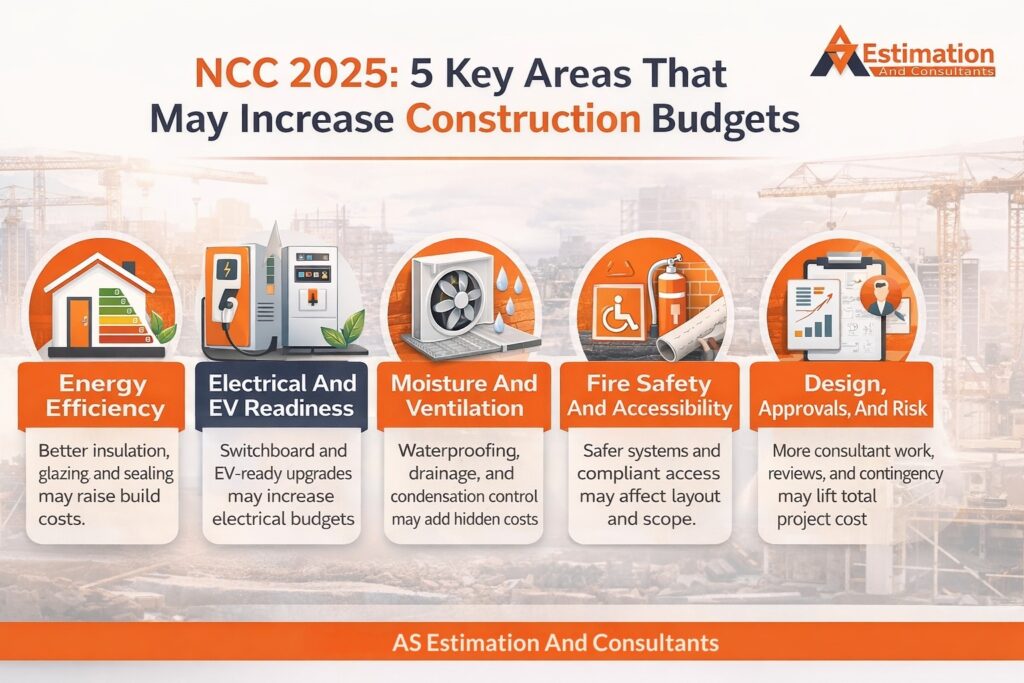
Under NCC 2025, some of the biggest budget changes will come from physical building items, not just paperwork. The new code is likely to increase the cost of products, systems, and installation work that help a building meet higher performance and safety standards.
That is why the new building code requirements Australia 2025 matter so much in early estimating. From thermal performance to electrical readiness, these upgrades can create a real construction compliance cost increase Australia-wide. In simple terms, this is where the direct build cost increase and broader NCC 2025 sustainability requirements cost begin to show up.
Energy Efficiency And Building Fabric
One of the clearest cost areas under NCC 2025 will be energy performance. If projects need to meet stronger 7-star energy rating requirements, the building fabric may need better insulation, higher-performing glazing, tighter sealing, smarter shading, and more carefully selected finishes. These are not small changes. They often affect the envelope from the slab to the roof.
This is where energy efficiency upgrade costs can build quickly. The energy efficiency cost impact of NCC 2025 may be felt through insulation and glazing upgrades, better thermal detailing, and broader material specification upgrades across the project. For many jobs, the new insulation and glazing requirements cost impact will be one of the most visible parts of the total 7-star compliance cost and overall thermal upgrade budget.
- Better Insulation Adds Up
Higher insulation levels can improve performance, but they also raise product and installation costs. - Glazing Becomes A Bigger Budget Item
Windows and glazing systems may need better thermal performance, which can lift both supply and fitting costs. - More Than One Upgrade Happens At Once
Energy compliance usually affects several parts of the envelope together, which is why the total energy code cost can rise faster than expected.
Electrical Capacity And EV Readiness
Electrical work may also cost more under NCC 2025, especially where projects need to allow for future EV charging or stronger system capacity. Even if a charger is not installed on day one, the building may still need the space, pathways, or electrical setup to support it later. That can increase the scope early.
The main pressure points here are EV charging infrastructure costs and switchboard capacity upgrades. These works may affect cable routes, boards, allowances, and consultant coordination. The EV charging infrastructure cost in Australian buildings may not look major in one line item, but across a full project, it can become a meaningful electrical upgrade budget. This is one of the practical NCC 2025 cost implications for developers and builders planning for future-ready assets.
- Switchboards May Need More Capacity
Extra demand can mean larger boards or updated layouts, which affects both materials and labour. - Future Readiness Still Costs Money
Even preparing for EV use later can increase the EV-ready cost today. - Coordination Work Expands
Electrical, mechanical, and design teams may need closer planning to make the infrastructure work properly.
Ventilation, Condensation, Waterproofing, And Drainage
Some of the most important cost increases under NCC 2025 may be hidden behind walls, under floors, and inside wet areas. Better moisture control usually means more detailed work, not just more material. Stronger ventilation and condensation requirements can affect how spaces are designed, sealed, and ventilated, while waterproofing and drainage standards can change detailing and installation quality.
This is where the cost of meeting new building standards in Australia can creep up quietly. A project may need extra membranes, more careful junction detailing, better drainage falls, or improved ventilation pathways. These items do not always stand out in a sales summary, but they often increase the moisture control cost, the waterproofing budget, and the total ventilation compliance cost. This is a very real part of the broader construction compliance cost increase in Australia.
- Hidden Work Can Become Expensive
Moisture and durability rules often affect details that are easy to miss in a rough estimate. - Better Detailing Takes More Time
Waterproofing and condensation control usually depend on careful site execution, not just product choice. - Fixing Mistakes Is Costly
Builders may spend more up front to avoid much bigger repair costs later.
Fire Safety And Accessibility
Safety and access requirements can also shift budgets under NCC 2025, especially in projects where layout, circulation, and compliance systems need to change together. Stronger fire performance rules may require upgraded doors, linings, penetrations, alarms, or separation systems. At the same time, wider accessibility requirements expansion may affect entry paths, internal movement, fixtures, and usable space.
These changes can influence both scope and layout, which is why fire safety compliance costs and accessibility cost impact need to be priced early. In larger or more complex projects, these items are a major part of commercial construction compliance costs in Australia. They also reflect wider NCC 2025 cost implications for developers, because better access and stronger safety performance can reshape not only the fire compliance budget, but also the way the building is planned.
- Fire Systems Can Trigger Multiple Upgrades
A single compliance requirement may affect doors, walls, penetrations, alarms, and finishes together. - Accessibility Can Change Layouts
Access rules do not only add fittings. They can affect room planning, circulation, and usable space. - Early Pricing Matters Most
These items can become much more expensive if discovered late in design or during construction.
What May Cost More Behind The Scenes
Not every NCC 2025 cost increase will show up as a clear line item for materials or site work. Some of the biggest budget pressures will happen behind the scenes, through planning, coordination, approvals, labour quality, and risk management before and during construction.
This is where how regulations affect construction pricing becomes more complex. A regulatory compliance cost increase often includes consultant time, design reviews, estimating updates, procurement delays, and larger allowances. These indirect construction costs are easy to miss early, but they often become major budget pressure points once the project moves forward.
Design Rework And Documentation
One of the first hidden costs is extra planning work. When rules change, teams often need to review drawings, update specifications, check product choices, and prepare more detailed information for approvals. These design changes due to NCC may not look dramatic on paper, but they can add many hours before the first trade even starts on site.
This is a key part of cost planning under new regulations. Architects, engineers, consultants, and certifiers may all need to revisit the same project documents to make sure everything aligns with the new code. That is why NCC 2025 budget changes explained often begin with more documentation, more checking, and more consultant coordination. In practical terms, the cost of meeting new building standards in Australia includes a real design compliance cost, a growing documentation burden, and extra approval preparation costs.
- More Drawing Updates
Even small code changes can lead to revised plans, details, schedules, and notes across multiple documents. - Approvals Take More Prep
Projects may need clearer supporting information before submission, which adds time and review work. - Consultants Stay Involved Longer
More back-and-forth between designers, certifiers, and estimators can stretch pre-construction costs.
Labour And Installation Complexity
Some code changes do not just need better products. They need better workmanship. That means builders may need trades with more experience, tighter installation methods, and closer supervision on site. This is where labour skill and installation cost increase start to affect the budget, especially when the work has less room for error.
Higher performance standards often rely on the quality of installation, not only the product itself. Better sealing, tighter detailing, improved waterproofing, and more accurate system fitting may all take more time and care. That is why construction compliance cost increase Australia can also come from site execution. In many projects, material specification upgrades only work as intended when paired with stronger quality control, better sequencing, and more careful labour. This is a real form of regulatory cost pressure in construction in Australia, showing up through labour escalation, skilled trade pricing, and rising installation quality costs.
- Specialist Trades May Cost More
Some work may need more experienced installers or more time on site to meet the required standard. - Quality Control Becomes Tighter
Better compliance often means more checks, inspections, and supervision during installation. - Sequencing Can Affect Rates
When trades need to coordinate more closely, the job can become slower and more expensive to deliver.
Contingency And Feasibility Pressure
Another hidden budget shift comes from uncertainty. When new rules are still being interpreted or priced by the market, builders and developers often need extra allowances to protect the project. This is where risk and contingency allowances for compliance become important, even if the final design already looks complete.
A project may need higher provisional sums, stronger contingency logic, and a closer review of whether the numbers still work. That is part of the impact of building code on project feasibility. It is also why future-proofing construction budgets in Australia matters so much under NCC 2025. Builders need to think not only about today’s known costs, but also about likely movement in pricing, scope, coordination, and delivery. This is exactly how builders should adjust budgets for NCC 2025 by allowing for feasibility risk, a realistic contingency allowance, and a stronger budget buffer before the job is locked in.
- Contingencies Need To Be Smarter
A flat allowance may no longer be enough when compliance changes affect several parts of the job. - Feasibility Needs A Fresh Check
A project that worked under old assumptions may need a new review under updated cost inputs. - Buffers Help Avoid Late Surprises
Stronger allowances can protect margins, timelines, and decision-making as the market adjusts.
Which Projects May Feel The Biggest Budget Impact
NCC 2025 will not affect every project in the same way. Some jobs will feel the cost pressure more than others, depending on the building type, the compliance scope, and how tight the budget already is at the start.
That is why project-type budget impact matters so much. The residential construction cost impact of NCC 2025 may look very different from commercial construction compliance costs Australia-wide. The same code change can create a modest shift in one project and a major pricing problem in another.

Housing Projects
Housing projects may feel some of the strongest budget pressure because home building is often price-sensitive from day one. Many owners are working within a fixed loan, a set allowance, or a clear target spend. When stronger 7-star energy rating requirements and tighter ventilation and condensation requirements come into play, even modest upgrades can push the total budget higher.
This is where how NCC 2025 affects construction costs becomes very real for households and small residential builders. Better insulation, glazing, sealing, and moisture control can all add to the final number. Because home projects usually have less room to absorb extra spending, the residential construction cost impact NCC 2025 may show up faster through house budget increase, tighter choices on finishes, and rising home compliance pricing. In many cases, it also adds to wider construction budget escalation in Australia across the housing market.
- Homes Are Highly Budget Sensitive
A small rise in compliance cost can have a bigger effect on residential work because margins and borrowing limits are often tighter. - Energy Rules Hit Early
Thermal and moisture upgrades usually affect core parts of the home, so the cost increase appears early in estimating. - Owner Decisions Become Harder
Homeowners may need to choose between scope, finishes, or timing when compliance costs rise.
Commercial And Multi-Use Projects
Commercial and multi-use projects may face a broader spread of compliance costs because they often involve larger systems, more users, and more coordination. These buildings may need stronger fire measures, wider access features, future-ready electrical capacity, and more consultant input across the design and approval process. That creates a wider compliance footprint.
This is why commercial construction compliance costs in Australia can rise across several budget areas at once. Items such as fire safety compliance costs, accessibility requirements expansion, and EV charging infrastructure costs may all affect scope, services, and layout. On larger projects, the NCC 2025 cost implications for developers and builders are not only about one product upgrade. They can shape the full commercial compliance budget, increase systems upgrade costs, and place pressure on the overall access compliance budget before construction even starts.
- More Systems Mean More Cost Layers
Commercial buildings often carry extra compliance demands across services, safety, and user access. - Coordination Becomes A Bigger Job
Larger teams and broader scope can increase review time, consultant input, and approval effort. - Layout Changes Can Be Expensive
Access and safety requirements may affect planning efficiency, usable area, and build complexity.
Developers And Feasibility Teams
Developers and feasibility teams may feel the biggest impact at the decision-making level. Their challenge is not only paying for compliance. It is working out whether the project still stacks up after those costs are added. When new requirements shift design, specification, consultant work, and contingency, the numbers behind the deal may change very quickly.
That is why the impact of building code on project feasibility is such an important part of this conversation. Developers need fresh feasibility reviews, updated assumptions, and clear estimating adjustments for NCC 2025. They also need smarter risk and contingency allowances for compliance to protect the project from pricing gaps and scope movement. These are real NCC 2025 cost implications for developers, especially where margins are already tight. Good developer budgeting now depends on stronger development feasibility checks, more realistic project viability cost testing, and better planning for future-proofing construction budgets in Australia.
- Feasibility Needs A Reset
Old assumptions may no longer reflect the real cost of delivering a compliant project. - Margins Can Tighten Fast
Even a moderate compliance increase can change return targets, yield decisions, or timing. - Early Testing Matters Most
The earlier developers update their numbers, the easier it is to avoid poor decisions later.
How To Adjust Budgets For NCC 2025
NCC 2025 should not be treated like a small compliance update. It changes how projects should be priced, reviewed, and planned from the start. Builders, estimators, developers, and owners need to adjust their budgets early, before hidden scope changes turn into expensive surprises later.
The best response is simple. Review the design early, update trade rates, allow for more risk, and fix old estimating systems that no longer match current code demands. This is the practical side of how builders should adjust budgets for NCC 2025 through better planning, clearer pricing, and smarter allowances.
Review Design Assumptions Early
The first step is to test the design before tender pricing begins. If drawings, specifications, and assumptions are still based on older code habits, the budget may already be wrong before quotes come in. Early review helps teams spot likely design changes due to NCC while there is still time to correct them without major disruption.
This is a key part of cost planning under new regulations. A proper early review should check layouts, performance requirements, consultant input, and likely compliance gaps. In simple terms, this is one of the most effective ways to control costs before it grows.
- Check Before Tender
Review the design early so missing compliance items do not get buried inside contractor pricing. - Align The Team
Bring architects, engineers, certifiers, and estimators into the same discussion before the numbers are fixed. - Protect The Budget Early
It is cheaper to fix assumptions on paper than to fix them during procurement or site work.
Update Material And Trade Rates
Once the likely compliance scope is clear, the next step is to reprice the job properly. Old rates may no longer reflect the real cost of compliant materials, upgraded systems, or higher-quality installation. This is especially important where the project may now need better insulation, glazing, electrical capacity, waterproofing, or fire-rated components.
That is where NCC 2025 estimating adjustments become practical, not theoretical. Teams need to review material specification upgrades, insulation and glazing upgrades, and the likely labour skill and installation cost increase across affected trades. Small pricing gaps across many items can quickly create a major budget shortfall.
- Reprice Key Trades
Update rates for insulation, glazing, electrical, fire protection, waterproofing, and finishing work. - Use Real Product Assumptions
Do not price low-grade products if the code path now needs higher-performance materials. - Price Labour Properly
Better materials often need better installation, so labour allowances must rise with product standards.
Increase Risk And Contingency Allowances
Even with better design review and better pricing, some uncertainty will remain. New code pathways, evolving supplier pricing, and consultant interpretation can still shift the final cost. That is why budgets under NCC 2025 need stronger allowance planning, not just sharper rates.
This is where risk and contingency allowances for compliance become essential. A smarter budget should allow for redesign, procurement changes, consultant review, and likely scope movement. This helps reduce the impact of building code on project feasibility and supports future-proofing construction budgets across Australia for different project types.
- Add A Real Buffer
A flat contingency may not be enough when several code-sensitive items are still moving. - Plan For Uncertainty
Allow for pricing shifts, scope clarification, and extra review time as the market adjusts. - Protect Feasibility
Good contingency planning helps keep the whole project viable, not just the estimate balanced.
Update Estimating Templates And Cost Plans
The final step is to fix the tools behind the estimate. If internal templates, BOQs, and cost plans still rely on old assumptions, the same mistakes will keep repeating. NCC 2025 should push a wider reset in how projects are budgeted, not just a one-time pricing adjustment.
Strong estimating adjustments for NCC 2025 should include refreshed benchmarks, updated cost planning systems, and more realistic compliance allowances. This is how teams respond to construction budget escalation in Australia with more confidence. A better template today makes every future budget stronger.
- Refresh Benchmarks
Old internal rates may no longer reflect the real cost of compliant work. - Fix BOQs And Cost Plans
Update quantities, scope logic, and assumptions so the budget matches current requirements. - Build A Better System
The goal is not only to improve one estimate. It is to improve every estimate that follows.
FAQs
NCC 2025 will change construction budgets in Australia by increasing both direct and indirect project costs. Builders may need to allow for better materials, stricter compliance work, more consultant input, and larger contingencies. In real terms, that means budgets will need to be reviewed earlier and priced more carefully.
NCC 2025 increases building costs because higher standards usually lead to better-performing products, more detailed design work, and tighter installation requirements. It is not only the materials that cost more. The added effort in planning, approvals, documentation, and coordination can also lift the total project budget.
Residential construction may feel NCC 2025 more sharply in some areas, especially where housing budgets are already tight, and energy efficiency rules affect core building elements. Commercial projects can also see major cost increases, but those often come through fire safety, accessibility, services, and wider system coordination.
The main cost drivers under NCC 2025 are likely to include insulation, glazing, ventilation, waterproofing, fire safety, accessibility, and electrical readiness. On top of that, projects may also face higher design costs, more consultant reviews, and stronger contingency needs as teams adjust to new compliance demands.
New building rules affect construction pricing by changing what needs to be built, how it needs to perform, and how carefully it needs to be documented. That can increase product costs, labour inputs, consultant fees, approval effort, and pricing risk across the full project.
Conclusion
NCC 2025 should be planned as a cost change, not only a compliance change. It is likely to affect materials, labour, design work, consultant input, and project risk, which means the NCC 2025 construction cost impact will reach across the full budget.
The impact of NCC 2025 on building budgets Australia-wide will vary by project, but the message is simple: early budgeting matters. Good cost planning under code changes can reduce surprises, protect feasibility, and support a stronger Australian construction budget strategy under growing construction budget escalation in Australia.