Commercial bids are rarely lost on one big mistake. They’re usually lost on small things that stack up fast—unclear scope, rushed takeoffs, weak subcontractor checks, or pricing risk that was never written down. When that happens, you either lose the tender or win a job that hurts your margin.
This guide shows a simple, repeatable way to create a winning commercial bid using independent estimating for contractors. You’ll follow a clear workflow—qualify, clarify, estimate, price, verify, submit, and learn—so your tenders stay competitive, compliant, and buildable.
The Winning Commercial Bid System (Overview)
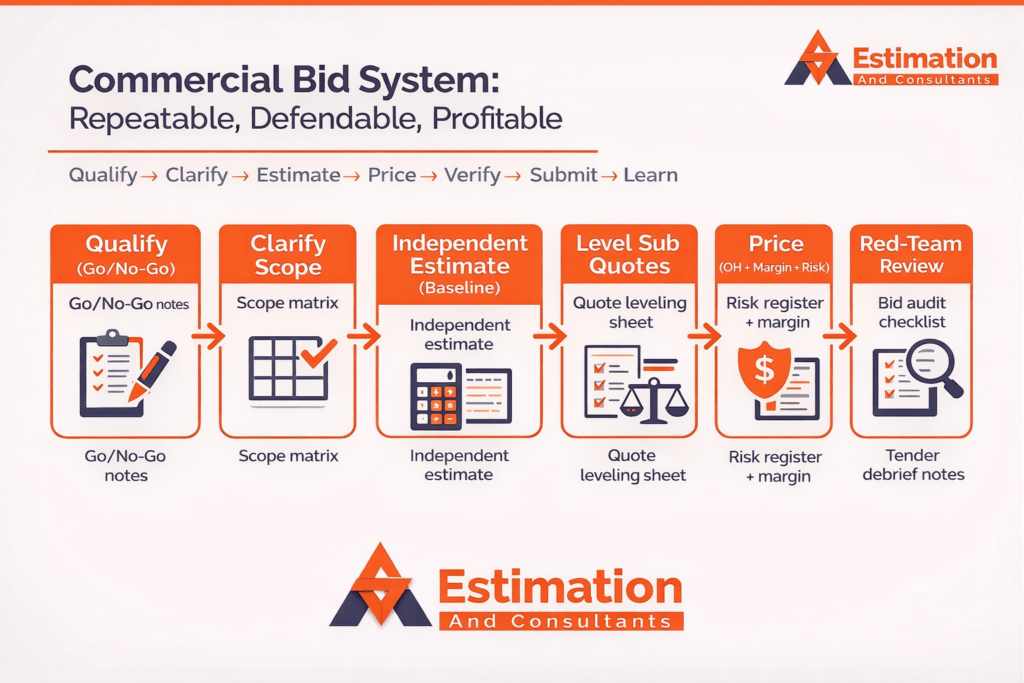
A winning commercial bid isn’t luck. It’s a repeatable commercial tender system you can run the same way, every time: qualify, clarify, estimate, price, verify, submit, then learn. This bid management workflow keeps you in control when deadlines tighten and details get messy.
Most bids fail in predictable spots—scope gaps, rushed numbers, weak checks, or chasing bid accuracy vs speed the wrong way. Independent estimating strengthens your commercial bidding strategy and lifts contractor tender success factors, helping with commercial bid preparation and the full construction bid estimating process to keep improving bid win rate.
- Qualify First — Only bid when the job fits your capacity, risk, and timeline.
- Clarify the Scope — Lock down inclusions, exclusions, and assumptions before pricing.
- Estimate With Discipline — Follow a clean construction bid estimating process, not guesswork.
- Price With Intent — Set margin and risk allowances without racing to the bottom.
- Verify Before You Send — Use checks that balance bid accuracy vs speed and prevent costly misses.
- Learn After Every Bid — Track outcomes and improve bid win rate with small, consistent upgrades.
| Stage | Purpose | What You Produce (Output) | Why It Helps You Win |
| Stage 1: Bid Qualification (Go/No-Go) | Decide fast and rationally | Go/No-Go decision + short notes on capacity, client, risk, and competition | Saves time, avoids bad-fit tenders, supports reducing risk in commercial bids |
| Stage 2: Scope Clarity & Trade Packaging | Lock scope and split it cleanly | Scope matrix + trade package breakdown + tender compliance checklist tracker | Stops scope holes, improves subcontractor comparison, keeps pricing consistent |
| Stage 3: Independent Estimating | Build a defendable baseline cost | Independent baseline estimate + tender takeoff checklist + rate assumptions | Reduces bias, improves bid accuracy vs speed, strengthens bid review process |
| Stage 4: Quote Leveling | Compare subs fairly | Subcontractor quote leveling sheet + exclusions/clarifications log | Prevents hidden gaps, supports tender compliance, reduces post-award surprises |
| Stage 5: Tender Pricing Strategy | Turn baseline into tender price | Final price build-up (prelims/overheads + margin + risk) + risk register | Helps set profit margin for bid without undercutting delivery |
| Stage 6: Red-Team Review | Catch mistakes before submission | Bid audit checklist + totals check + coverage/compliance sign-off | Avoids common commercial bidding mistakes that cost margin |
| Stage 7: Submission Pack | Make evaluation easy | Tender submission pack: executive summary + clarifications + alternates + schedules | Builds trust, makes your offer easier to compare and approve |
| Stage 8: Post-Bid Learning | Improve next tender | Tender debrief notes + win-loss analysis + database updates | Improves bid win rate over time and tightens contractor tender success factors |
Stage 1 — Bid Qualification (Go/No-Go) With Clear Criteria (Overview)
Bid qualification is where winning starts. Before you price anything, you decide if the job is worth chasing. A clear tender selection framework protects your time and margin. It also supports independent estimating, because you’re only estimating bids you can actually deliver—one of the simplest ways of reducing risk in commercial bids.
Go/No-Go With Clear Criteria
Use go no-go criteria to make a quick, rational decision instead of relying on gut feel. Start with capacity: do you have the people, key subcontractors, and time to build it well? Then check the risk profile—site access, complexity, design gaps, and contract terms that shift cost to you. Client type matters too. Some clients pay on time and value scope clarity; others create variation fights and slow approvals. Finally, make a realistic competition guess. If the job is crowded with low-ball bidders, your commercial estimating strategy should focus on strong coverage and clean submission, not speed. This is where competitive bidding strategies construction work best: you choose the right jobs, then price them properly.
Red Flags That Should Stop a Bid
Red flags are the early warnings that usually lead to common commercial bidding mistakes later. If documents are incomplete, you’re forced to guess—and guessing turns into unpriced risk. If the programme is impossible, preliminaries rise, productivity drops, and you end up under water even if you “win.” If scope clarity is missing, you can’t package trades properly or compare quotes, which breaks risk identification and pricing. Harsh terms are another tender red flags category—things like unlimited liquidated damages, unfair warranties, or one-sided variation rules. A simple bid risk checklist helps you step away early, before you burn hours estimating a job that was never a good fit.
Stage 2 — Scope Clarity and Trade Packaging
Stage 2 is where a bid stops being “a pile of drawings” and becomes something you can price with control. You build a scope matrix that matches how you do an accurate quantity takeoff and how you’ll buy the work. This trade package breakdown helps pricing commercial projects accurately because each trade is measured, priced, and checked without gaps or overlap.
Build a Scope Map That Matches Takeoff + Procurement
A MECE scope map means every part of the job sits in one clear bucket—no double counting, no missing items. Start with a work breakdown that mirrors procurement: concrete, steel, blockwork, joinery, MEP, finishes, and so on. Then lock in inclusions and exclusions for each package, plus assumptions like working hours, access, protection, temporary works, and who supplies what. Interfaces are the hidden killers—where trades meet, like fire stopping, penetrations, builder’s works, and commissioning. If you don’t assign these clearly, you’ll struggle with subcontractor comparison later because every quote will “look cheaper” in a different way. With independent estimating, this scope map becomes your pricing backbone and your proof when questions come up.
Tender Compliance Checklist (Built Into the Scope Map)
Compliance works best when it’s built in early, not rushed at the end. Add a tender compliance checklist directly into your scope map so each package also carries its tender requirement list—mandatory forms, insurances, schedules, addenda acknowledgements, and submission rules. This creates a simple compliance tracker that stops last-minute mistakes like missing attachments or using the wrong revision. It also improves consistency across bids because you’re not relying on memory when deadlines hit. When compliance is tied to scope, your estimate stays aligned with what the client actually asked for, and your submission stays valid, clear, and easy to evaluate.
Stage 3 — Independent Estimating: Baseline Cost You Can Defend
Independent estimating gives you a clean baseline cost before pressure, optimism, or “let’s just submit” thinking creeps in. It reduces blind spots and bias by creating a benchmark you can test your bid against. Whether it’s an external estimator for tenders or an independent internal reviewer, the goal is the same: a defendable number and a stronger bid review process.
Independent estimating for contractors is also practical when your team is overloaded. You can use outsourced estimating as overflow support, then run second-opinion checks to compare an independent cost estimate vs in-house estimate. When the two numbers don’t line up, you don’t guess—you investigate. That’s how you avoid silent scope gaps, underpriced labour, and missed preliminaries that turn a “win” into a problem job.
Accurate Quantity Takeoff and Measurement Rules
A winning bid starts with an accurate quantity takeoff that someone else can follow and verify. Your quantity takeoff method should be traceable: clear measurement notes, visible assumptions, and a tender takeoff checklist that keeps you consistent across projects. If drawings are incomplete, you document what you assumed and where, so scope clarity is protected. Revision control is non-negotiable—one missed addendum can wipe out your margin. This is a core part of the construction bid estimating process because it stops “memory-based estimating” and replaces it with a repeatable system. When the takeoff is clean, pricing becomes faster and safer, and your estimate can be defended in reviews, negotiations, and post-bid questions.
Labour Productivity Rates and Build Method Assumptions
Labour is where bids swing the most, so you need productivity assumptions that match the real site. Labour productivity rates change with access, working hours, height, congestion, weather exposure, and how many trades are stacked at once. Your labour build-up rates should reflect crew size, supervision needs, and the actual build method—not the best-case version. This is also where preliminaries and overheads get pulled in, because longer durations increase site running costs. If you don’t align labour with programme reality, you won’t be pricing commercial projects accurately, even if your material rates are perfect. Independent estimating helps here by challenging “optimistic” production rates before they land in the tender.
Material Pricing Validation (Quotes, Escalation, Availability)
Material pricing validation is about matching your estimate to the market, not last year’s spreadsheet. You confirm supplier quote validity, lead times, and availability, then decide if you need a material escalation allowance based on the tender period and delivery schedule. If products have long lead times or price volatility, you either price the risk or offer alternates as value engineering options—clearly documented, not mixed into the base bid. Supplier quote validation should include what’s included (delivery, offloading, wastage, fixings) so you don’t get surprised later. This step is central to pricing commercial projects accurately, because even small material gaps multiply fast across a commercial job.
Stage 4 — Subcontractor Pricing Analysis (Quote Leveling)
Stage 4 is where you stop guessing and start comparing. Subcontractor pricing analysis gives you an apples-to-apples comparison, so you can see who’s truly covered the scope and who’s leaving holes. This step protects your tender compliance too, because missing items usually show up later as variations, delays, or margin loss.
A simple subcontractor quote leveling sheet makes the decision clearer. You check exclusions, chase scope clarifications, and line every quote up against the same package rules. When independent estimating is in place, your baseline cost helps you spot quotes that are unrealistically low or quietly incomplete.
- Level the Quotes — Use a subcontractor quote leveling sheet so every price is compared the same way.
- Check Exclusions Early — Find what they didn’t include before it becomes your cost.
- Confirm Scope Coverage — Match each quote to the package and drawings for real coverage.
- Test Tender Compliance — Make sure forms, insurances, and bid rules are met, not assumed.
- Run an Apples-to-Apples Comparison — Adjust for scope gaps so “cheapest” doesn’t mislead you.
- Lock Clarifications in Writing — Keep scope clarifications documented to reduce disputes later.
Stage 5 — Tender Pricing Strategy (Overheads + Margin + Risk)
Stage 5 is where your baseline estimate turns into a real tender price you can stand behind. This is the commercial tender pricing strategy step: you add preliminaries and overheads, decide how to set profit margin for bid, and price risk in a way that protects delivery. Done right, it’s how to price a commercial tender without guessing.
You’re balancing three things at once: market reality, your margin and profit strategy, and risk identification and pricing. Independent estimating helps because you’re starting from a clean baseline, not a number that’s already been “pushed down” to look competitive. Then you apply clear contingency planning rules so your tender is sharp but still buildable.
Competitive Pricing Without Undercutting
Competitive tender pricing is not the same as being the cheapest. You want price positioning that matches the job and the client. Start with quick market checks: recent wins/losses, typical rates, and where your baseline sits. Then look at bid positioning—what makes you safer to choose? Scope clarity can be a value on its own. When your inclusions, exclusions, and assumptions are clear, the client sees less risk and fewer surprises. That’s part of solid commercial bidding strategy and one of the most practical competitive bidding strategies construction teams can use. You don’t undercut to win—you price to deliver, and you make your offer easy to trust.
Reducing Risk in Commercial Bids (Priced and Documented)
If risk isn’t priced, it usually shows up later as overtime, rework, delays, or disputes—meaning the job “wins” but your margin disappears. Reducing risk in commercial bids starts with a simple tender risk register: list the key risks, assign an allowance, and add a supporting note so it’s transparent. That’s risk pricing method in plain terms. Tie risks back to scope gaps, design unknowns, access limits, programme pressure, and supply uncertainty. Then apply contingency planning rules so you don’t double-count risk or hide it randomly across the estimate. The goal is clean risk identification and pricing: priced, documented, and controlled—so your tender stays competitive and your delivery stays realistic.
Stage 6 — Bid Review and Validation Process (Red-Team Gate)
Stage 6 is your last safety gate before you hit submit. A red team tender review helps you catch mistakes, confirm assumptions, and verify totals while there’s still time to fix them. It’s the simplest way to avoid common commercial bidding mistakes that don’t look big in the office, but cost big on site.
Treat the bid review and validation process like a short, focused audit. Someone not involved in the estimate should run the checks, using a bid audit checklist. Independent estimating makes this stronger because your numbers can be tested against a baseline instead of relying on “it feels right.”

- Independent Check — Get fresh eyes to challenge assumptions and spot gaps.
- Arithmetic Verification — Recheck formulas, totals, and rate build-ups for errors.
- Coverage Check — Confirm every scope package is priced once, with no missing items.
- Assumptions Review — Make sure inclusions, exclusions, and allowances are clear and realistic.
- Compliance Check — Confirm the submission meets tender rules and required documents.
- Final Risk Scan — Identify anything that could hurt margin and confirm it’s priced or noted.
Stage 7 — Submission Package That Makes Evaluation Easy
Stage 7 is where a solid estimate becomes an easy “yes” for the evaluator. Your tender submission pack should present price, method, and tender compliance in a clean bid presentation structure. When reviewers can find key details fast, they trust your numbers more—and your scope clarity reduces back-and-forth questions.
Think of this as the practical end of your commercial bid preparation guide. You’re not adding fluff. You’re packaging the bid so it’s clear, compliant, and simple to compare. A tight tender compliance checklist stops last-minute misses that can invalidate an otherwise strong tender.
- Executive Summary — State the offer, key assumptions, and what makes delivery realistic.
- Scope Clarity Notes — List inclusions, exclusions, and interfaces in plain language.
- Clarifications Log — Show questions asked, answers received, and what you priced.
- Alternates and Options — Present alternates as optional, priced clearly, and easy to evaluate.
- Schedules and Programme — Attach key dates, durations, and any constraints that affect cost.
- Compliance Pack — Include all required forms, insurances, addenda, and check them twice.
Stage 8 — Post-Bid: Improve Bid Win Rate With Win/Loss Analysis
Stage 8 is where you get better without guessing. A simple tender debrief turns each outcome into a clear lesson. You compare your price and scope to what the client wanted, then adjust your system. This is how improving bid win rate becomes routine, not luck.
Treat win-loss analysis like a bid performance review. Look for patterns: were you too high because of prelims, or too low because scope gaps slipped through? Note competitor positioning, then update your database so your next independent estimate starts stronger. Over time, these small updates lift contractor tender success factors and show you how to win commercial construction bids more often.
- Run a Tender Debrief — Ask what mattered most: price, scope clarity, programme, or confidence.
- Check Pricing vs Scope Gaps — Find where you were over-covered or under-covered.
- Map Competitor Positioning — Learn if the market went aggressive or if you missed value points.
- Update Your Estimating Database — Refresh rates, productivity, supplier quotes, and prelims rules.
- Record One Key Fix — Add one process change to prevent repeat mistakes next bid.
- Track Win/Loss Trends — Review results monthly so improvement is visible and measurable.
FAQs
A good tender debrief will usually tell you. If the client says “your price was above budget” but can’t point to scope differences, you were likely too high. If competitors excluded items you included, your scope may have been stronger. Compare your inclusions line-by-line against the final scope and note what others left out.
Ask clear, specific questions. “Where did we rank on price?” “What were the top three decision factors?” and “Was anything in our bid unclear or missing?” also works well. This keeps the conversation practical and helps you improve bid win rate without guessing.
Keep it focused on the process, not the person. Treat it like a bid performance review: what assumptions were right, what was off, and what should change next time. When you write down one improvement action after each tender, you build momentum and protect team morale.
Independent estimating gives you a clean baseline to compare against outcomes. If you lost, you can see whether the gap was pricing, scope coverage, or market positioning. If you won, you can check whether you won by being genuinely competitive or by missing risk. This is a practical way to learn how to win commercial construction bids without repeating mistakes.
Update the items that change your future accuracy: labour productivity rates, supplier quotes, preliminaries allowances, and common scope gaps by trade. Also note client-specific tender requirements and any terms that affected risk pricing. Over time, these small updates improve contractor tender success factors and make your next bid faster and cleaner.
Conclusion
A winning commercial bid comes from a repeatable system, not last-minute effort. Qualify the job, lock scope, use independent estimating to build a defendable baseline, then price risk and margin with control. Review, submit cleanly, and learn from every result. That’s how win rate improves without sacrificing profit.