The warehouse construction cost estimating in Perth in 2026 is not one fixed number because every warehouse project is different. The cost to build a warehouse in Perth depends on the building size, the structural system, the amount of office space, the level of fire protection, and the site conditions. A basic storage warehouse will cost far less than a larger industrial facility with offices, services, and heavy external works.
That is why this article should be read as a practical WA warehouse construction budget guide, not just a list of rates. The industrial building cost per m² in Perth is a useful starting point, but smart cost planning for warehouses in Perth means looking at the real scope behind the rate. This guide is designed to help Perth buyers, developers, and owner-builders understand what shapes pricing and how to build a more realistic budget from the start.
What Is the Average Cost to Build a Warehouse in Perth in 2026?
If you want a practical starting point, the average warehouse cost in Perth in 2026 is usually discussed as a range, not a fixed number. Based on current Australian quantity surveying and industry guides, a basic warehouse may start around A$500 to A$950 per m², while a more complete Perth project with slab, services, and office content can sit closer to A$1,200 to A$2,200 per m². That makes the warehouse construction cost in Perth 2026 question less about one exact figure and more about what you are actually building.
That is why the industrial building cost per m² in Perth should be treated as an early budgeting tool, not a final contract price. A simple shell build will usually sit at the lower end, while a turnkey warehouse with internal offices, fire systems, and completed external works will land higher. Perth builders and consultants are also working in a market where cost escalation, labour pressure, and procurement risk are still real in 2026, so any WA warehouse construction budget guide should be used with local project advice before decisions are made.
Cost Range by Warehouse Type
The easiest way to understand the cost to build a warehouse in Perth is to match your project to the right type of warehouse. A basic storage warehouse with simple access, limited services, and little or no internal fitout will usually be priced in the lower bracket. Once you add a larger office fitout, staff amenities, better presentation, or a more demanding loading area, the budget starts to move up. This is why a clear Perth warehouse build cost breakdown matters so much at the early planning stage.
A simple way to think about it is this: a warehouse shell is normally the most budget-friendly option, often sitting around A$450 to A$900 per m² in Perth-style steel shell guides, while a more complete warehouse with slab, services, and office content can move into the A$1,200 to A$2,200 per m² range. Broader Australian QS guidance also supports the idea that standard warehouse cost Perth sits well below a more fitted-out distribution warehouse or warehouse with office cost Perth. In other words, the gap between warehouse shell vs turnkey cost Perth can be large, so readers should never compare two quotes unless the inclusions are clearly the same.
Simple Cost Bands
- Basic Storage Warehouse: Usually the lowest-cost bracket, with simple structure, minimal services, and little internal fitout.
- Warehouse With Office Space: A mid-range option that costs more because of amenities, partitions, finishes, and extra services.
- Higher-Spec Logistics or Distribution Warehouse: Usually the highest bracket, with stronger service needs, better access, and more operational fitout.
One important caution: these are still guide rates, not final tender numbers. RLB notes that indicative construction figures usually exclude land, many soft costs, and some external works, while Perth’s 2026 market remains influenced by labour shortages and ongoing pricing pressure. That is why a reader can use these ranges to budget early, but should still test the project with local Perth pricing before committing.
| Warehouse Type | Typical Cost Range (Per m²) | What’s Usually Included |
| Basic Shell Warehouse | A$450–A$900 | Steel shell, cladding, and basic enclosed structure at the lock-up stage |
| Smaller Warehouse Without Office | A$500–A$950 | Basic warehouse build with limited internal scope and simpler overall specification |
| Warehouse With Office and Amenities | A$900–A$1,500 | Warehouse structure plus office area, staff amenities, and more building services |
| Full Turnkey Warehouse | A$1,200–A$2,200 | Slab, services, offices, and a more complete design-and-construct delivery, depending on the spec |
What Changes the Cost of a Warehouse Build the Most?
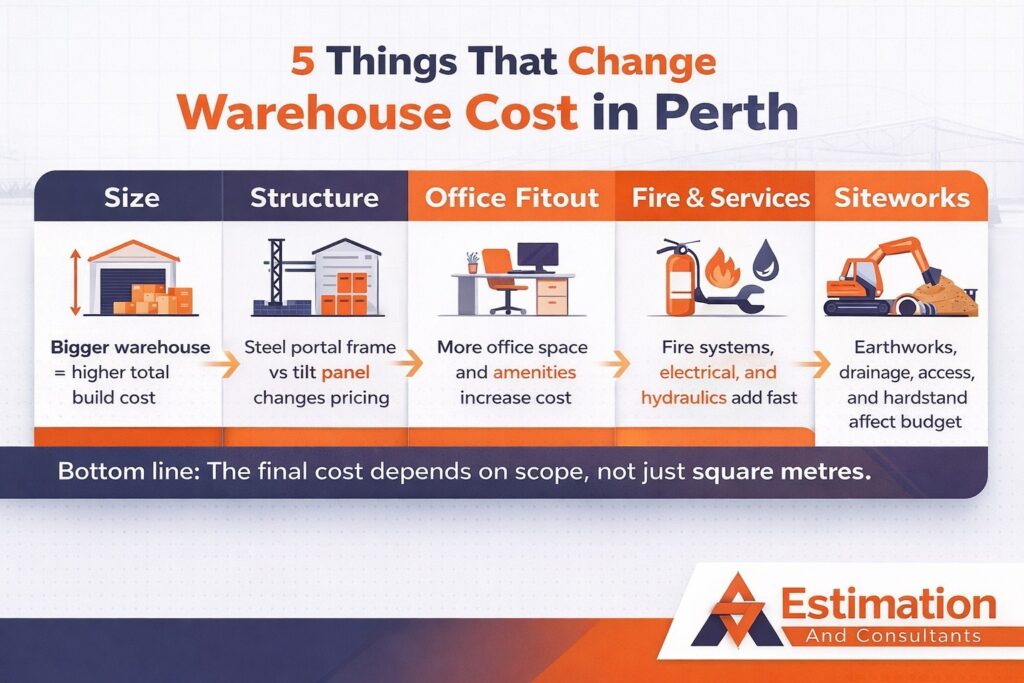
The cost of a warehouse build is usually shaped by a small group of big decisions, not one single factor. In Perth, the main price drivers are the building size, internal height, structural system, office content, fire requirements, and the condition of the site itself. These are the real warehouse build cost drivers 2026 because they affect both the rate per square metre and the total project budget.
This matters because two warehouses with the same footprint can still have very different prices. A simple storage shed on an easy site will not cost the same as a taller warehouse with a larger office area, stronger slab design, and more complex fire services. That is why good cost planning for warehouses in Perth should focus on the biggest scope and design choices first, instead of relying only on broad Perth industrial construction rates.
Size, Height, and Layout
The first major driver is the shape and scale of the building. A larger warehouse footprint can improve efficiency in some cases, but it also increases the total spend because more slab, steel, roofing, and wall area are needed. Height also matters. A warehouse with greater eave height or more internal clearance often needs stronger structural support, more wall cladding, and sometimes different access equipment, all of which affect the overall budget.
Layout efficiency is just as important as raw size. A clean, clear span design may improve usable space, but longer spans can increase steel costs. Adding a mezzanine can create more floor area without expanding the footprint, but it also adds structure, stairs, safety requirements, and fit-out costs. These choices all influence the industrial building cost per m² Perth, which is why warehouse size cost Perth and warehouse height cost Perth should never be treated as minor details.
Why This Matters Most
- Warehouse Size: Bigger buildings increase total cost, even if the rate per m² becomes more efficient.
- Eave Height: Taller warehouses often need more structure, more wall area, and higher-spec access planning.
- Layout Efficiency: Clear spans, mezzanines, and smart planning can improve function, but they also change the build cost.
Structure and Building Materials
The structural system is another major part of warehouse pricing. In many Perth projects, the choice comes down to a steel portal frame or tilt panel construction. A steel portal frame is often a practical and cost-effective choice for standard warehouse projects because it is simple, proven, and widely used. A tilt panel warehouse can offer more strength, durability, and presentation, but it may come with a higher upfront cost depending on design, engineering, and site access.
Material choices around the shell also make a real difference. The slab design, wall cladding, roofing, insulation, and finish level can push the cost up quickly. A heavier-duty slab for forklifts or racking is not priced the same way as a lighter-use floor. In the same way, premium wall systems or precast concrete elements can increase build costs beyond a simpler shell. This is why steel portal frame warehouse cost, tilt panel warehouse pricing Perth, and warehouse cladding and roofing cost are some of the biggest warehouse structure cost WA questions at the planning stage.
Main Structural Choices
- Steel Portal Frame: Common for standard warehouse builds and often simpler to deliver.
- Tilt Panel: Strong and durable, but can cost more depending on engineering and access.
- Envelope Materials: Slab, cladding, and roofing choices have a direct effect on budget and long-term performance.
Services, Fire, and Office Fitout
This is where many early warehouse budgets start to grow. A simple shell building is one thing, but once you add an office fitout, staff amenities, upgraded lighting, air conditioning, and extra service connections, the project becomes more expensive very quickly. The same applies to electrical services and hydraulic services, especially when the building needs more power, more plumbing, or a higher standard of internal finish.
Fire services are another major driver and can have a big impact on the final build cost. Depending on the warehouse size, use, and layout, the project may need hydrants, hose reels, alarms, emergency lighting, or more advanced protection systems. These items are essential, not optional, and they can change the Perth warehouse build cost breakdown in a big way. That is why warehouse fire services cost, warehouse office fitout cost, warehouse fitout cost Perth, and office warehouse cost Perth should always be considered early, not added as an afterthought.
Scope Items That Push Cost Up Fast
- Office Fitout: Adds partitions, finishes, ceilings, air conditioning, and amenities.
- Fire Services: Can include essential compliance systems that significantly increase the budget.
- Electrical and Hydraulic Services: More power, lighting, plumbing, and drainage means a bigger construction cost.
Warehouse Build Cost Breakdown in Perth
A warehouse budget makes more sense when you break it into the main building packages instead of looking at one flat number. In the current market, broad warehouse construction guides put smaller warehouses without offices at about A$500–A$950 per m², while larger warehouses or those with office space and amenities often sit around A$900–A$1,500 per m². That is why a proper Perth warehouse build cost breakdown matters so much.
For simpler shell-style steel buildings, Perth-focused guides also put shell-only builds at roughly A$450–A$900 per m², which helps explain why the final cost changes so much once you start adding internal areas, services, and compliance items. In other words, the total warehouse cost breakdown Perth is really a mix of base structure, shell, and fitout scope rather than one fixed rate.

Slab and Foundations
The slab and foundations package is one of the first places real money gets locked in. For a simple Australian shed-style slab, public pricing guides put concrete slab allowances at roughly A$120–A$180 per m² for a basic 100–125 mm slab with mesh. That is a helpful early benchmark, but warehouse slabs often go higher than that once you need thicker sections, more reinforcement, stronger load capacity, or tougher ground conditions.
That is why this part of the budget should never be treated as a small detail. If the geotechnical report shows weak ground, high loads, or the need for heavier footings, the warehouse slab and foundations cost can climb quickly above basic slab rates. In simple terms, a light-use storage slab is one thing, but a warehouse designed for forklifts, racking, or harder industrial use will usually need a stronger base and a bigger allowance in early cost planning for warehouses in Perth.
Early Slab Budget Guide
- Basic slab allowance: about A$120–A$180 per m²
- Heavier warehouse slabs: usually higher once thickness, reinforcement, and load demands increase
- Poor site conditions: can add more through stronger foundations and extra ground preparation
Frame, Walls, and Roof
This is the main shell of the building, and it usually takes up a large share of the overall cost. Perth and Australian guides for steel warehouse-style builds place simpler shell structures in the broad A$450–A$900 per m² range, while full warehouse projects with more scope move well beyond that. That shell price generally covers the core structure, but not everything people assume is included in a finished building.
The final shell price depends on whether you use a steel portal frame or a heavier system such as tilt panels, plus your choices around wall cladding, roof sheeting, insulation, and finishes. Public Perth commentary also notes cases where newer portal-frame builds cost more than older tilt-panel stock when extra clearance and better features were added, which is a reminder that structure and spec work together. So when you budget for warehouse cladding and roofing cost, think of the shell as a major cost block, not just a background line item.
Early Shell Budget Guide
- Simple shell warehouse: about A$450–A$900 per m²
- Smaller complete warehouses without offices: about A$500–A$950 per m²
- Larger or better-specified warehouses: usually move toward A$900–A$1,500 per m²
Services and Internal Areas
This is where many warehouse budgets start to separate from the cheaper shell rates. RLB’s Perth cost guide notes that building services include electrical power and lighting, hydraulic plumbing, and fire protection items such as detectors, sprinklers, hydrants, hose reels, and extinguishers. Once you add those systems, plus toilets, lunchrooms, partitions, and admin space, the project starts moving away from shell pricing and toward the higher warehouse cost bands.
A good practical way to read the market is this: the more office area and services you add, the more likely your project moves from the A$500–A$950 per m² type of warehouse into the A$900–A$1,500 per m² range. And if the office component is more substantial, remember that broader Australian commercial office benchmarks are much higher again, with MCG putting office buildings at roughly A$1,450–A$2,600 per m². That is why warehouse office fitout cost and warehouse fire services cost can change the full budget much faster than many owners expect.
Internal Scope Items That Push Cost Up
- Electrical and lighting: essential for usable warehouse space and often more than people expect
- Fire services: detectors, sprinklers, hydrants, hose reels, and extinguishers can add major compliance costs
- Office fitout and amenities: Even a modest office area can pull the budget toward much higher rates
One important note: these are still planning ranges, not tender prices. RLB says indicative construction figures typically exclude items such as siteworks and drainage, land, legal and professional fees, and some tenancy works, so they should be used as a budgeting guide rather than a final contract number.
Shell Vs Turnkey Warehouse Cost in Perth
When people ask about the cost estimate to build a warehouse in Perth, they often compare prices that are not based on the same level of finish. A shell build usually refers to the basic outer structure at or around the lock-up stage, while a turnkey warehouse is much closer to a finished, usable building. In the Perth market, public guidance puts a simple industrial warehouse shell at roughly A$450–A$900 per m², while a more complete warehouse with slab, services, and office content can rise to around A$1,200–A$2,200 per m² depending on the specification.
That difference matters because the lower number can look attractive until you realise it may not include everything needed to operate the building. A shell price is usually about getting the structure enclosed. A turnkey price is usually about delivering something much closer to an occupancy-ready warehouse. So when comparing warehouse shell vs turnkey cost Perth, the real question is not just “which one is cheaper?” but “what exactly is included in each price?” That is what makes this section such an important part of any honest Perth warehouse build cost breakdown.
What Is Usually Included in Each Option?
A shell build usually covers the basic building envelope. In most cases, that means the slab, primary frame, external cladding, and roofing, along with the doors needed to close the building up to a lock-up standard. It gives you the main warehouse structure, but not always the finished internal areas or the wider site completion works. In Perth-style steel shell guides, this is the scope that generally sits in the lower shell warehouse cost Perth range of about A$450–A$900 per m².
A turnkey warehouse usually goes much further. It may include the internal fitout, staff amenities, electrical and hydraulic services, paving, line marking, and parts of the external works needed to make the site functional. Public warehouse benchmarks also show that smaller warehouses without offices often sit around A$500–A$950 per m², while larger warehouses or those with offices and amenities often land around A$900–A$1,500 per m². Once Perth projects move into a more complete design-and-construct scope with office and services, guides show they can reach A$1,200–A$2,200 per m², which is why a full warehouse build cost in Perth can look very different from a shell-only quote.
What A Shell Build Usually Includes
- Basic structure: slab, frame, walls, and roof
- Lock-up stage items: main doors and enclosed shell
- Limited completion: usually excludes much of the internal fitout and broader site finishing work
What A Turnkey Build Usually Includes
- Internal completion: office areas, amenities, and fitout items
- Building services: electrical, hydraulic, and other operational systems
- Site completion items: paving, line marking, and some external works to make the site usable
One practical way to think about it is this: a shell price helps you understand the cost of the warehouse box, while a turnkey price helps you understand the cost of a building you can actually use. That is why warehouse office fitout cost, siteworks, and external works warehouse estimate items should never be ignored when comparing quotes. If one builder is pricing the shell and another is pricing a more complete delivery, the numbers will never be a fair comparison.
Hidden Costs Many Warehouse Budgets Miss
A lot of warehouse budgets look fine at first because they focus on the obvious building cost. The problem is that the obvious cost is not always the full cost. Many standard construction benchmarks exclude things like siteworks, drainage, land, and consultant fees, which means a warehouse can appear affordable on paper but still need a much bigger total budget once the missing items are added back in. That is why hidden warehouse costs in Perth are such an important topic for anyone trying to price a project properly.
This section is not about scare tactics. It is about realistic budgeting. In simple terms, the biggest missed items are usually the costs outside the warehouse shell itself, such as external works, utility tie-ins, design and approval fees, and allowances for contingency and escalation. These are not rare extras. They are normal parts of the full budget and should be included early in any serious WA warehouse construction budget guide or siteworks and external works warehouse estimate.
Siteworks and External Works
This is one of the biggest areas where early warehouse budgets fall short. The warehouse structure may be priced, but the site around it may still need a lot of work before the building is usable. That can include earthworks, bulk excavation, stormwater drainage, hardstand areas, parking, fencing, retaining walls, and proper vehicle access. RLB’s cost guidance specifically notes that site works and drainage are typically excluded from its indicative building figures, which shows how easy it is for this part of the budget to be missed.
These costs can grow quickly depending on the block and the intended use of the warehouse. A site with heavy truck traffic may need a stronger hardstand, more turning space, and better pavement design. A sloping block may need retaining walls and extra drainage. A site with poor entry conditions may need a new crossover, more car parking, or better truck access. That is why a realistic Perth warehouse build cost breakdown should always separate the building from the wider warehouse external works cost in Perth. Even if the shell price looks reasonable, the site around it can still shift the budget by a large amount.
External Costs People Often Miss
- Earthworks: clearing, excavation, fill, and level corrections
- Stormwater: drainage lines, pits, and water management around the building
- Hardstand and Access: pavement, crossover work, truck movements, and parking
- Retaining and Fencing: support works and boundary completion items
Professional Fees, Approvals, and Risk Allowances
The second group of missed costs sits outside the physical construction itself. These are the soft costs needed to design, approve, and safely budget the project. That usually includes the architect, engineer, survey work, permit-related costs, and often a quantity surveyor if the project is being budgeted properly. RLB’s published exclusions also list legal and professional fees outside its indicative building rates, which is a clear reminder that a headline construction rate does not equal the full development cost.
Then there is risk. A good warehouse budget should also include contingency and escalation, especially in a market where cost pressure has not fully disappeared. Engineers Australia’s contingency guidance treats contingency as a structured allowance for uncertainty, not a random extra, and AIQS’ WA cost forecast plus RLB’s 2026 outlook both support the need for careful escalation planning in the current market. So when people ask about warehouse consultant fees Perth, approval cost warehouse Perth, or contingency warehouse Perth, the honest answer is that these are not optional add-ons. They are part of responsible cost estimating planning for warehouses in Perth.
Soft Costs and Risk Allowances To Include
- Consultant Fees: architect, engineer, surveyor, and quantity surveyor
- Approvals: planning approval, building permit, and authority-related costs
- Contingency: allowance for project uncertainty and scope risk
- Escalation: allowance for price movement before tender or during delivery
How to Budget a Warehouse Project Properly in Perth
The best way to budget a warehouse project in Perth is to treat early online rates as a starting point, not the final answer. Broad market guides can help you form an initial range, but a proper budget should be built around a clear concept design, a written scope schedule, and current Perth rates. That is how a rough number starts becoming a useful feasibility budget instead of just a guess. This is especially important in 2026, when warehouse tender pricing in Perth is still being shaped by labour pressure, procurement risk, and live market conditions.
A good WA warehouse construction budget guide should also leave room for the things that change during planning. That includes site-specific conditions, office area, services, external works, and the timing of the tender itself. If the early budget is too light, the project may look affordable on paper but become difficult once real builder pricing comes in. That is why smart warehouse budgeting in Perth is really about moving step by step from broad cost advice to a locally tested budget that reflects your actual project.
Best First Steps Before You Build
The first step is to define the project clearly before asking anyone to price it. That means preparing a simple project brief and some early concept plans that show the warehouse size, intended use, office ratio, loading needs, and likely site layout. Even a basic brief can make a big difference because it gives the estimator something real to measure. Without that, pricing is usually too broad to be useful. If you want a solid Perth warehouse estimate guide, start with clarity, not assumptions. This is the foundation of good industrial budget planning WA.
The next step is to test the budget against local market conditions before going to tender. That usually means speaking with a local estimator or quantity surveyor, checking the likely build cost against current Perth industrial construction rates, and doing a basic tender check before making decisions. A national average may help with early research, but it will not reflect your exact site, your office ratio, or your intended operating standard. A stronger warehouse pre-tender budget Perth comes from local input, clear scope, and realistic allowances for market movement. That is the safest way to estimate warehouse cost in Perth without walking into a budget gap later.
Best Early Budgeting Steps
- Define the scope clearly: set the warehouse size, use, office content, and loading requirements.
- Prepare concept plans: even simple drawings improve pricing accuracy.
- Use a local Perth estimator: local advice is stronger than a generic national rate.
- Check before tender: test the budget against live market pricing and current tender conditions.
FAQs
A warehouse cost per square metre in Perth depends mostly on the scope. If you are pricing a basic shell or lock-up-style warehouse, the market guide range is roughly A$450–A$900 per m². If you are pricing a more complete warehouse with office fitout, services, and amenities, a more realistic range is often A$900–A$1,500 per m², and high-spec full delivery projects can push into the A$1,200–A$2,200 per m² range. That is why a square metre rate only makes sense when the inclusions are clear.
Yes, a shell warehouse is usually cheaper than a turnkey warehouse in Perth because a shell build covers much less. Current Perth guidance puts a simple industrial shell at about A$450–A$900 per m², which usually reflects the steel shell and cladding side of the job. A turnkey warehouse costs more because it can include slab, services, offices, and completion items, and full design-and-construct pricing can rise to around A$1,200–A$2,200 per m² depending on the building standard.
The biggest cost drivers for a warehouse build in Perth are usually the building size, height, structure, office content, fire requirements, and site conditions. The reason this matters is simple: two warehouses with the same footprint can still land in very different price brackets. RLB says construction cost pressure is still elevated in 2026 due to labour constraints, low productivity, and supply chain pressure, while AIQS’ WA forecast has also pointed to continued escalation in Perth, so scope decisions and timing still matter a lot.
Hidden costs in Perth warehouse budgets often include siteworks, drainage, authority connections, consultant fees, approvals, contingency, and escalation. RLB’s cost calculator notes that indicative construction figures generally exclude site works and drainage, land cost, legal and professional fees, interest costs, and taxes, which is a big reason early budgets can fall short. So even if the main warehouse build rate looks reasonable, the full project budget may still need a healthy allowance outside the shell price.
The best way to get a more accurate warehouse cost estimate in Perth is to move beyond broad online rates and build a proper feasibility budget around your real project. That usually means preparing concept plans, defining the warehouse use and office ratio, and getting a local estimator or quantity surveyor to test the budget against current Perth rates and likely tender conditions. National guides are useful for early research, but a Perth-specific budget is much safer before you commit.
Conclusion
The cost to build a warehouse in Perth in 2026 depends on more than just the size of the building. The final number is shaped by the warehouse type, structural system, office fitout, services, and siteworks around the building. A basic shell will sit in a very different price range from a more complete warehouse with offices, fire systems, paved external areas, and full operational scope. That is why any serious warehouse budget Perth should look beyond simple square metre rates.
The safest way to approach a Perth warehouse project is to use market guides as a starting point, then move to a local feasibility estimate before making decisions. Good local cost planning helps you test the real scope, site conditions, and likely tender outcome before the budget gets locked in. If you want a practical Perth warehouse cost guide, the key lesson is simple: define the project clearly, price it locally, and build your budget around real inclusions rather than assumptions. That is the smartest way to build warehouse WA projects with fewer surprises and better budget control.