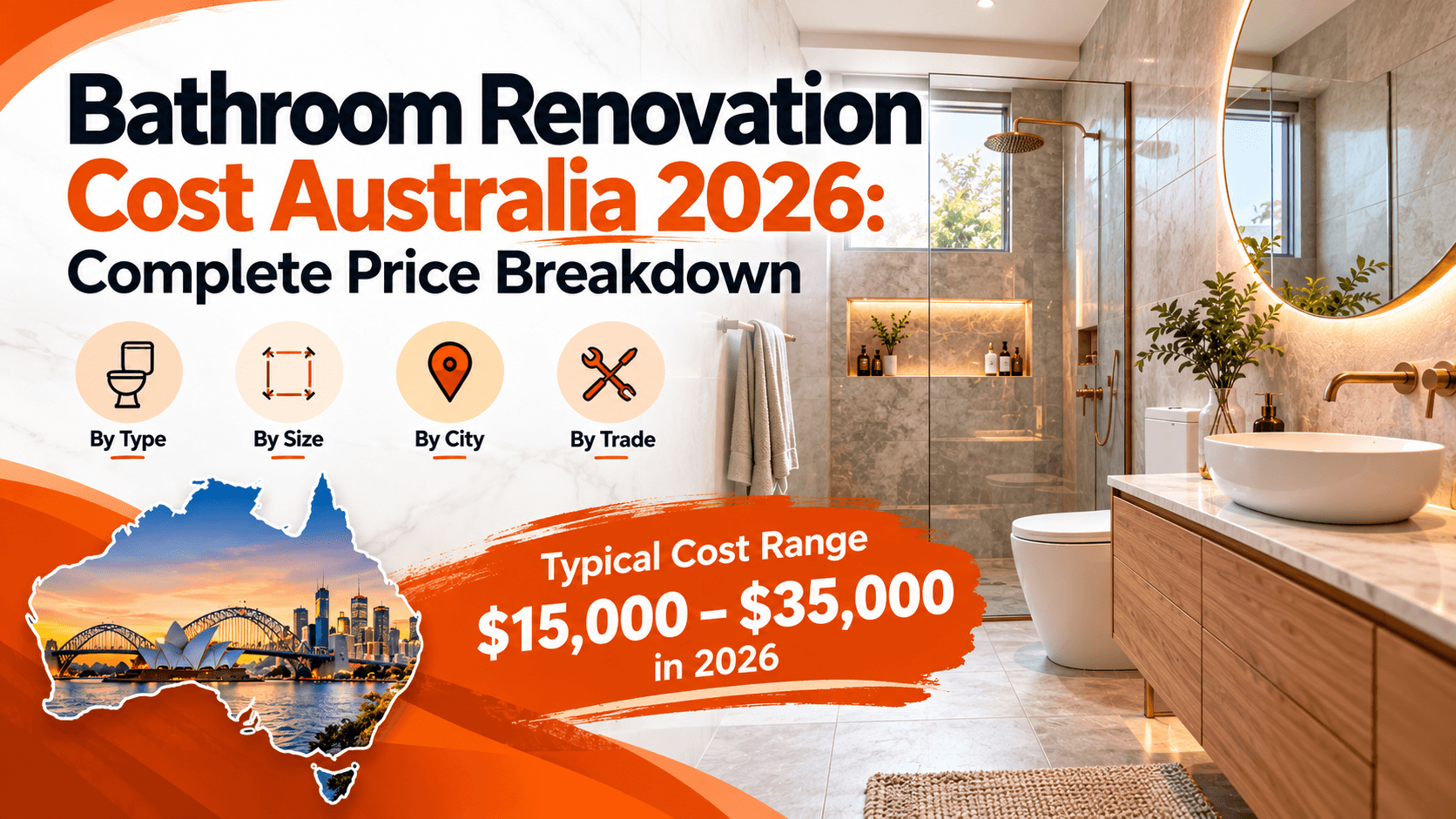
Residential benchmarks in Australia range from ~$2,000–$3,000/m² for standard project homes to $4,000–$8,000+/m² for architect-designed residences. Commercial and industrial rates vary even more. A $/m² rate is a starting benchmark, not a final budget.
If you are planning a construction project in Australia, the construction cost per square metre is often the first figure you will come across. It helps with early budgeting, comparing options and testing viability. But treating one figure as the “Australian average” is a mistake — projects differ by standard, location and site conditions.
In 2026, Australian cost data shows major differences between homes, apartments, offices and industrial buildings. Labour and material costs also continue to shift. A square-metre rate is only a starting point.
AS Estimation & Consultants helps Australian builders, contractors and developers move beyond generic rates with detailed, project-specific estimates based on drawings, specifications and measured quantities.
Key Takeaway: A $/m² rate is useful for early feasibility but should never be used as a final construction budget. Always verify what’s included, GST treatment, and site-specific conditions. |
What Is the Average Construction Cost per Square Metre in Australia in 2026?
There is no single construction cost per square metre that applies to every Australian project.
For residential construction, current 2026 benchmarks show that standard project homes can sit around the low-to-mid $2,000s per m², while more complex or higher-specification homes can move into the $3,000–$5,000+ per m² range. Architecturally designed and luxury residences can be substantially higher.
For other building types, the difference is even greater. BMT’s 2026 cost table, for example, lists medium-finish benchmarks of approximately:
- $2,483/m² for a single-level 3-bedroom brick-veneer project home
- $4,241/m² for a 4–8 level apartment complex with a lift
- $3,964/m² for a 1–4 level open-plan office
- $1,912/m² for a high-bay warehouse with concrete flooring and metal cladding
2026 Australian Construction Cost Benchmarks by Building Type
Building Type | Example 2026 Benchmark* | What Can Change the Rate? |
Standard project home | ~$2,000–$3,000+/m² | Design, finish, location, site |
Custom / unique home | ~$3,000–$4,500+/m² | Specification and complexity |
Architect-designed residence | $4,000+/m² | Design, materials, structural complexity |
Apartment development | ~$3,400–$5,900+/m² | Height, basement, lifts, services |
Office building | ~$3,500–$6,500+/m² | Services, height, fitout |
Industrial warehouse | ~$1,700–$2,500+/m² | Structure, slab, services, specification |
Indicative benchmarks based on current 2026 Australian cost data. Actual project rates vary, and GST treatment differs between sources. BMT’s published figures are exclusive of GST.
Key Takeaway: A $/m² rate can help you start a budget. It should not be the final number you use to price a construction project. |
Need a project-specific estimate? Get a detailed quote → |
Why Construction Cost per Square Metre Varies So Much
The biggest mistake in construction budgeting is assuming that floor area determines cost. It doesn’t. Floor area is only one variable.
Imagine two houses, both measuring 250 m².
House A is a straightforward single-storey project home with a standard kitchen, standard bathrooms, conventional windows and a level site.
House B is a two-storey architectural home with premium stone, custom joinery, large glazed areas, complex structural elements, premium bathrooms and a sloping block.
Both are 250 m². But they are completely different construction projects.
This is why professional estimators don’t simply multiply floor area by an arbitrary rate. They look at the actual scope of work.
The cost can be influenced by:
- Location
- Building type
- Structural system
- Site conditions
- Materials
- Finishes
- Labour
- Building services
- Access
- Number of storeys
- Design complexity
- External works
- Procurement conditions
- Contractor availability and tender competition
Australian cost publications such as BMT and Rawlinsons therefore provide different rates for different building categories rather than presenting one universal Australian rate. Rawlinsons’ 2026 publications include building costs per square metre, regional indices, elemental costs and detailed trade prices.
2026 Construction Cost Guide by Building Type
A useful way to approach the question is to separate construction into major project categories.
The table below uses current BMT 2026 benchmarks to demonstrate how dramatically rates can differ according to building type and specification.
Detailed 2026 Construction Cost Benchmarks by Project Type
Project Type | Low Benchmark | Medium Benchmark | High Benchmark |
3BR brick veneer project home, single level | $2,228/m² | $2,483/m² | $2,965/m² |
4BR brick veneer, unique design | $3,120/m² | $3,267/m² | $4,112/m² |
Architect-designed executive residence | $4,645/m² | $5,947/m² | $8,318/m² |
2BR single-level townhouse | $3,291/m² | $3,729/m² | $4,200/m² |
4–8 level apartment complex | $3,953/m² | $4,241/m² | $5,138/m² |
1–4 level open-plan office | $3,552/m² | $3,964/m² | $4,658/m² |
High-bay industrial warehouse | $1,691/m² | $1,912/m² | $2,061/m² |
Supermarket | $2,806/m² | $3,003/m² | $3,365/m² |
These aren’t prices that a builder is required to charge. They are benchmarks for understanding the order of magnitude of construction costs. That’s an important distinction for anyone using this information for feasibility or tender preparation.
Key Takeaway: Benchmarks help you understand the market. They don’t replace a project-specific estimate. |
Want a precise estimate for your project? Request a quantity takeoff → |
What Does Cost per Square Metre Actually Mean?
The calculation itself is simple:
Construction Cost per m² = Total Construction Cost ÷ Construction Area
For example, if a project has a construction cost of $750,000 and a floor area of 250 m²:
$750,000 ÷ 250 = $3,000/m²
But the calculation doesn’t tell you whether $750,000 is a realistic project cost. The quality of the input matters.
If your total construction cost is based on outdated rates, incomplete drawings or missing trades, the resulting $/m² figure can look precise while being fundamentally wrong.
That’s why experienced estimators don’t ask only: “What’s the cost per square metre?” They also ask: “What exactly is included in that rate?”
What Is Included in a Construction Cost per m²?
There is no universal answer. Different cost guides use different assumptions. A benchmark may include some combination of:
What’s Typically Included in a $/m² Benchmark
Cost Component | Usually Considered? |
Main building structure | Yes |
Labour | Yes |
Building materials | Yes |
Internal finishes | Depends on specification |
Electrical services | Depends on project |
Plumbing | Depends on project |
Mechanical services | Building-type dependent |
Builder preliminaries | May be included |
Builder overheads | May be included |
Builder margin | May be included |
GST | Must be checked |
For example, BMT explicitly states that its 2026 construction cost table figures are exclusive of GST. That means you should never compare two online construction-cost figures without first checking whether both use the same GST basis.
What Is Not Necessarily Included?
A construction benchmark can also leave high costs outside the headline $/m² figure.
Depending on the source and project, these may include:
Site & Land Costs
- Land purchase
- Demolition
- Major excavation
- Rock removal
- Retaining walls
External Works
- Landscaping
- Driveways
- Swimming pools
Professional & Statutory Costs
- Professional fees
- Engineering
- Planning costs
- Council fees
- Approval costs
Financial & Other Costs
- Finance costs
- Utility connections
- Contingency
- Escalation
This is why a project advertised as “$3,000 per square metre” does not necessarily mean the owner needs exactly $3,000 × floor area to complete the entire development.
Key Takeaway: Always ask what’s excluded from a $/m² rate before using it for budgeting. |
How Much Does It Cost to Build a 200 m² House?
Let’s use a simple example. Suppose you’re assessing a 200 m² residential project.
- At $2,500/m²: 200 × $2,500 = $500,000
- At $3,000/m²: 200 × $3,000 = $600,000
- At $3,500/m²: 200 × $3,500 = $700,000
Preliminary Cost Estimates by Floor Area and Rate
Floor Area | $2,500/m² | $3,000/m² | $3,500/m² |
150 m² | $375,000 | $450,000 | $525,000 |
180 m² | $450,000 | $540,000 | $630,000 |
200 m² | $500,000 | $600,000 | $700,000 |
220 m² | $550,000 | $660,000 | $770,000 |
250 m² | $625,000 | $750,000 | $875,000 |
300 m² | $750,000 | $900,000 | $1,050,000 |
This table is useful for early feasibility only. The final construction estimate needs to reflect the actual project.
Ready for a detailed estimate? Upload your drawings for a quote → |
Why Two 200 m² Houses Can Have Completely Different Costs
This is one of the most important concepts for anyone researching Australian construction costs.
Consider these two hypothetical projects:
Comparison of Two 200 m² Projects
Cost Factor | Project A | Project B |
Floor area | 200 m² | 200 m² |
Design | Standard | Architect-designed |
Site | Level | Sloping |
Kitchen | Standard | Custom |
Windows | Standard | Large premium glazing |
Bathrooms | Standard | Premium finishes |
Structure | Conventional | Complex |
Joinery | Standard | Bespoke |
External works | Limited | Extensive |
Both projects have the same floor area. Yet their cost per square metre could be significantly different.
The square metre does not know what is inside the building. A professional estimate does.
How Location Affects Construction Costs in Australia
Australian construction costs are not geographically uniform. Sydney, Melbourne, Brisbane, Perth, Adelaide, Canberra, Hobart and Darwin have different labour markets, supply chains and construction conditions.
The latest ABS data illustrates this clearly.
Annual Change in House Construction Output Prices by State (Year to June 2026)
State / Territory | Annual Change to June 2026 |
NSW | +4.8% |
Victoria | +3.7% |
Queensland | +8.0% |
South Australia | +8.5% |
Western Australia | +8.8% |
Tasmania | +11.5% |
Northern Territory | +4.6% |
ACT | +5.0% |
Australia | +5.9% |
These figures represent changes in construction prices, not $/m² construction rates. They are useful because they show that construction markets can move differently across Australia.
For a live project, an estimator should therefore consider location-specific pricing, rather than applying a national average without adjustment.
What Is Driving Australian Construction Costs in 2026?
The Australian construction market continues to experience cost pressure from several directions.
According to the ABS, input prices to house construction increased 3.8% over the 12 months to June 2026. During the June quarter alone, input prices rose 2.1%, with higher raw material, freight and fuel costs contributing to the movement.
At the output level, house construction prices increased 5.9% over the year, while non-residential building construction prices increased 4.4%.
Major cost pressures include:
Labour: Skilled trade availability continues to influence pricing, particularly for trades such as bricklaying, carpentry and concreting.
Materials: Steel, aluminium, electrical products, PVC-related products and other construction materials can influence project pricing.
Transport: Fuel and logistics costs affect the delivered cost of materials.
Tender competition: The availability of contractors and subcontractors can influence the price a builder receives when going to market.
Project duration: Longer projects can have greater exposure to price movements and escalation.
Residential vs Commercial Construction Costs
One of the biggest mistakes in construction budgeting is comparing residential and commercial projects using the same $/m² rate.
They aren’t equivalent.
A commercial building may require:
- Mechanical services
- Fire systems
- Lifts
- Accessibility provisions
- Commercial electrical systems
- Data infrastructure
- Security systems
- Specialist finishes
- Larger structural spans
- More complex compliance requirements
For example, BMT’s 2026 benchmarks put a medium-finish 1–4 level open-plan office at approximately $3,964/m², while a medium-finish high-bay warehouse is approximately $1,912/m².
The difference isn’t simply because one building is “more expensive.” The buildings have fundamentally different scopes.
Need commercial estimating? Learn about our commercial services → |
Construction Cost per m² for Builders vs Developers
The same benchmark can also be used differently depending on who is using it.
Homeowner: A homeowner may use a $/m² figure to understand whether a proposed house is broadly affordable.
Builder: A builder may use benchmarking to assess whether a preliminary project budget is realistic before completing a detailed estimate.
Developer: A developer may use construction rates as one input in a feasibility model alongside land, construction, professional fees, finance, holding costs, sales costs, contingency and revenue.
Estimator: An estimator uses the benchmark differently. The estimator’s job is to replace broad assumptions with measurable quantities and current rates as the project documentation becomes available.
Why Quantity Takeoff Is More Useful Than a Simple $/m² Rate
Suppose an architectural drawing shows 1,200 m² of floor area.
A broad benchmark might tell you: $2,800/m².
1,200 × $2,800 = $3.36 million
But what happens if the actual project contains significant structural steel, premium façade materials, extensive glazing, complex mechanical services, high-end internal finishes, or difficult site access?
The $3.36 million figure may no longer be appropriate.
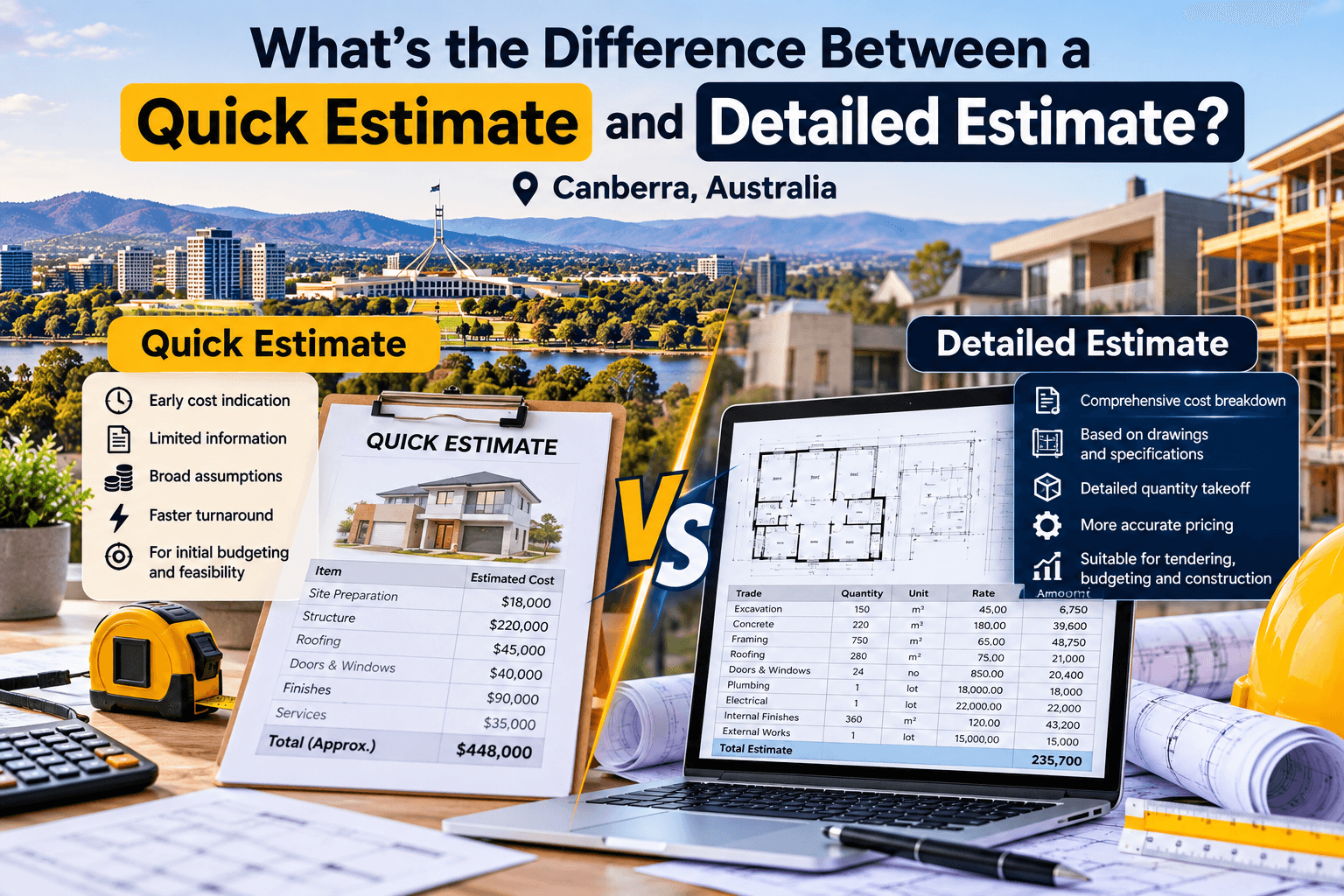
A detailed quantity takeoff can break the project into measurable components.
Common Quantity Takeoff Measurements by Trade
Trade | Measurement Example |
Concrete | m³ |
Reinforcement | tonnes |
Brickwork | m² |
Plasterboard | m² |
Flooring | m² |
Painting | m² |
Doors | Number |
Windows | Number / m² |
Roofing | m² |
Electrical | Fixtures / points / allowance |
Plumbing | Fixtures/points/allowance |
This creates a much clearer connection between the drawings and the estimated cost.
Need a quantity takeoff? Request a quote → |
From Drawings to a Construction Estimate
A professional estimating workflow generally becomes more detailed as the project develops.
Understand the Scope: Identify the project type, location, size, and intended specifications.
Review Documentation: Examine architectural drawings, structural drawings, engineering information, and specifications.
Measure Quantities: Complete quantity takeoffs for the relevant trades.
Apply Rates: Apply current material, labour and subcontractor rates appropriate to the project’s location.
Build the Cost Plan: Organise the estimate into trade packages and project-level costs.
Review: Check quantities, assumptions, exclusions, rates and scope gaps.
Finalise: Produce the estimate or BOQ in a format suitable for budgeting, tendering or internal review.
This is where construction estimating software and professional experience become valuable. We use systematic estimating workflows to analyse project documentation and develop detailed, structured cost information for Australian construction projects.
When Should You Stop Using a $/m² Estimate?
A square-metre benchmark is useful during the early stages. But there comes a point when it is no longer sufficient.
You should consider moving to detailed estimating when:
- You have developed architectural drawings
- You are putting together a competitive tender submission.
- You need up-to-date subcontractor rates for your project.
- You are comparing builder quotes
- Your project includes detailed specifications.
- The project has unusual site conditions
- The design has become complex
- Your project requires a detailed and accurate BOQ.
- The project has a high overall value
- A small percentage error could materially affect your margin
The closer you get to procurement, the more important actual quantities and current rates become.
Key Takeaway: Use $/m² to start the conversation. Use detailed estimating to make the decision. |
Ready to move to a detailed estimate? Request a quote → |
Common Mistakes When Using Construction Cost per Square Metre
Using an outdated rate: Construction prices change. A rate from several years ago may not reflect today’s labour and material market.
Comparing different building types: A warehouse rate cannot simply be applied to a house.
Ignoring GST: Always establish whether a published rate includes or excludes GST.
Ignoring site conditions: A difficult site can add substantial costs that a generic benchmark doesn’t capture.
Treating the benchmark as a quotation: A published $/m² rate isn’t a builder’s tender.
Ignoring specification: The finish level can materially change the project cost.
Forgetting external works: Driveways, landscaping, retaining walls and other works can sit outside the headline construction rate.
Using one national number: Australian construction markets differ by location.
How Accurate Is a Construction Cost per Square Metre?
It depends on what you’re using it for.
Suitability of $/m² Benchmarks by Purpose
Purpose | Suitability of $/m² Benchmark |
Early project idea | Useful |
Initial feasibility | Useful |
Comparing broad options | Useful |
Preliminary budget | Use carefully |
Development feasibility | Needs project-specific adjustments |
Tender submission | Not sufficient alone |
Final construction budget | Detailed estimate recommended |
Contract pricing | Requires detailed scope and pricing |
The further a project progresses, the less appropriate a generic benchmark becomes.
How AS Estimation Uses Cost Benchmarks
At AS Estimation & Consultants, construction cost benchmarks can provide an initial reference point, but detailed estimating goes further.
Our approach can incorporate:
- Project drawings
- Specifications
- Quantity takeoffs
- Trade breakdowns
- Material quantities
- Labour allowances
- Subcontractor pricing
- Project location
- Scope inclusions
- Exclusions
- Current market rates
This approach is particularly useful for Australian builders, contractors and developers who need more than a broad $/m² assumption.
Our estimating services cover projects across areas including residential, commercial, industrial, civil/sitework and renovation or refurbishment.
Need a detailed construction estimate? Request an Estimate → |
conclusion
So, what is the average construction cost per square metre in Australia in 2026?
For standard residential construction, current benchmarks can sit around the low-to-mid $2,000s per square metre, while custom, complex and high-end projects can move well above $4,000/m². Commercial, apartment and industrial projects have their own cost structures and should be benchmarked separately.
More importantly, the Australian construction market is still moving. ABS data shows house construction prices increased 5.9% over the 12 months to June 2026, while non-residential building construction prices increased 4.4%.
That means a generic online figure can help you understand the market, but it shouldn’t be the number you rely on for a major tender or construction commitment.
Use $/m² to start the conversation. Use detailed estimating to make the decision. |
Need a Detailed Construction Estimate?
AS Estimation & Consultants provides construction estimating and quantity takeoff services for Australian builders, contractors, developers and construction professionals.
From residential developments to commercial, industrial, civil and renovation projects, our estimating team can help turn project documentation into structured quantities and cost information.
Get started today: Request an Estimate → |
Frequently Asked Questions
What is the average construction cost per square metre in Australia in 2026?
There is no single national rate. Current 2026 benchmarks vary by building type, finish and location. BMT’s published examples range from around $2,000/m² for some standard residential and industrial projects to more than $8,000/m² for high-specification architect-designed residences.
Is $3,000 per square metre a realistic construction budget?
It can be a useful preliminary benchmark for some projects, but it is not universally applicable. The building type, location, specification, site conditions and inclusions need to be considered before using $3,000/m² as a project budget.
Why does construction cost per square metre vary between Australian cities?
Differences in labour, materials, logistics, subcontractor availability, site conditions and market activity can influence construction costs. Current ABS data shows that construction price movements differed substantially between Australian states in the year to June 2026.
Does construction cost per square metre include GST?
Not always. Different sources use different GST treatments. BMT’s 2026 construction cost table, for example, publishes its rates exclusive of GST. Always check the source methodology before comparing rates.
Does construction cost per square metre include land?
A construction rate generally relates to the building work rather than the purchase of land. Land acquisition should normally be considered separately when preparing a development feasibility.
Why can two builders quote different prices for the same project?
Different quotes can reflect differences in quantities, specifications, labour rates, subcontractor pricing, exclusions, overheads, margins, assumptions and site allowances. A detailed estimate can help identify these differences.
How can I get a more accurate construction cost?
The most reliable approach is to use current project drawings and specifications, complete detailed quantity takeoffs, apply relevant local rates and clearly document inclusions and exclusions.
What is the difference between a quantity takeoff and a construction estimate?
A quantity takeoff measures the materials or work quantities shown in the project documentation. A construction estimate applies costs, labour, rates and other allowances to those quantities to develop an overall project cost.
When should I hire a construction estimator?
Professional estimating support is particularly useful when preparing tenders, pricing complex projects, managing multiple bids, checking an existing estimate or when your internal estimating resources are limited.