Construction costs in Australia can vary widely depending on where you build. A project in Sydney will not cost the same as one in Adelaide or Perth, even if the design is identical. These differences come from labour rates, material supply, and local demand.
In this guide, we break down construction cost estimation in Australia by city so you can plan better, compare locations, and make smarter budgeting decisions from the start.
Why Construction Costs Vary Across Australian Cities
Construction costs in Australia don’t stay the same from city to city. Prices shift based on local demand, labour availability, and how materials are supplied.
Understanding why construction costs vary by location in Australia helps you plan better and avoid budget surprises.
- Labour Costs Change by City – Labour rate differences by city can raise or lower total project costs.
- Material Supply & Freight – Transport distance and supply chains affect material supply and freight costs.
- Market Demand Pressure – High demand in cities like Sydney increases pricing.
- Local Regulations & Standards – Different states may require specific building standards.
- Infrastructure & Growth – Rapid development creates regional construction cost variation across Australia.
Average Construction Cost Per m² by City (Quick Comparison)
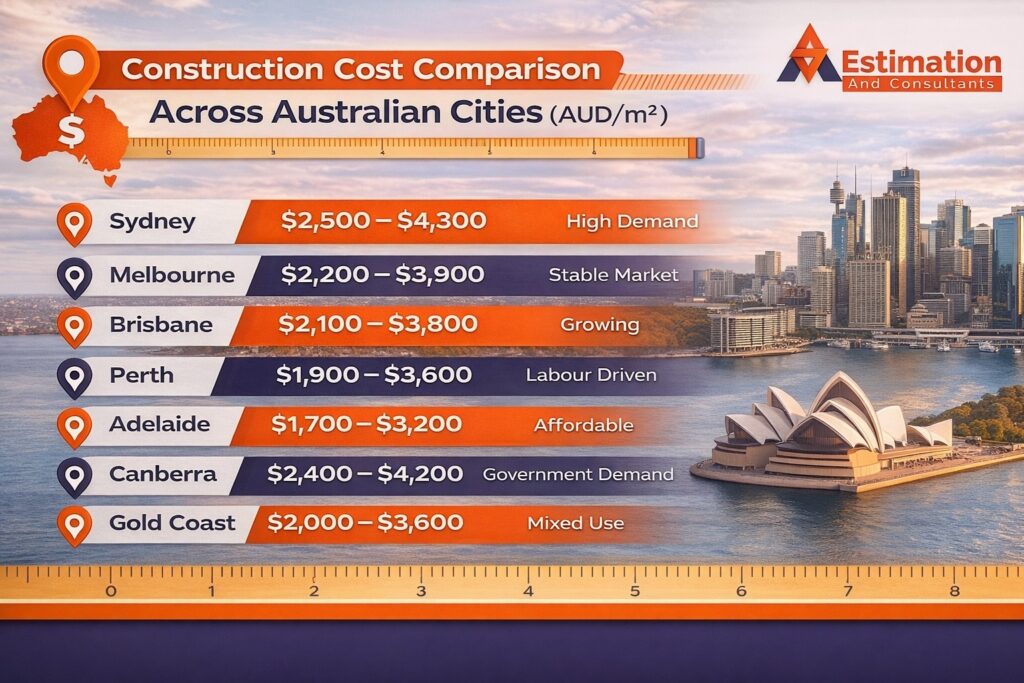
Construction costs per square metre in Australia vary clearly by city. Sydney and Canberra sit at the top end, while Adelaide and Perth remain more affordable. These ranges give a reliable starting point before detailed estimating.
Use this quick comparison to set a realistic budget based on where you plan to build.
- Sydney – Highest Cost Range – Around AUD 2,500–4,300/m², driven by demand and premium Sydney construction costs.
- Melbourne – High but Controlled Pricing – Typically AUD 2,200–3,900/m² with stable Melbourne construction pricing.
- Brisbane – Balanced Growth Market – About AUD 2,100–3,800/m² reflecting steady Brisbane construction cost trends.
- Perth – Mid to High Variation – Around AUD 1,900–3,600/m² due to labour and logistics factors.
- Adelaide – Most Affordable Capital – Roughly AUD 1,700–3,200/m² with lower cost per square metre.
- Canberra & Gold Coast – Premium to Mid Range – Canberra AUD 2,400–4,200/m²; Gold Coast aligns with Brisbane ranges depending on build type.
Construction Cost Comparison by City (Real-World Breakdown)
Construction costs across Australian cities don’t just vary slightly—they can shift a lot depending on demand, labour supply, and project pressure. Sydney and Brisbane often lead in pricing, while Adelaide stays more affordable. These differences directly impact how you plan, price, and manage a project.
This breakdown gives you a real-world view of construction cost differences across Australian cities so you can estimate more accurately, not just rely on national averages.
Sydney – Highest Cost Market
Sydney construction costs remain among the highest in Australia, typically ranging around AUD 2,500–4,000+ per m² depending on build quality. Strong market demand and infrastructure pressure push labour and contractor rates higher. Limited land and strict compliance requirements also increase project complexity. This leads to consistent construction cost escalation by the city, where tender pricing variation across Australia is most noticeable in Sydney projects.
Melbourne – High but More Stable Pricing
Melbourne construction estimating sits slightly below Sydney, generally around AUD 2,000–3,800 per m². The market is still expensive but more balanced. Supply chains and labour availability are relatively stable, which reduces sudden cost spikes. In residential construction cost comparison across Australia, Melbourne offers more predictable budgeting, especially for volume housing and outer suburban developments.
Brisbane – Growing Market with Moderate Costs
Brisbane construction cost trends show steady growth, with typical ranges between AUD 1,800 and 3,500 per m². However, recent infrastructure investment and population growth are pushing prices up quickly. In some commercial sectors, Brisbane is now among the most expensive due to strong project pipelines and labour shortages. This makes Brisbane a fast-changing market where construction cost trends in Australia by region are clearly visible.
Perth – Labour-Driven Cost Fluctuations
Perth construction estimating is heavily influenced by workforce availability. Costs usually range around AUD 1,900–3,700 per m². When mining and resource sectors expand, labour shifts away from construction, increasing wages. This creates a strong regional labour cost impact on construction, where pricing can rise quickly even if material costs stay stable.
Adelaide – Most Cost-Efficient Metro
Adelaide construction cost per square metre is among the lowest, typically around AUD 1,700–3,200 per m². Lower population pressure and fewer large infrastructure projects keep costs stable. Compared to other capitals, the metro vs regional construction cost differences are smaller here, making Adelaide a reliable option for budget-focused residential builds.
Canberra – Government Demand Impact
Canberra construction cost is shaped by strong government and institutional demand.
Public sector projects create steady competition for contractors and skilled labour. This leads to higher pricing during peak periods and clear tender pricing variation across Australia, especially when large government projects are active.
Gold Coast – Tourism & Residential Mix
Gold Coast construction costs sit close to Brisbane but vary more by project type. High-rise residential, tourism developments, and lifestyle housing all influence pricing differently. This makes construction estimating for different Australian markets essential, as costs can shift depending on whether the project is residential, commercial, or mixed-use.
Key Cost Drivers In Construction
Construction costs in Australia are driven by a few core factors that change from city to city. These are not random—they follow clear market patterns like labour shortages, supply chain pressure, and demand spikes.
Understanding these key cost drivers helps you estimate smarter and avoid underpricing your project from the start.
Labour Costs by City
Labour cost construction in Australia is one of the biggest drivers of total cost. Skilled labour shortages across the country continue to push wages higher, especially in busy cities and infrastructure-heavy regions. This regional labour cost impact on construction means your estimate must adjust based on local workforce demand. In high-activity markets, labour alone can significantly increase total project costs and timelines.
Material & Supply Chain Costs
Construction material cost in Australia depends heavily on supply chains, energy prices, and transport. Key materials like cement, timber, and plasterboard have seen price increases due to higher input and energy costs. Material supply cost differences across Australia are also affected by freight distances and import reliance. Remote or fast-growing regions often face higher costs due to delays, logistics, and limited supplier access.
Demand & Infrastructure Pressure
Construction demand in Australia plays a major role in pricing. Strong building activity, population growth, and infrastructure projects increase competition for labour and materials. This market demand and infrastructure pressure explain why construction costs vary by location in Australia. When demand is high, prices rise quickly, especially in cities with large project pipelines like Sydney and Brisbane.
Tender Pricing & Procurement Differences
Construction tender pricing in Australia changes based on market conditions and procurement strategy. When contractors are busy, they price higher to manage risk and workload. Tender pricing variation across Australia is also influenced by contract type, competition, and project size. Choosing the right procurement strategy by location is critical, as it can directly affect overall project cost and value.
How to Estimate Construction Costs Across Multiple Cities
Estimating across cities in Australia is not about using one number everywhere. Each location has its own cost pattern, so you need to adjust your estimate step by step.
A clear multi-city estimating strategy helps you stay accurate, control risk, and avoid underpricing your project.
- Step 1 – Start with a Base Benchmark – Use a reliable cost benchmarking by location to set your starting rate per m².
- Step 2 – Adjust for City Factors – Apply estimating adjustments by city based on labour, materials, and demand.
- Step 3 – Add Contingency for Risks – Include extra allowance for regional risks like delays and price changes.
- Step 4 – Validate with Local Data – Check your estimate against current market quotes and supplier pricing.
- Step 5 – Review Before Final Pricing – Recheck all assumptions to ensure your numbers reflect real project conditions.
Residential vs Commercial Construction Costs by City
Construction costs for residential and commercial projects in Australia are not the same. They follow different pricing structures, levels of complexity, and risk profiles. Using the wrong benchmark can lead to serious budget errors.
This section helps you understand construction estimating for different Australian markets so you can price projects correctly from the start.
Residential vs Commercial Cost Comparison (Australia Benchmarks)
| Project Type | Typical Cost Range (AUD/m²) | Key Cost Drivers | Complexity |
| Residential (Standard Homes) | 1,900 – 4,300 | Simpler design, lower compliance, faster builds | Low–Medium |
| Residential (High-End) | 3,500 – 6,000+ | Custom design, premium finishes | Medium |
| Commercial (Office/Retail) | 2,500 – 5,500 | Services, compliance, fit-outs | Medium–High |
| Industrial/Warehouse | 1,500 – 3,800 | Structure-focused, lower finishes | Medium |
| Healthcare / High-Spec | 3,000 – 6,000+ | Complex systems, strict regulations | High |
Benchmarks based on Australian quantity surveying data and industry reports (Altus Group, Rawlinsons, CESOL, 2025).
Residential Construction – More Predictable Costs
Residential construction cost comparison in Australia shows that housing projects are generally more predictable. Standard designs, repeated layouts, and simpler compliance rules keep costs within a defined range. National averages sit around AUD 1,900–4,300 per m², depending on quality and city.
Because of this, estimating is easier. Most risks are known early, and cost variations mainly come from finishes, site conditions, and location rather than structural complexity.
Commercial Construction – Higher and More Variable Costs
Commercial construction pricing by city in Australia is higher and less predictable. Office, retail, and mixed-use projects typically range from AUD 2,200–5,500 per m², with some sectors going even higher.
These projects involve more services like HVAC, fire systems, lifts, and complex structures. Design changes, approvals, and longer timelines increase both cost and risk compared to residential builds.
Key Differences That Impact Estimation
- Design Complexity Matters More in Commercial – More systems and coordination increase cost.
- Compliance Is Much Stricter – Commercial projects must meet higher safety and accessibility standards.
- Labour Skill Levels Differ – Commercial builds need specialised trades, increasing labour cost construction in Australia.
- Material & Fit-Out Costs Are Higher – Interiors and services drive up commercial costs significantly.
- Time = Cost in Commercial Projects – Longer build times increase overheads and risk exposure.
What This Means for Your Estimate
If you’re estimating across cities, you must also adjust for project type. Residential projects follow clearer cost patterns, while commercial builds require deeper analysis, contingency, and city-specific adjustments.
Ignoring this difference is one of the biggest reasons construction estimates go wrong in Australia.
Common Mistakes When Estimating Across Cities
Estimating across cities can go wrong if you treat every location the same. Costs change with labour, materials, and demand, so one fixed rate rarely works.
Avoiding these construction estimating mistakes helps you build a stronger city-based construction estimating strategy and protect your budget.
- Using One Rate for All Cities – Ignoring estimating adjustments by city leads to inaccurate budgets.
- Skipping Local Labour Checks – Labour costs vary and can shift quickly by location.
- Ignoring Material Logistics – Freight and supply delays increase costs in some regions.
- No Contingency Planning – Missing contingency planning for regional variation exposes you to risk.
- Relying on Old Data – Outdated rates don’t reflect current market conditions.
- Not Validating Locally – Always check quotes with local suppliers and contractors.
FAQs
The average construction cost per m² in Australia by city usually ranges from AUD 1,700 to AUD 4,500, depending on location and build type. Sydney and Canberra are at the higher end, while Adelaide and Perth are more affordable. The final cost also depends on design, materials, and labour availability.
Construction costs vary across Australian cities because labour rates, material supply, and demand are different in each location. Cities with high population growth and infrastructure projects often have higher prices. This is why construction cost differences across Australia can be significant from one city to another.
To estimate construction costs for different cities in Australia, start with a base rate per m² and then apply estimating adjustments by city. You should also include contingency planning for regional variation and validate your estimate using local supplier quotes and contractor pricing.
Yes, construction is more expensive in Sydney compared to other cities because of high demand, labour shortages, and strict regulations. Sydney construction costs are among the highest in Australia, which makes accurate estimating even more important when planning a project there.
The difference between residential and commercial construction costs in Australia comes down to complexity and requirements. Residential builds are simpler and more predictable, while commercial projects involve more systems, stricter compliance, and higher labour costs, making them more expensive.
Final Thoughts: Choosing the Right City for Your Budget
Choosing the right city is not just about land price—it’s about the full construction picture. Labour, materials, demand, and local conditions all shape your final cost. That’s why construction cost estimation in Australia by city matters when planning any project. A smart decision comes from comparing cities using real data, not assumptions. With the right guidance, you can reduce risk and stay within budget. At AS Estimation & Consultants, we help you plan with accurate, location-based estimates so you can move forward with confidence and clarity.