Commercial painting costs in Australia vary depending on the building type, surface condition, paint specification and access requirements. For a standard commercial interior repaint in 2027, the latest published guides indicate approximately 20–45 per m², while exterior commercial painting can range from 40–100 per m². However, these rates are indicative and can vary with labour, materials, preparation and project complexity.
To help, AS Estimation & Consultants supports builders, painting contractors and property owners understand project costs through detailed painting takeoffs and cost estimates. Specifically, this guide compares commercial painting rates for offices, retail shops, warehouses and factories. In addition, it explains labour charges, surface preparation, specialist coatings and access equipment, helping you understand how commercial painting quotes are calculated and what to check before approving a project.
How Much Does Commercial Painting Cost per m² in Australia in 2027?
Standard interior commercial painting is approximately 20–45 per m², while exterior work is approximately 40–100 per m² in the latest published guides, a sound starting point for 2027 budgets. Specialist coatings and difficult access can increase the total.
Overall, the commercial painting price per square metre depends on what is being painted and what the quoted rate includes. For example, interior wall and ceiling repainting is generally less complex than exterior facade work, which may require additional preparation, access equipment and weather-resistant coatings.
Indicative commercial painting rates per m²
First, the following table provides indicative Australian pricing benchmarks. Rates are in Australian dollars, so treat them as preliminary budgeting allowances rather than confirmed contractor quotations.
| Commercial painting work | Indicative commercial rate per m² | What’s included or excluded |
|---|---|---|
| Interior office walls and ceilings | 20–45 | Standard repaint; preparation and access requirements must be confirmed |
| Retail interior painting | 20–45 | Standard interior repaint; excludes unusual finishes and difficult access |
| Warehouse and factory walls | 15–45 | Standard wall painting; high-access requirements may cost extra |
| Exterior commercial facades | 40–100 | Exterior repainting; access and preparation affect pricing |
| Structural steel repainting | 15–45 | Standard in-situ steel repainting; protective systems may cost more |
| Industrial protective coatings | 50–140 | Specialist coating systems; specification and substrate condition affect cost |
| Fire-rated coatings | 45–130 | Indicative specialist coating rates; system requirements need verification |
Pricing basis: the latest published 2027 market guides. The figures are not a single consistent national tariff. In addition, publishers do not consistently disclose GST treatment, labour and material inclusions, or measurement basis, so confirm these before using the rates in a project budget.
Why per m² rates can be misleading
One important distinction is the measurement area. A commercial painting rate per m² may refer to the actual wall or ceiling surface, not the building’s floor area. For example, a 500 m² office floor does not necessarily have 500 m² of paintable wall and ceiling surfaces.
There is also a noticeable difference between published guides. Some place standard interior work around 20–45 per m², while another published guide gives 60–100 per m² for standard commercial interior painting. As a result, this spread highlights the importance of checking the scope, preparation, number of coats and inclusions rather than comparing headline rates alone.
Commercial Painting Costs by Building Type
Offices and retail premises generally cost more per m² than large warehouse walls because they have more partitions, doors, detailed finishes and restricted working hours.
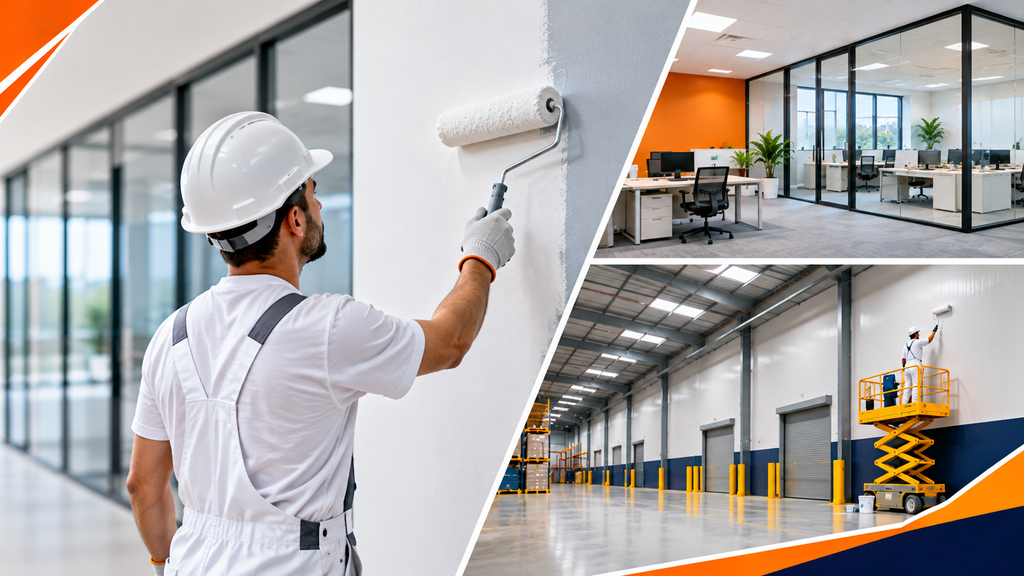
In particular, the building’s purpose affects the painting scope. An office repaint may involve walls, ceilings, meeting rooms, corridors and door frames, while a warehouse project may concentrate on large wall surfaces, structural steel and high-level areas.
How much does it cost to paint an office?
Budget approximately 25–60 per m² of painted wall area for an office repaint, depending on the layout, surface condition and access arrangements.
Currently, published Australian guides show office painting rates around 25–50 per m², with a Perth commercial contractor publishing a broader 35–60 per m² range. In short, the difference reflects local pricing and the scope included in the work.
In practice, the number of partitions, meeting rooms, reception areas and internal doors influences office painting cost. For instance, a relatively open office with clear access is usually easier to paint than a fitted-out workplace with furniture, equipment and detailed architectural finishes.
In most cases, office painting requirements include:
-
- Interior walls, plasterboard partitions and ceilings.
-
- Meeting rooms, reception areas and corridors.
-
- Door frames, skirting boards and window surrounds.
-
- Feature walls and different colour finishes.
-
- Low-VOC paint where the building remains occupied.
-
- After-hours painting to minimise disruption to employees.
In addition, ceiling painting can require extra equipment where services, lighting fixtures and suspended ceiling systems restrict access. The estimator should measure wall and ceiling surfaces separately rather than applying one rate to the entire floor area.
How much does it cost to paint a retail shop?
Standard retail painting can use the same initial commercial interior budgeting range of approximately 20–60 per m², but shopfront details, trading hours and specialist finishes can increase the quote.
Typically, retail shop painting involves more than repainting walls. The scope may include display areas, fitting rooms, counters, doors, shopfront surrounds and feature finishes.
However, the main pricing challenge is usually working around business operations. For instance, a shopping centre or retail tenant may require painting after closing, overnight or in stages so customers and staff can continue using the premises.
Similarly, typical retail painting requirements include:
-
- Walls, ceilings and display areas.
-
- Feature walls and decorative finishes.
-
- Shopfront surrounds and internal doors.
-
- High-traffic corridors and customer areas.
-
- Low-odour coatings for occupied premises.
-
- After-hours and weekend work.
Therefore, retail quotations should identify the exact working hours in the quotation. For example, a contractor pricing a vacant shop during normal business hours may produce a substantially different figure from one required to complete the same work overnight.
How much does it cost to paint a warehouse or factory?
The latest published guides indicate approximately 15–45 per m² for 2027 warehouse and factory wall painting. High ceilings, structural steel and industrial coating requirements need separate consideration.
On the other hand, warehouse painting cost is often lower per m² for large, uninterrupted wall surfaces. Even so, the overall project can become more expensive when painters need elevated work platforms, scaffolding or specialised protective coatings.
Factory environments may also need extra preparation because of dust, grease, moisture, corrosion and existing coating deterioration.
Likewise, common warehouse and factory painting work includes:
-
- Internal concrete and masonry walls.
-
- External metal cladding and building facades.
-
- Structural steel beams and columns.
-
- Factory ceilings and high-level surfaces.
-
- Protective coatings for exposed metalwork.
-
- Floor coatings and line marking.
Therefore, do not combine all these activities into one standard wall-painting rate. Epoxy floor coating, line marking and steel painting involve different materials, preparation methods and application requirements.
For this reason, on large industrial projects a trade-by-trade painting takeoff helps identify the actual quantities and separate standard painting from specialist coating work.
Do Commercial Painters Charge per m², per Hour or per Day?
Commercial painters use all three pricing methods. Contractors commonly quote larger projects as fixed-price jobs, while hourly and day rates are useful for smaller tasks, maintenance and difficult-to-measure work.
Generally, the pricing method depends on the size and complexity of the project.
| Pricing method | Indicative rate | Common application |
|---|---|---|
| Commercial painting per m² | 20–45 for standard interior work | Large, measurable wall and ceiling surfaces |
| Commercial painter hourly rate | 65–95 per hour (published Perth guide) | Touch-ups, repairs and restricted-access work |
| Commercial painter day rate | 520–760 per day (published Perth guide, 8 hours) | Maintenance and smaller work packages |
| Fixed project price | Based on the complete scope | Office, retail and industrial projects |
Hourly and daily rates above are from a Perth commercial painting contractor’s 2027 guide. They are not national averages. GST treatment should be confirmed with the contractor.
However, an hourly labour rate is not the same as an employee’s wage. A painting contractor’s charge-out rate can account for labour, business overheads, equipment, insurance and operating costs. Whether the rate includes paint and other materials depends on the agreement.
For a larger project, however, a fixed quotation is generally easier to assess because it establishes the agreed scope and price before work begins.
So, when reviewing a quote, check whether the contractor has included:
-
- Labour and supervision.
-
- Paint, primer and consumables.
-
- Surface preparation.
-
- Access equipment and equipment hire.
-
- Site protection and clean-up.
-
- After-hours or weekend allowances.
What Affects Commercial Painting Costs?
Surface preparation, paint specification, access equipment, working hours, ceiling heights, specialist coatings and project location are the main factors that influence commercial painting costs.
In fact, two commercial buildings with similar floor areas can have very different painting requirements. The following factors explain why.
1. Surface preparation
First, existing surfaces need to be suitable for the new coating system. Preparation may involve washing, sanding, filling cracks, patching damaged plasterboard, removing loose paint and treating rust.
Consequently, poor surface conditions increase labour requirements and material consumption. For this reason, measure and price preparation separately where it falls outside the standard repaint allowance.
A 2027 commercial cost guide publishes an indicative surface preparation allowance of 8–25 per m². This includes activities such as washing, sanding, patching and priming, although you should confirm the actual scope.
2. Primer, number of coats and paint specification
Next, a painting quote should identify the proposed paint system rather than simply state that two coats will be applied.
In particular, the specification should clarify:
-
- Paint manufacturer and product range.
-
- Primer type and compatibility with the substrate.
-
- Number of primer and finish coats.
-
- Required colour and sheen.
-
- Expected coverage and application method.
-
- Drying and curing requirements.
Similarly, a surface requiring stain blocking, corrosion protection or a specialist primer will need a different allowance from a straightforward repaint.
3. Access equipment and working heights
Similarly, high walls, ceilings, stairwells and external facades can require additional access arrangements.
Depending on the site, contractors may therefore need:
-
- Scissor lifts for elevated internal work.
-
- Boom lifts for external or difficult-to-reach surfaces.
-
- Scaffolding for extended facade work.
-
- Additional equipment operators and site controls.
A 2027 published guide indicates high-access equipment allowances of approximately 500–2,000 per day. Still, this is a broad budgeting range, not a guaranteed equipment hire quotation.
Furthermore, working at heights requires suitable risk controls and competent personnel. Therefore, establish site-specific requirements before pricing the work.
4. After-hours or staged painting
Commercial premises do not always close for maintenance. As a result, offices, shops, medical facilities and warehouses may need painters to work overnight or in separate work zones.
Naturally, after-hours painting can increase costs because of labour arrangements, additional mobilisation, restricted working periods and repeated site setup.
Staging can also extend the project duration. For example, a contractor may complete one floor, department or retail section at a time rather than painting the entire building continuously.
5. Ceiling heights and building layout
Generally, a large open warehouse wall is easier to measure and paint than an office with numerous partitions, doorways and service installations.
Likewise, high ceilings, exposed services, suspended ceiling grids and restricted spaces can reduce productivity. The estimator should consider both the surface area and the practical conditions under which the work will be completed.
6. Specialist coatings and additional painting work
In addition, some commercial environments require more than standard decorative paint.
| Specialist work | What affects the cost |
|---|---|
| Epoxy floor coating | Concrete condition, grinding, repairs and coating thickness |
| Line marking | Layout, line widths, traffic requirements and coating type |
| Steel painting | Rust removal, surface preparation and corrosion protection |
| Fire-rated coatings | Required fire performance, tested system and application thickness |
| Low-VOC paint | Product specification, substrate and application requirements |
Price fire-rated coatings against the specified system and required performance. In other words, do not treat them as interchangeable with ordinary decorative paint.
Similarly, epoxy floor coating needs a separate scope covering concrete preparation, repairs, primer, coating layers and curing requirements.
7. Project location
Also, commercial painting rates can differ between Australian cities and regional areas. Labour availability, contractor travel, material transport and equipment hire can all affect the final quotation.
For example, a project in a regional location may require travel and accommodation allowances. Meanwhile, larger metropolitan projects may have higher operating costs or more complex access arrangements.
For this reason, a national rate should be used as an initial budgeting reference, not as a substitute for local project pricing.
Why Is Commercial Painting More Expensive Than Residential?
Commercial painting often costs more because projects involve larger operational requirements, stricter scheduling, specialised coatings, access equipment and coordination with other building activities.
To begin with, residential painting generally involves smaller spaces with relatively straightforward access. By contrast, commercial painting can require a coordinated team working around employees, tenants, customers and other contractors.
In short, the main differences include:
| Cost consideration | Residential painting | Commercial painting |
|---|---|---|
| Project size | Usually smaller areas | Often larger buildings and multiple work zones |
| Working hours | Generally standard hours | May require night or weekend shifts |
| Access | Often standard ladders and platforms | May require lifts and scaffolding |
| Paint specification | Mainly decorative finishes | Decorative and specialist coating systems |
| Preparation | Depends on property condition | May involve large-scale surface repairs |
| Site management | Generally simpler | May involve inductions, staging and coordination |
| Safety planning | Depends on work involved | Often requires more extensive site-specific controls |
Commercial projects also need clearer documentation. Before submitting a reliable price, contractors must understand the building’s operating conditions, access restrictions and required completion dates.
For a broader comparison of painting work, see our guide to residential and general painting costs in Australia.
Worked Example: Estimating the Cost to Paint an Office
Under the assumptions below, painting 600 m² of office wall surface would cost approximately $30,900 excluding GST, including a separate preparation allowance and one day of high-access equipment.
Below, this example demonstrates how a commercial painting estimate can be developed from measured quantities and published budgeting rates.
Note that the figures are illustrative estimating assumptions, not a contractor quotation.
Step 1: Establish the paintable area
To start, assume an office project has:
-
- Measured wall area: 600 m².
-
- Standard interior repaint.
-
- Existing surfaces requiring moderate preparation.
-
- Normal commercial paint specification.
-
- One day of high-access equipment.
Note that the 600 m² represents actual wall surface, not the office floor area.
Step 2: Calculate the standard painting cost
Next, use an assumed commercial painting rate of $35 per m², within the published standard interior pricing range.
600 × $35 = $21,000
Base painting allowance: $21,000
Step 3: Add surface preparation
After that, assume a separately measured preparation rate of $15 per m².
600 × $15 = $9,000
Preparation allowance: $9,000
Step 4: Add access equipment
Finally, allow one day of high-access equipment at an assumed $900.
Access equipment allowance: $900
Step 5: Calculate the estimated project total
| Cost component | Estimated amount |
|---|---|
| Standard painting | $21,000 |
| Surface preparation | $9,000 |
| High-access equipment | $900 |
| Subtotal excluding GST | $30,900 |
| GST at 10% | $3,090 |
| Total including GST | $33,990 |
Importantly, the example assumes the base painting rate includes labour, paint and standard application materials, but excludes separately itemised preparation and access equipment. The source guides do not consistently disclose GST treatment; this calculation explicitly presents its assumed pre-GST amounts and adds GST at 10%.
Equally, the example excludes after-hours premiums, major repairs, specialist coatings, furniture relocation and additional site management. Add these items if the actual project requires them.
Ultimately, a measured painting estimate helps separate the painted area, preparation quantities, coating specifications and additional work before you finalise a tender price.
Need a commercial painting estimate for an upcoming tender? Send us your plans for a measured painting takeoff.
What Should a Commercial Painting Quote Include?
A commercial painting quotation should identify measured surfaces, preparation work, paint specifications, labour, equipment, working hours, exclusions and GST.
Remember, a low headline rate does not necessarily represent the lowest project cost. Instead, the scope of work determines whether the contractor has allowed for everything required to complete the job.
Then, use this checklist when reviewing commercial painting quotations:
-
- Building areas and surfaces to be painted.
-
- Measured wall, ceiling and external surface quantities.
-
- Surface preparation and repair requirements.
-
- Primer type and number of finish coats.
-
- Paint brand, product specification and colour.
-
- Labour, supervision and material allowances.
-
- Scissor lift, boom lift or scaffolding requirements.
-
- After-hours, weekend or staged working arrangements.
-
- Specialist coatings, steel painting and floor finishes.
-
- Site protection, cleaning and waste removal.
-
- Project duration and proposed completion schedule.
-
- Exclusions, variations and additional charges.
-
- GST treatment and payment terms.
Finally, check whether the quotation covers the entire project or only selected areas. For example, a contractor might include walls but exclude ceilings, doors, frames and external surfaces.
Our guide on how to read and understand a painting estimate explains the information to check when comparing quotations.
For projects involving both internal and external surfaces, our guide to interior vs exterior painting estimates provides further context.
How AS Estimation Helps With Commercial Painting Estimates
AS Estimation & Consultants prepares painting takeoffs and estimates from project plans to help builders and painting contractors price commercial tenders.
After all, commercial painting estimates require accurate measurements and a clear understanding of the specified work. To do this, our estimating team reviews available drawings and project information to identify painting quantities and organise the scope for pricing.
AS Estimation & Consultants brings experience from 11,000+ projects, with 7+ years of experience and a team of 60+ estimators.
Our painting estimating services support painting contractors and builders preparing commercial project tenders. We also provide commercial estimating services for broader construction estimating requirements.
Send us your plans through our contact page to discuss a commercial painting estimate.
Conclusion
In summary, commercial painting costs in Australia depend on more than the size of the building. Surface preparation, paint specifications, labour requirements, access equipment and working hours all influence the final project cost. Moreover, offices, retail premises and warehouses have different painting requirements, so applying one standard commercial painting rate to every project can lead to inaccurate budgets.
Before accepting a contractor’s quotation or submitting a tender, review the measured painting quantities, material allowances, preparation requirements and project exclusions. As a result, a detailed estimate helps identify potential cost gaps and provides a clearer basis for comparing quotations.
AS Estimation & Consultants provides commercial painting takeoffs and estimates to help builders and painting contractors price projects with greater clarity. Contact our estimating team to discuss your commercial painting project.
Frequently Asked Questions
Do commercial painters charge per hour or per m²?
Commercial painters use both pricing methods. Contractors commonly quote larger projects using measured surface areas or a fixed project price, while hourly rates are more suitable for maintenance, repairs and small painting jobs.
Is after-hours commercial painting more expensive?
Yes. After-hours commercial painting can cost more because of night-shift labour arrangements, restricted working periods and additional site setup. The actual premium depends on the contractor’s labour arrangements and project requirements.
How long does it take to paint an office?
The duration depends on the paintable area, surface preparation, number of coats, drying times and available working hours. For example, a small office may take several days, while larger commercial floors can require multiple weeks. Prepare a reliable programme only after reviewing the drawings and site conditions.
How is a commercial painting quote calculated?
A commercial painting quote is calculated using measured surface areas, labour requirements, paint quantities, preparation work, equipment hire and project-specific allowances. The estimator then combines these costs to establish the total project price, including applicable GST.
Does a commercial painting price include preparation?
Not always. While some contractors include standard preparation in their commercial painting rates, others price washing, sanding, patching and priming separately. Always check the quotation for specific preparation inclusions and exclusions.
What is included in a commercial painting estimate?
A commercial painting estimate generally includes measured painting quantities, labour, paint and materials, surface preparation, primer, finish coats and relevant equipment allowances. However, the estimate should identify specialist coatings and after-hours work separately where applicable.
How can I reduce commercial painting costs?
Above all, you can control costs by arranging clear site access, coordinating painting with other maintenance or fit-out work, confirming paint specifications early and avoiding unnecessary changes. In addition, accurate drawings help estimators measure quantities and identify additional requirements before tender submission.