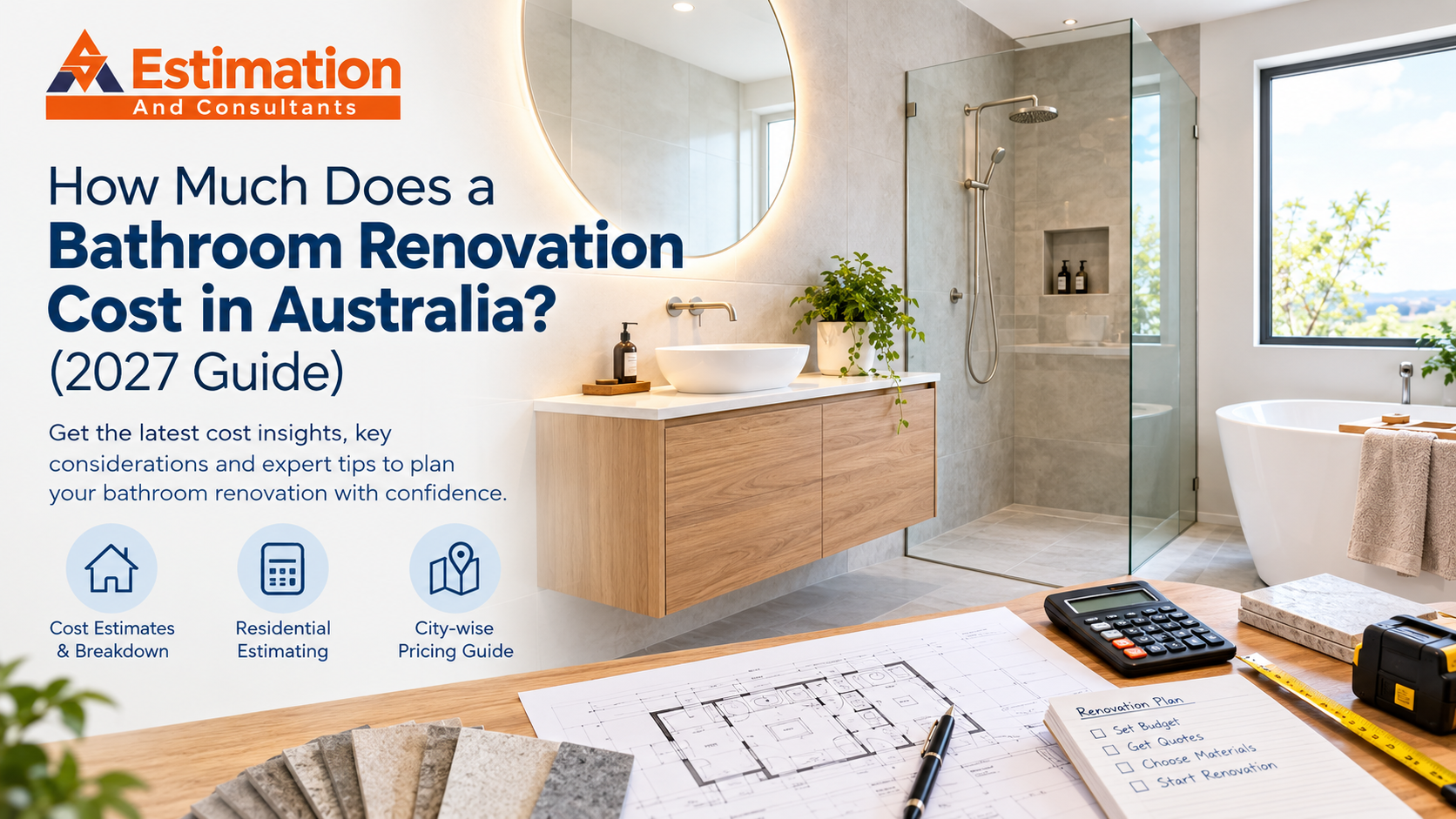
Most full bathroom renovations in Australia cost somewhere between $15,000 and $35,000 in 2026. A simple job that keeps the existing layout can come in closer to $12,000. A high-end bathroom with stone, custom joinery and relocated plumbing can go well past $40,000.
That’s a wide range, and there’s a reason for it. The final price comes down to the size of the room, whether the plumbing stays put, the tiles and fixtures you choose, local labour rates, and what the builder finds once the old tiles come off.
At AS Estimation & Consultants, we price renovations trade by trade, and this guide draws on that same approach. Below you’ll find realistic 2026 figures by finish level, bathroom type, trade and city, along with the hidden costs that catch people out and a practical way to compare builder quotes.
How Much Does a Bathroom Renovation Cost in Australia in 2026?
Here’s a starting point for planning:
| Renovation level | Indicative 2026 budget | Typical scope |
| Budget | 12,000–20,000 | Existing layout, standard fixtures and finishes |
| Mid-range | 20,000–35,000 | Full renovation with better fixtures and finishes |
| Premium | 35,000–60,000+ | Premium materials, custom joinery, layout changes |
Treat these as planning ranges, not quotes. Numbers shift once the room is opened up and the product list is locked in.
Part of the reason online estimates vary so much is that “bathroom renovation” covers very different jobs. Swapping a vanity, toilet and tapware is a small project. Stripping the room back to the frame and redoing waterproofing, tiling, plumbing, electrical, cabinetry and the shower screen is a proper construction job. When you’re comparing prices, compare what’s actually included, not just the total.
Bathroom Renovation Cost by Finish Level
Budget bathroom renovation: 12,000–20,000
A budget renovation works best when the toilet, shower and vanity stay exactly where they are. Moving a toilet or floor waste often costs more than the new fixture itself, so leaving the drainage alone is the single easiest way to protect your budget.
At this level you’re typically looking at standard ceramic or porcelain tiles, a modular vanity, a standard toilet and tapware, a basic shower screen, a new mirror, updated lighting, a new exhaust fan and fresh waterproofing.
Cheap and cutting corners aren’t the same thing, though. Waterproofing, plumbing, drainage and electrical work still need to be done properly. Save on the finishes you can see, not on the work that protects the house.
Mid-range bathroom renovation: 20,000–35,000
This is the price range many Australian homeowners can expect for a complete bathroom renovation. You’d usually get quality porcelain tiles run floor to ceiling, a wall-hung vanity, a frameless or semi-frameless screen, modern tapware, a shower niche, better storage and lighting, and a decent exhaust fan.
Product choices drive a lot of the variation here. A bathroom finished in $80/m² tiles with an off-the-shelf vanity has a very different materials bill from one using large-format porcelain, a stone top and custom cabinetry.
Luxury bathroom renovation: 35,000–60,000+
Premium bathrooms start around $35,000 and highly customised projects can reach $60,000 to $80,000 or more. Think natural stone, large-format tiles, a freestanding bath, a wall-hung toilet with an in-wall cistern, designer tapware, heated floors, feature lighting, skylights and high-end shower systems.
The products cost more, but so does the installation. Large-format tiles require a properly prepared, level surface and more careful installation. Stone has to be templated accurately. Custom joinery has to be measured, built and fitted. Complex plumbing layouts simply take longer.
Bathroom Renovation Cost by Size and Type
Size matters, but you can’t just multiply floor area by a rate. A 4 m² bathroom still needs a plumber, an electrician, a waterproofer and a tiler. It still needs demolition, rubbish removal and fit-off. Those fixed costs are why small bathrooms often look expensive per square metre.
Small bathroom renovation cost
A bathroom under 5 m² usually costs around $12,000 to $25,000. You save on tiles and some materials, but you still need nearly every trade a larger bathroom needs, so the savings are smaller than most people expect.
Ensuite renovation cost
Ensuites commonly come in at $15,000 to $30,000. They’re smaller, but homeowners tend to spend more per square metre on finishes because there’s less area to cover. A walk-in shower, wall-hung vanity, frameless screen, feature tiles and a niche are typical. Keeping the existing plumbing positions matters even more here, since tight ensuites rarely leave room for alternative layouts anyway.
Main bathroom renovation cost
A main family bathroom usually runs $20,000 to $40,000 or more. The bigger footprint means more tiling, and families often want a double vanity, a separate shower and bath, more storage and bigger mirrors. If kids are using it every day, durability deserves as much thought as looks.
Powder room renovation cost
With no shower or bath, a powder room is the cheapest wet area to renovate, usually $5,000 to $12,000. It can still get pricey once you add custom joinery, stone, or move the plumbing.
Bathroom-laundry renovation cost
Combining the two usually costs $20,000 to $35,000 or more. You’re fitting two working rooms into one space, which means extra plumbing and drainage, laundry connections, more cabinetry, more power points and better ventilation.
Bathroom Renovation Cost Per Square Metre
You’ll often see 3,000–6,000 per m² quoted as a rough guide. It’s useful for a first sense check and not much more. Because so many bathroom costs are fixed regardless of room size, a per-square-metre figure tends to underprice large bathrooms and overprice small ones.
For a budget you can actually rely on, the project needs to be priced by trade, quantity and specification.
Bathroom Renovation Cost by Australian City
Location changes the price, but a city average won’t tell you what your bathroom will cost. A third-floor Sydney apartment with no parking is a completely different job from a ground-floor bathroom in a suburban house with a driveway. Labour rates, trade availability, access, travel time, waste disposal and the age of the building all feed in.
As rough mid-range planning figures for 2026:
| City | Indicative mid-range budget |
| Sydney | 25,000–38,000 |
| Melbourne | 22,000–35,000 |
| Canberra | 23,000–35,000 |
| Darwin | 22,000–36,000 |
| Brisbane | 20,000–32,000 |
| Perth | 20,000–32,000 |
| Adelaide | 18,000–30,000 |
| Hobart | 18,000–30,000 |
Work hours, common-area protection and strata sign-off, all of which add time. Older homes in Melbourne and Adelaide have a habit of revealing problems with framing, flooring or old plumbing once demolition starts. In Brisbane, ventilation and moisture management deserve extra attention. Regional projects can be affected more by freight and trade availability than by any city average.
This is where residential cost estimation earns its keep. A city range gives you a rough idea, but an estimate built on your actual bathroom, its access, its age and your chosen finishes tells you what the job should really cost.
Bathroom Renovation Cost Breakdown by Trade
This is where the money usually goes:
| Item | Indicative cost range |
| Demolition and rubbish removal | 1,500–3,500 |
| Waterproofing | 800–2,000 |
| Plumbing and drainage | 3,000–8,000 |
| Electrical and lighting | 1,000–3,500 |
| Tiling (supply and install) | 3,500–9,000 |
| Vanity | 500–4,000 |
| Toilet | 300–1,500 |
| Shower screen | 600–2,500 |
| Bath | 500–4,500 |
| Tapware and accessories | 800–3,000 |
| Exhaust fan, painting and finishing | 600–1,800 |
Don’t add these up and call it a quote. Some scopes overlap, and quantities differ a lot from one bathroom to the next. The table shows you the shape of the budget. A proper estimate builds it from real measurements and a real product list.
Demolition
Stripping a bathroom and removing the waste usually costs $1,500 to $3,500. Access is the detail people forget. Carrying broken tiles and an old bath down three flights of stairs takes a lot longer than tipping them into a skip from a ground-floor window.
If the house is older and asbestos is a possibility, get it tested before anything is pulled out. Licensed removal may be required, and that’s a separate cost.
Waterproofing
Expect around $800 to $2,000 for a standard bathroom. Cutting costs here could end up costing you more in the long run. A failed membrane lets water into floors and wall cavities, and the repair bill for mould, rotted timber and damaged subfloors will dwarf whatever you saved.
Wet-area work falls under the National Construction Code. NCC 2022 references AS 3740:2021 for domestic waterproofing as one way to comply, though exact requirements depend on the building. Get the waterproofing specification confirmed before work starts.
Plumbing
Allow roughly $3,000 to $8,000 for plumbing and drainage. The big question is whether anything moves. Keeping the toilet in the existing position keeps the replacement process straightforward. Moving it across the room can mean new drainage, cutting into the floor and reinstating everything afterwards. On a concrete slab, that can escalate quickly.
Electrical
Electrical work usually lands between $1,000 and $3,500, depending on how many downlights, power points and extras you want. A heated towel rail, illuminated mirror or underfloor heating all add wiring. All of it needs a licensed electrician.
Tiling
Tiling is one of the biggest line items, typically $3,500 to $9,000. Tile prices range from cheap to eye-watering, and installation gets slower (and dearer) with large formats, herringbone, mosaics, feature walls, niches, lots of cuts or uneven walls. A plain rectangular room with standard tiles is a very different job from one clad in large-format stone-look porcelain with two niches.
Fixtures
Vanity, basin, toilet, bath, shower, screen, tapware, mirror and storage. A modular vanity can cost a fraction of custom cabinetry with a stone top, and the same spread applies to almost every fixture. When you get quotes, check what fixture allowances each builder has used. Two quotes that look similar can be built on completely different product assumptions.
Labour vs Materials
Bathrooms are labour-heavy because up to ten trades have to come through in the right order: demolition, plumbing and electrical rough-in, carpentry, waterproofing, tiling, cabinet install, fit-off, screen install and finishing. No fixed labour-to-materials ratio suits every job.
Here’s a simple way to think about it. Picking a vanity that’s $600 cheaper saves you $600. Leaving the toilet where it is could save several thousand. The decisions you make before demolition usually matter far more than the products you pick afterwards.
What Pushes the Price Up: A few decisions can turn a $20,000 bathroom into a $35,000 one.
Moving plumbing: Relocating toilets, showers, basins or floor wastes means new drainage and pipework.
Premium tiles: Stone, large formats and detailed patterns cost more to buy and more to lay.
Custom joinery: Made-to-measure cabinetry involves design, manufacturing and fitting.
What’s behind the walls: Rotted timber, damaged flooring, old pipework or a failed earlier waterproofing job can’t be priced accurately until the tiles come off.
Apartment access: Strata approval, lift bookings, limited work hours and waste arrangements all add time.
Hidden Costs to Plan For
The price tag on the showroom floor is rarely the full story.
Older homes may contain asbestos. A slow leak hidden behind tiles for years may only show up once the room is stripped, and it may have damaged the subfloor too. Old pipes might not be fit to connect to. Skip bins, floor protection, dust control and cleaning are easy to forget if you’re budgeting yourself. Depending on the job and where you live, you may also need approvals, inspections or certificates.
Put aside a contingency of around 10–15%. For older homes or bathrooms where nobody knows what’s under the floor, allow more.
Regulations, Waterproofing and Licensing
Rules vary by state and territory, building type and scope of work. The NCC sets the national framework for wet areas, while plumbing and electrical licensing is handled at the state level.
Before you start, find out whether your project needs building or plumbing approval, certification, strata or owners corporation approval, or heritage sign-off. This matters most in apartments, heritage homes and any job that changes walls, waterproofing or services. “It’s only a bathroom” isn’t a safe assumption.
How Long Does a Bathroom Renovation Take?
A straightforward bathroom usually takes three to five weeks. Bigger or more complex jobs take longer.
| Stage | Approximate duration |
| Demolition | 1–2 days |
| Plumbing and electrical rough-in | 2–3 days |
| Preparation and waterproofing | 2–3 days |
| Tiling | 3–6 days |
| Fixtures and screen installation | 2–3 days |
| Finishing and cleaning | 1–2 days |
The usual causes of delay are late products, trade scheduling, curing times, surprises behind the walls, and changes made mid-job. Order custom vanities, stone and made-to-measure screens early so they don’t hold everyone else up.
How to Save Money Without Cutting Corners
The biggest savings usually come from doing less unnecessary work, not buying cheaper things.
Keep the layout. Use standard tile sizes in a simple pattern, then spend on the one or two things you’ll actually notice, such as a feature wall, the vanity or the tapware. Choose your main products before the quote is finalised so everything is priced upfront. Order long-lead items early. And ask for an itemised estimate so you can see exactly where your money is going.
How to Compare Bathroom Renovation Quotes
Say three builders quote you $21,500, $28,000 and $34,000. The cheapest one isn’t automatically the best deal. There’s a good chance they aren’t pricing the same bathroom.
Before comparing totals, check whether each quote clearly covers demolition and waste, waterproofing, plumbing and drainage, electrical, tile supply and laying, every fixture, painting, ventilation, site protection, cleaning, certificates, GST and the builder’s margin.
Pay close attention to Prime Cost (PC) items and Provisional Sums. A low allowance makes a quote look attractive on paper. When the real tapware or tiles cost more than the allowance, you pay the difference.
The only fair comparison is like for like: same scope, same quantities, same specifications, same allowances and clearly listed exclusions.
Why Get an Independent Bathroom Renovation Estimate?
A builder’s quote tells you what that builder wants to charge. An independent estimate answers a different question: what should this work reasonably cost, based on the actual scope, quantities, materials and labour?
At AS Estimation & Consultants, we prepare itemised renovation estimates from your drawings, measurements and specifications. Depending on the project, we break down demolition, waste removal, waterproofing, plumbing, drainage, electrical, tiling, fixtures, cabinetry, shower screens, painting, labour and materials.
It isn’t meant to replace your builder’s quote. It gives you a second reference point, so you can spot missing items, understand what you’re paying for and compare contractors with more confidence.
Working on a bigger job? Take a look at our residential estimating services and room-by-room renovation cost guides.
Final Thoughts
Bathroom costs in Australia swing a lot depending on size, layout, finishes and what’s hiding behind the tiles. A realistic budget, a clear scope and quotes you can compare properly will save you more money than any single product choice.
If you’d like an itemised estimate before you commit to a builder, AS Estimation & Consultants can price your bathroom renovation trade by trade, so you start the project with a budget you can trust.
FAQs
What is the average cost of a bathroom renovation in Australia in 2026?
Most full renovations fall between $15,000 and $35,000, though some come in lower and plenty go higher. Published figures vary because some guides include cosmetic updates while others only count full strip-outs. HIA-referenced data reported by Hipages put average bathroom renovation spending at about $26,000, based on 2023 figures.
Can you renovate a bathroom for $10,000?
A full renovation for $10,000 is hard to achieve in most parts of Australia. A cosmetic refresh is more realistic at that budget, especially if the layout, waterproofing and services are still in good shape.
How much does a 10 m² bathroom renovation cost?
Roughly $30,000 to $60,000 or more, depending on finishes and location. Floor area alone won’t give you a reliable number.
Is it cheaper to renovate or replace a bathroom?
If the room is sound and the waterproofing, plumbing and surfaces still work, a partial renovation usually costs less than a full strip-out. If there are leaks, damaged floors or failed waterproofing, going the whole way usually makes more sense.
How much does it cost to retile a bathroom?
Usually $4,000 to $10,000, depending on tile area, demolition, surface preparation, waterproofing, the tiles chosen and the laying pattern.
How much does bathroom waterproofing cost?
Around $800 to $2,000 for a standard bathroom. Larger or more complex wet areas cost more.
Does a bathroom renovation add value to a home?
It can improve how the home looks, works and sells. The actual return depends on the property, the suburb, the quality of the work and the market at the time. Don’t count on getting every dollar back.
Do I need council approval to renovate a bathroom?
It depends on your state or territory, the building type and what you’re changing. Structural work, major changes to services and some apartment renovations may need approval or certification.
Do apartment bathroom renovations require strata approval?
Often, yes. If the work touches waterproofing, floors, walls, ceilings, services or common property, you’ll likely need strata or owners corporation approval. Check the building’s by-laws first.
What is included in a full bathroom renovation?
Usually demolition, waste removal, plumbing, electrical, waterproofing, surface preparation, tiling, fixtures, cabinetry, shower screen, ventilation, painting and final finishing. Always get the inclusions confirmed in writing before work starts.
Can AS Estimation & Consultants prepare a bathroom renovation estimate?
Yes. We prepare itemised estimates from your drawings, measurements, specifications and project details, covering quantities, materials, labour and trade costs.