Masonry quotes can look miles apart, even when the drawings are the same, and it’s usually not because someone is trying to “overcharge.” Most of the time, the gap comes from masonry quote gaps—different scope, different assumptions, and different risk allowances. That’s the real reason why masonry quotes don’t match and why the same job can produce very different totals.
In this guide, I’ll break down the 10 most common gaps that drive differences in masonry pricing, so you can stop guessing and start comparing masonry quotes properly. Once you know what to look for, you can ask better questions, reduce tender confusion, and move closer to cost certainty in masonry works with better masonry estimating accuracy, even when masonry tender pricing issues show up.
What a “Quote Gap” Means (In Plain Words)
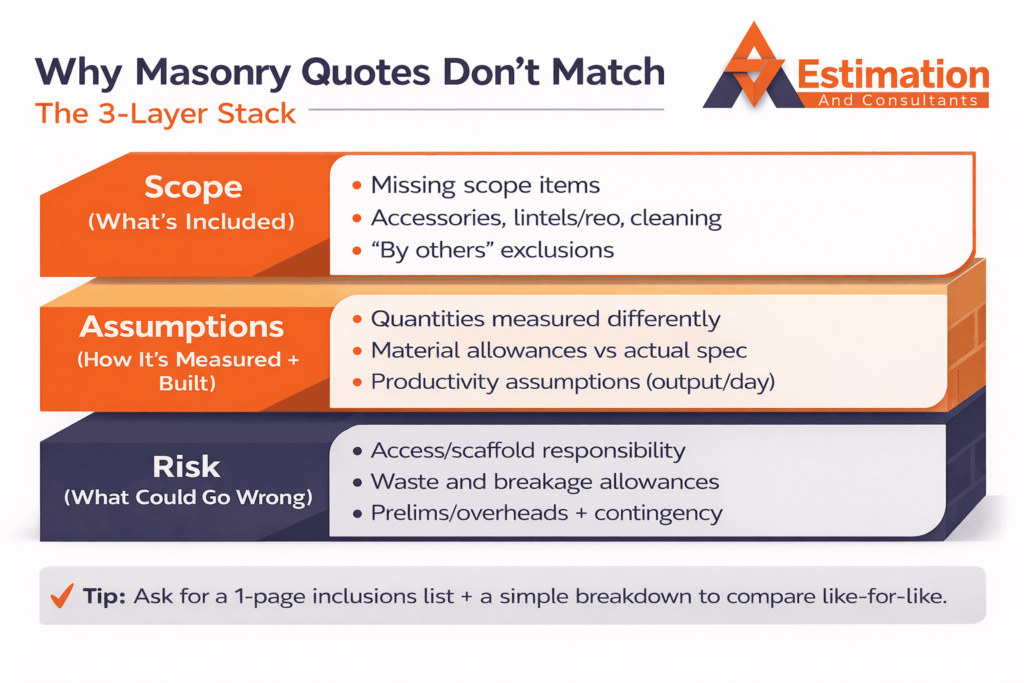
Here’s masonry quote gaps explained in plain terms: a quote gap is the space between what you think is priced and what’s actually priced. It comes from missing scope items, a different assumption, or an exclusion. Left unchecked, masonry scope gaps create confusion now and variations during construction later.
- Missing Items — Many “cheap” quotes have missing items in masonry quotes, like ties, lintels, sealants, or cleaning, so the total looks lower at first.
- Different Assumptions — One contractor may assume easier access or higher output, which affects labour and masonry estimating accuracy.
- Hidden Exclusions — “Scaffold by others” or “access not included” is a classic gap that changes the real cost.
- Why Prices Don’t Match — If the scope isn’t the same, you’re not comparing like-for-like, even if the drawings are identical.
- How It Becomes Variations — Variations caused by quote gaps usually show up mid-job when the missing scope has to be added back in.
- How to Spot It Early — Ask for a clear inclusions/exclusions list and a simple breakdown. This avoids common masonry estimating mistakes.
Why Two Masonry Quotes Can Both Be “Right” (But Still Not Match)
Two masonry quotes can both be “right” because they’re built on different inputs, even when the drawings match. One contractor may measure inconsistent quantities, allow for higher-grade materials, or assume slower output. Add access, waste, preliminaries and overheads, and risk pricing differences, and you’ll see why masonry quotes don’t match in real tenders.
- Quantity Takeoff Isn’t Identical — Small takeoff changes create big blockwork cost discrepancies, especially around openings, corners, and returns.
- Materials Aren’t Like-for-Like — Material specification differences (brick type, block strength, mortar class) can shift totals without looking obvious.
- Productivity Assumptions Change Labour — Labour productivity assumptions (crew size, output per day, congestion) are a major reason masonry prices vary.
- Access and Handling Vary by Site — If one quote assumes easy access and another plans for lifts, scaffolds, or double handling, you get differences in masonry pricing.
- Prelims and Overheads Are Priced Differently — Supervision, insurance, protection, and site setup can be included in one quote and thinly allowed in another.
- Risk Is Treated Unequally — Weather, sequencing, and programme uncertainty lead to masonry tender pricing issues when one builder prices risk, and the other doesn’t.
How Masonry Pricing Is Built (So You Know What You’re Comparing)
Masonry pricing is a stack of moving parts, not just “bricks and labour.” A good quote is a simple rate build-up: materials, labour, access/scaffold, waste, accessories, finishing, preliminaries and overheads, plus risk. When any layer is missed, you get inaccurate rate build-ups and poor masonry estimating accuracy.
- Materials — Bricks/blocks, mortar, delivery, and allowances set the base and drive differences in masonry pricing.
- Labour — Time on the wall depends on crew rates and labour productivity assumptions, not just hourly cost.
- Access & Scaffold — Lifts, scaffold, edge protection, and handling can be included, excluded, or under-allowed.
- Waste & Breakage — Waste and breakage allowances cover cutting, damage, re-orders, and real site loss.
- Accessories & Finishing — Ties, flashings, sealants, cleaning, and pointing often hide common masonry estimating mistakes.
- Prelims, Overheads & Risk — Supervision, insurance, programme impacts, and contingency explain many masonry tender pricing issues.
The 10 Most Common Quote Gaps in Masonry (And How They Change the Price)
This is the heart of the masonry quote gaps explained. When two quotes don’t match, it’s usually because they’re not pricing the same inputs. These ten masonry quote gaps are the most common “missing links” that change the total. I’ll keep each one simple: what it is, how it shifts cost, what to ask, and how to compare so you can get transparent masonry estimating and avoid surprises.
Think of it like this: the cheapest number often comes from missing scope items or optimistic assumptions. The more complete quote may look higher, but it can be closer to the real cost once the job starts. If you learn how to spot missing items in masonry quotes early, you can compare masonry quotes properly and reduce variations later.
| Quote Gap | How It Changes Price | What to Ask (One Line) | Where It Shows Up in the Quote |
| 1) Inclusions vs Exclusions (Scope) | Missing scope items make the total look lower, then reappear as extras | “What exactly is included and excluded in your masonry scope?” | Exclusions list, “by others,” scope notes |
| 2) Quantity Takeoff Differences | Different measurement rules create different totals | “What rules did you use for openings, returns, corners, lintels?” | Quantity breakdown, takeoff notes, m² vs item rates |
| 3) Material Spec vs Allowances | Allowances hide the real spec cost and change later | Allowances hide the real spec cost and can change later | Prime cost/allowance lines, spec notes |
| 4) Labour Rates & Site Conditions | Different rates, hours, supervision, and conditions shift labour cost | “What labour conditions and hours are you assuming?” | Preliminaries, labour notes, dayworks assumptions |
| 5) Productivity Assumptions | Higher assumed output reduces labour allowance on paper | “What production rate are you assuming, and what could slow it?” | Method notes, programme assumptions, crew/output notes |
| 6) Access/Scaffold/Lifting | If access is excluded, the cost moves elsewhere or becomes a variation | “Who provides scaffold, edge protection, lifting, permits?” | Exclusions, site notes, scaffold/access clauses |
| 7) Waste & Breakage Allowances | Low/no waste allowance causes reorders and cost creep | “What waste and breakage % have you allowed for?” | Material quantities, wastage notes, supply terms |
| 8) Reinforcement & Lintels | Structural items omitted can be large add-ons | “Does this include all reo, lintels, and required inspections?” | Scope notes, structural allowances, exclusions |
| 9) Ties, Flashings, DPC, Weeps | Accessories add up; missing them shifts totals and causes add-ons | “Can you list accessories as a separate line item?” | Breakdowns, “by others,” accessory omissions |
| 10) Cleaning & Finishing | End-of-job cleaning/finish standards affect labour and final cost | “Is cleaning/finishing included, and to what standard?” | Exclusions, finishing notes, defects/hand-over scope |
Quote Gap 1 — Inclusions vs Exclusions (Scope Definition)
This gap happens when the scope list isn’t the same across quotes. One contractor prices “everything shown,” while another prices “masonry only” and expects other trades—or you—to cover the rest. These masonry scope gaps can make a quote look cheaper without actually being better value. The price changes because the missing pieces still have to be paid for, usually later, and usually under pressure.
What this gap usually looks like is short, vague wording that pushes responsibility away. You’ll see phrases that sound harmless but create real variations caused by quote gaps once construction starts and someone needs to supply the missing scope.
When you’re comparing, don’t argue about who is “right.” Just get clarity. Ask: “Can you confirm exactly what is included and excluded in your masonry scope?” Then request the answer in writing, so you’re not guessing.
Quote Gap 2 — Quantity Takeoff Differences (Measurement Rules)
Different quantities create different totals, even if the drawings are identical. One quote may be measured in m², another may be priced per block or per brick. Some contractors deduct openings fully, others only deduct above a certain size. Corners, returns, and piers can also be counted differently. These small takeoff changes add up fast and cause blockwork cost discrepancies that look like pricing mistakes, but are often just inconsistent quantities.
This gap changes price because labour and materials are both tied to quantity. If the takeoff is light, the quote will look sharp. But the work doesn’t shrink in real life. You either get claims, variations, or quality shortcuts when the scope is larger than the priced quantity.
To keep things fair, align the takeoff method. Ask: “What measurement rules did you use (openings, returns, lintels, sills)?” Then compare each quote against the same rules. This is a big step toward masonry estimating service accuracy and fewer bricklaying quote comparison issues.
Quote Gap 3 — Material Specification vs Allowances
This gap is about what materials are actually being priced. A quote can look complete, but still hide big cost differences through “allowances.” Brick type, block strength, mortar class, colour, and fire or acoustic requirements can shift the material cost a lot. If one contractor prices the exact specification and another prices a cheaper substitute allowance, the totals will never match. This is one of the biggest reasons masonry prices vary.
The price changes because allowances are not fixed. If the allowance is low, it drags the quote down. Later, when you insist on the correct spec, the gap shows up as a variation or a claim. That is why many “good deals” turn into messy conversations during procurement.
The simple fix is to lock the spec. Ask: “Are you pricing the exact specified brick/block and mortar, or an allowance?” If it’s an allowance, ask what product and what rate it is based on. That’s how you stop hidden substitutions and reduce differences in masonry pricing.
Quote Gap 4 — Labour Rates and Site Conditions
Labour can be priced differently even on the same job because site conditions and labour assumptions vary. One contractor may allow a higher base rate, include supervision, and factor in overtime or restricted hours. Another may assume standard hours, minimal supervision, and smoother site access. These labour rate differences in masonry are real, and they often sit inside preliminaries and overheads, so they’re not obvious in the headline number.
This gap changes the price because labour is a major part of masonry work. If a quote assumes low labour costs or ignores site conditions, it will look cheaper. But if the site has tight access, staging issues, or strict safety controls, the real labour cost rises quickly.
You can check this without confrontation. Ask: “What labour conditions and hours are you assuming for this site?” Then compare apples to apples. When labour assumptions are clear, you get better masonry estimating accuracy and fewer surprises later.
Quote Gap 5 — Productivity Assumptions (Output per Day)
Productivity is about how much work a crew can install in a day. This is one of the most common causes of pricing spread because it’s an assumption, not a fixed number. Crew size, blocks or bricks per day, site congestion, lift heights, rework, and sequencing all affect productivity. Two contractors can look at the same wall and assume very different production rates. That’s why masonry quotes don’t match is often a productivity story.
This gap changes price because productivity drives labour hours. If a contractor assumes high output, the labour allowance drops and the quote looks better. If the job has tight staging, lots of openings, or poor sequencing, that output won’t happen. The result is pressure: requests for extra time, claims, or quality issues.
To check realism, ask: “What production rate are you assuming and what could slow it down?” This is a clean way to uncover common masonry estimating mistakes and improve masonry estimating accuracy.
Quote Gap 6 — Access, Scaffold, and Lifting Assumptions
Access is a deal-breaker in masonry pricing because it affects speed, safety, and handling. Quotes differ when one contractor assumes scaffold or lifting is provided by others, while another includes it. Working heights, edge protection, hoists, traffic control, and permits can all sit inside access assumptions. This is why access and scaffold exclusions are one of the fastest ways a quote can become misleading.
This gap changes the price because scaffolds and access are not optional on many sites. If they are excluded, the cost doesn’t disappear—it just moves to another contract or becomes a variation. That’s how masonry tender pricing issues start: unclear responsibility and incomplete scope.
Make responsibility clear early. Ask: “Who provides scaffold, edge protection, and lifting—your quote or someone else?” Then write it into the scope schedule so your comparison stays fair.
Quote Gap 7 — Waste and Breakage Allowances
Waste is normal in masonry, but it’s not always allowed for. Cutting, breakage, handling damage, returns, reorders, pallets, and double handling can add up. One quote might include realistic waste and breakage allowances, while another assumes near-zero waste. The zero-waste quote often looks cheaper, but it’s a “perfect world” assumption that rarely holds on a live site.
This gap changes the price because materials are not bought in perfect amounts. If waste is not allowed, the contractor either absorbs it (and looks for it elsewhere), or claims it later. That’s one reason masonry prices vary on paper versus what you pay in the end.
Confirm the allowance in a simple way. Ask: “What waste and breakage percentage have you allowed for?” Once you align that number across quotes, you reduce differences in masonry pricing and improve masonry estimating accuracy.
Quote Gap 8 — Reinforcement, Lintels, and Structural Requirements
Structural items are often missed or assumed by others, especially in blockwork. Reinforcement in cores, lintels over openings, ties in structural zones, shop drawings, inspections, and compliance requirements can be substantial. When you see reinforcement and lintel omissions, you’re looking at a quote that may be incomplete, even if it seems detailed elsewhere.
This gap changes the price because these components are part of the real scope, not optional extras. If they are missing, the quote is not a full masonry package. Once construction starts, missing structural items become urgent, and urgent changes are usually more expensive.
Ask a direct question early: “Does your price include all reinforcement, lintels, and any required inspections?” If the answer is unclear, request a breakdown line item. That’s how you avoid expensive scope corrections later.
Quote Gap 9 — Ties, Flashings, DPC, Weeps, and Other Accessories
Accessories are the “small parts” that quietly add up. Wall ties, anchors, cavity trays, DPC, flashings, weep holes, and sealants are easy to miss in a rushed estimate. But when ties and accessories not priced show up, you usually end up paying for them later anyway. This is why missing items in masonry quotes can create big pricing swings.
This gap changes the price because accessories affect both materials and labour. They take time to install, they must meet standards, and they are often needed in large quantities. If they’re not clearly priced, the quote may look cheaper, but it’s not a true total.
The best way to fix this is to force visibility. Ask: “Can you show accessories as a separate line item in your breakdown?” Once accessories are shown clearly, bricklaying quote comparison issues become much easier to solve.
Quote Gap 10 — Cleaning, Finishing, and Final Presentation
The last stage of masonry work is often where the scope gets fuzzy. Cleaning, acid wash, pressure wash limits, pointing touch-ups, sealers, protection, and defects list response are sometimes excluded or lightly allowed. These cleaning and finishing exclusions change the quote because finishing is labour-heavy and often happens under time pressure at the end of the job.
This gap changes the price because clients judge masonry by how it looks when it’s finished, not how it looked mid-build. If the cleaning standard isn’t priced, the contractor may do the minimum or request additional payment to meet your expected finish. That’s a common trigger for variations caused by quote gaps late in the program.
Prevent last-minute surprises by asking: “Is cleaning/finishing included, and what standard are you pricing to?” If you get that in writing, you protect the final presentation and keep the quote comparison fair.
A Simple Way to Compare Masonry Quotes Properly (5-Step Friendly Method)
If you want to know how to compare masonry quotes properly, don’t start by circling the lowest total. Start by making sure each quote is pricing the same scope, is measured the same way, and is based on the same materials and access rules. This quick method reduces bricklaying quote comparison issues and improves masonry estimating accuracy without needing technical skills.
The goal is simple: turn messy quotes into a clean like-for-like comparison. When you do that, you’ll spot inconsistent quantities, missing scope, and hidden exclusions early. That’s what transparent masonry estimating looks like in the real world.

Step 1 — Ask for a One-Page Inclusions/Exclusions Schedule
This step standardises the scope, so you’re not guessing what’s inside each number. Ask every contractor to use the same headings and to clearly list what is included and excluded. This is where most missing scope items hide, and it’s also where masonry scope gaps turn into disputes later. When you see a quote with no clear inclusions list, treat it as incomplete until proven otherwise.
Keep it simple and consistent. You’re trying to stop “assumed” scope from slipping through. This one-page schedule also makes tender reviews faster and reduces masonry tender pricing issues because everyone is responding to the same checklist. It is the quickest way to uncover missing items in masonry quotes without turning the process into a fight.
Step 2 — Lock the Quantity Rules (Openings, Returns, Corners)
Before you compare totals, align measurement rules. Two people can measure the same wall and get different results because they deduct openings differently, count corners differently, or measure returns and piers in different ways. That’s how inconsistent quantities create blockwork cost discrepancies that look like price games, even when they’re not.
Ask each contractor what rules they used, then apply one agreed method across the board. You don’t need perfection, you need consistency. Once quantity rules are locked, you remove one of the biggest drivers of differences in masonry pricing, and your comparison becomes fair and easy to explain to anyone.
Step 3 — Lock Material Specs (No Loose Allowances)
This step stops “cheap allowance” quotes from winning on paper and losing in real life. If one quote uses an allowance for bricks or blocks and another prices the exact specification, they will never match. Material specification differences and material allowance differences are a common reason masonry prices vary, especially when colour, strength, or fire/acoustic ratings are involved.
Ask for confirmation of the exact products and standards being priced. If allowances must be used, make sure all tenderers use the same allowance levels and the same assumed products. This protects masonry estimating accuracy and reduces the risk of a low quote turning into variations later when the real materials are ordered.
Step 4 — Make Scaffold/Access Responsibility Crystal Clear
Access is one of the biggest hidden exclusions in masonry. If scaffold, edge protection, lifting, or permits are “by others” in one quote and included in another, the totals will look miles apart. These scaffold and access exclusions are the reason many quotes feel confusing, and they are a common trigger for masonry tender pricing issues.
You don’t need a long argument. Just ask who provides what, and write it down. Confirm scaffold, edge protection, lifting/hoists, working heights, traffic control, and permits. When access responsibility is clear, you avoid nasty surprises and keep the quotes truly comparable.
Step 5 — Compare the “Gap Total,” Not Just the Bottom Line
This is the real comparison method. Once you’ve standardised scope, quantities, materials, and access, you can identify what is missing in each quote and price it consistently. That missing value is the “gap total.” It explains why masonry quotes don’t match and prevents you from choosing a low number that’s low only because it’s incomplete.
This step is also how you reduce variations during construction. Many variations are simply variations caused by quote gaps showing up mid-job. When you calculate the gap total up front, you get masonry quote gaps explained in dollars, not guesses, and you can make a confident decision based on the true cost.
Quick Red Flags That Usually Lead to Variations Later
Quick red flags matter because most variations during construction don’t come out of nowhere. They usually start with an unclear scope, vague assumptions, or missing details in the quote. A simple rule works well here: if it’s not written, it’s probably not included. Spotting these triggers early helps you avoid variations caused by quote gaps and the stress that comes with last-minute pricing.
One more thing: a low price is not always a problem, but a low price with no detail is. That’s where common masonry estimating mistakes hide, and where risk pricing differences turn into claims later. Use these red flags to keep your tender review clean and reduce masonry tender pricing issues.
- No Clear Inclusions/Exclusions — If the quote doesn’t spell out what’s included, expect missing scope items to show up later as extras.
- Too Many “By Others” Notes — This is a common source of variations caused by quote gaps, especially for access, accessories, and finishing.
- No Quantity Breakdown — If you can’t see quantities and measurement rules, you’re exposed to takeoff disputes and scope creep.
- Allowances With No Detail — Vague “material allowance” lines often hide spec changes and re-pricing during procurement.
- Scaffold/Access Not Mentioned — If access isn’t clearly assigned, it can become a large, sudden variation once site constraints hit.
- Risk and Program Not Addressed — Quotes that ignore weather, sequencing, or delays can look cheaper but tend to create claims later due to risk pricing differences.
What to Send Contractors So Quotes Come Back Cleaner
If you want quotes that actually match, send a short “quote pack” instead of just drawings. When everyone prices the same inputs, comparing masonry quotes becomes simple, and the totals come closer. This is transparent masonry estimating in practice, and it’s the quickest way to improve masonry estimating accuracy and cost certainty.
- Latest Drawings Revision — One set, one revision number, so no one prices old details that drive differences in masonry pricing.
- Scope Schedule — A clear inclusions/exclusions list so every contractor prices the same work for cost certainty in masonry works.
- Quantity Rules — Your method for openings, returns, corners, and deductions, so takeoffs stay consistent across quotes.
- Spec List — Brick/block type, mortar class, colour/finish, and any fire/acoustic requirements to lock the real materials.
- Access Notes — Who provides scaffold, lifting, edge protection, working heights, and any site restrictions that affect labour.
- Finish Standard — Cleaning, pointing, protection, and the final presentation level, so you can compare masonry quotes properly.
FAQs
One masonry quote is often cheaper because it includes missing scope items or uses optimistic labour productivity assumptions that don’t hold on site. This is one of the most common masonry estimating mistakes. Ask for a simple breakdown and a clear inclusions/exclusions list, so you can see what’s priced and what’s not, and understand the real differences in masonry pricing.
Scaffold and access can be included or excluded depending on the contract, but it must be stated clearly either way. Scaffold and access exclusions are a major cause of masonry tender pricing issues because the cost doesn’t disappear—it just moves to someone else or becomes a variation. If a quote is silent on access, treat it as a risk and clarify it in writing.
The most common missing items in masonry quotes are wall ties and accessories, lintels and reinforcement (reo), and cleaning or finishing at the end. Waste and breakage allowances are also often missing or too low, which leads to reorders and extra costs later. These gaps are exactly what “masonry quote gaps explained” means in practice—scope that exists on site but not on paper.
You compare masonry quotes properly by making sure everyone prices the same inputs. Use the 5-step method: standardise scope with an inclusions/exclusions schedule, lock measurement rules, lock material specs, confirm scaffold/access responsibility, then compare the “gap total,” not just the bottom line. This approach supports transparent masonry estimating and reduces bricklaying quote comparison issues quickly.
No, quote gaps don’t always become variations, but they raise the risk a lot. When masonry scope gaps and exclusions are unclear, the missing work usually appears later as a claim or a rushed change. That’s why variations caused by quote gaps are so common and why masonry prices vary between tenders. The best fix is to close the gaps before you sign.
Conclusion — Get Quotes That Match (And Avoid Surprises)
If you want quotes that match, you don’t need more opinions—you need the same inputs. Align the scope, lock the quantities method, confirm material specs, and make access responsibilities clear. Then ask for a simple breakdown so you can compare like-for-like. That’s transparent masonry estimating, and it’s the fastest path to cost certainty in masonry works.
Before you sign anything, use what you’ve learned from masonry quote gaps explained and apply the 5-step method on every tender. When you compare masonry quotes properly, the “cheap” number and the “expensive” number usually start to make sense, and you avoid most masonry tender pricing issues that lead to variations. The next step is simple: send a quote pack, ask for the inclusions schedule, and insist on clarity. That’s real masonry estimating accuracy.