Accurate estimating services are vital for safeguarding your construction budget. These services provide precise, data-driven cost projections that help avoid budget overruns. Without accurate estimating, construction projects are often subject to unexpected financial challenges, including hidden costs, over-estimation, and scope creep. By utilizing accurate estimating services, you can ensure that every cost is accounted for, providing greater financial control and security throughout the project. Accurate estimating plays a central role in protecting your construction finances, offering a clear understanding of costs from the start and minimizing risks.
How Accurate Estimating Prevents Budget Blowouts
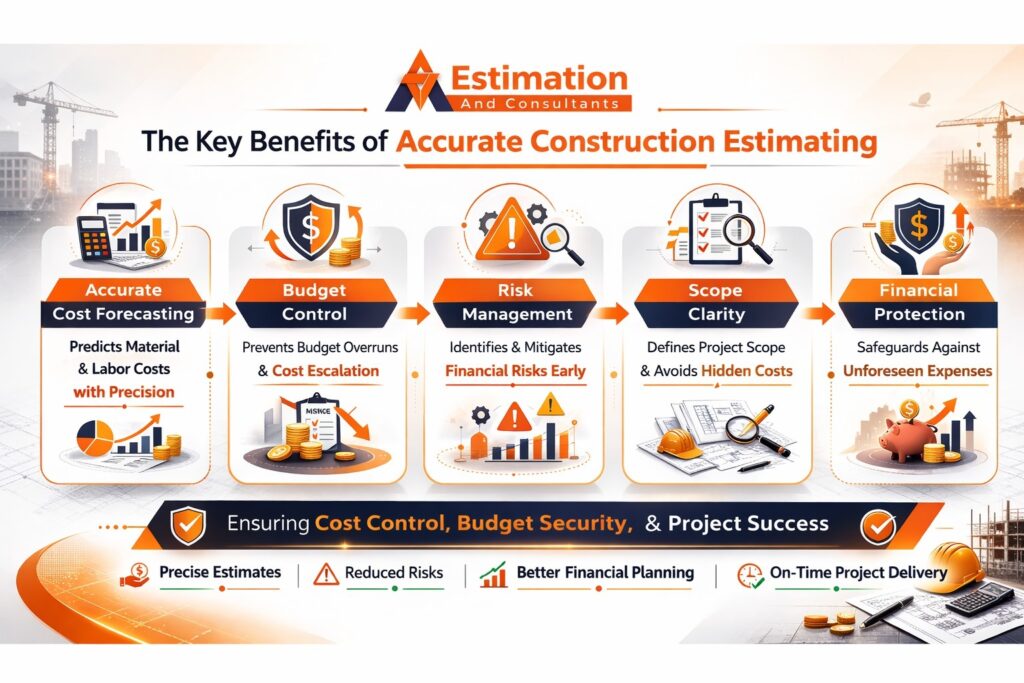
Accurate estimating plays a crucial role in preventing construction budget blowouts. By forecasting costs accurately, estimators help identify potential risks early, ensuring projects stay within financial limits. This foresight helps avoid over-commitment and ensures realistic budgeting, protecting your overall construction budget.
- Identifies Potential Risks Early: Foresees problems before they escalate.
- Accurate Cost Forecasting: Ensures realistic budget planning.
- Prevents Over-Commitment: Keeps projects within financial boundaries.
- Cost Benchmarking: Ensures estimates align with industry standards.
- Manages Construction Risks: Reduces the likelihood of unforeseen costs.
- Protects Your Budget: Guards against budget blowouts and cost overruns.
Detailed Quantity Takeoff and Its Role in Accurate Budgeting
A detailed quantity takeoff is essential for accurate budgeting in construction. It breaks down materials and labor costs, providing clarity and certainty in estimates. By specifying quantities, this service prevents overestimation and ensures your budget is based on actual project requirements.

- Accurate Material Estimation: Avoids overordering or underordering materials.
- Labor Cost Breakdown: Provides clear labor cost insights.
- Cost Accuracy: Ensures realistic and precise cost projections.
- Scope Clarity: Prevents misunderstandings regarding project scale.
- Prevents Over-Estimation: Protects against unnecessary budget increases.
- Construction Scope Verification: Confirms that all elements are accounted for.
Risk Identification and Contingency Planning in Estimating
Accurate estimating not only involves precise cost forecasting but also identifying potential risks that could impact the construction budget. Professional estimators integrate risk identification and contingency planning into their estimates, ensuring that unforeseen circumstances do not derail the project’s financial stability.
Risk Identification in Construction Budgets
Estimators play a critical role in identifying potential risks early in the planning phase. By analyzing historical data, market trends, and potential site-specific challenges, they can foresee issues such as material shortages or labor delays. This foresight allows them to prepare for unexpected costs.
- Forecasting Risks: Analyzing data to predict potential obstacles.
- Site-Specific Challenges: Anticipating unique project risks.
- Minimizing Surprises: Reducing the likelihood of unexpected budget changes.
Contingency Planning in Estimates
Contingency planning ensures that your budget includes allowances for unforeseen expenses. Estimators add a contingency margin to account for possible price fluctuations or changes in project scope. This safeguards the budget by covering potential financial gaps, keeping the project on track.
- Contingency Margins: Accounting for unexpected cost increases.
- Flexible Budgeting: Adjusting to unforeseen project changes.
- Minimizing Financial Stress: Easing the impact of unexpected costs.
The Role of Risk Allowances
Risk allowances are built into the estimate to cover identified risks. These financial buffers ensure that your project stays within budget even if some risks materialize. By including adequate risk allowances, estimators help control cost overruns and avoid project delays.
- Financial Buffering: Protecting the budget from unexpected costs.
- Ensuring Stability: Maintaining budget integrity throughout the project.
- Strategic Allowances: Allocating funds to manage identified risks.
Professional Estimating vs. Rough Budgeting: Why It Matters
When managing construction costs, understanding the difference between professional construction estimating and rough budgeting is crucial. Professional estimating provides precise, data-driven cost projections that ensure long-term financial stability, whereas rough budgeting relies on general assumptions, often leading to unforeseen costs. Professional estimating services offer greater cost certainty and reduce the risk of budget overruns.
The Accuracy of Professional Estimating Services
Professional estimating services use detailed data analysis, including material and labor costs, site conditions, and project scope. This in-depth approach ensures that every aspect of the project is accurately accounted for, leading to more reliable cost forecasts and minimizing financial surprises.
The Pitfalls of Rough Budgeting
Rough budgeting relies on generalized assumptions and limited data, often overlooking hidden costs and specific project factors. This method results in higher chances of financial surprises and cost overruns, ultimately jeopardizing the project’s budget.
Key Comparison Table: Professional Estimating vs. Rough Budgeting
| Aspect | Professional Estimating | Rough Budgeting |
| Accuracy | High – based on detailed data and analysis | Low – relies on assumptions and general estimates |
| Cost Forecasting | Reliable, with precise cost projections | Uncertain, with potential for major discrepancies |
| Risk Management | Minimizes risks by considering all variables | Higher risk due to overlooked factors |
| Scope | Comprehensive – all project elements are considered | Limited – overlooks certain aspects of the project |
| Tender Price Validation | Ensures bids are competitive and realistic | No formal validation, leading to potential underpricing or overpricing |
| Long-Term Cost Certainty | Provides long-term budget stability and foresight | Short-term and uncertain financial planning |
Long-Term Cost Certainty with Professional Estimating
Professional estimating helps to validate the tender price and incorporate financial forecasting, offering a long-term, reliable budget. This minimizes the chances of unexpected budget changes, ensuring projects stay on track financially throughout their duration.
- Tender Price Validation: Ensures that estimates are both competitive and accurate.
- Financial Forecasting: Predicts long-term costs with greater precision.
- Cost Control: Prevents unexpected budget increases and overruns.
The Impact of Independent Cost Reviews and Benchmarking
Independent cost reviews and benchmarking play a vital role in protecting your construction budget by ensuring estimates are realistic and aligned with industry standards. These practices help prevent over-estimation, providing added financial protection and ensuring projects stay within budget throughout their lifespan.
- Ensures Realistic Estimates: Independent reviews validate the accuracy of cost projections.
- Prevents Over-Estimation: Benchmarking against industry standards avoids inflated costs.
- Improves Cost Accuracy: Ensures estimates are in line with market trends.
- Tender Price Validation: Verifies that the proposed price is fair and competitive.
- Promotes Value Engineering: Identifies opportunities to optimize project costs.
- Boosts Financial Confidence: Provides reassurance to clients and stakeholders.
FAQs
An independent cost review involves a third-party expert assessing the cost estimates provided for a construction project. They ensure the estimates are realistic, accurate, and in line with industry standards, which helps prevent over-estimation and keeps the project within budget.
Cost benchmarking compares your project’s estimated costs with industry standards and similar projects. This comparison helps identify any discrepancies or inflated estimates, ensuring that you’re not paying more than necessary. It adds an extra layer of protection, promoting fair and accurate pricing.
Using independent cost assessment services ensures an unbiased review of your project’s financials. It helps validate cost accuracy, prevent potential budget blowouts, and gives you peace of mind that your estimates are aligned with market expectations and best practices.
Value engineering is a process where project costs are evaluated to find the most cost-effective solutions without sacrificing quality. When combined with an independent cost review, it helps identify opportunities to optimize expenses, ensuring the budget remains efficient and the project stays within financial limits.
Tender price validation ensures that the prices quoted for construction work are fair, realistic, and competitive. It helps prevent under- or over-bidding, which can lead to project delays or unexpected costs. By validating the tender, you secure a price that accurately reflects the project’s true value.
Conclusion
Accurate estimating services play a crucial role in securing your construction budget. Through effective cost control, meticulous planning, and proactive risk management, professional estimators help ensure your project remains financially on track. By choosing reliable estimating services, you reduce financial risks, protect your budget, and pave the way for better, more predictable project outcomes.