If you’ve been searching for render cost per m² in Australia, you’ve probably noticed the numbers are all over the place. That’s because “per m²” isn’t one fixed price—it changes with wall condition, access, finish level, and the render system you choose. This 2026 render pricing guide is here to make the pricing feel clear, so you can stop guessing and start comparing properly.
By the end, you’ll know what drives render cost per square metre in Australia, how supply and install rates are usually built up, and how to compare acrylic, cement, lime, and insulating render in a way that matches your job. If you’re trying to work out a realistic rendering price per m2 or the house rendering cost in Australia for your project, this guide will help you ask better questions and get quotes that make sense.
What “Render Cost Per m²” Usually Includes (And What It Often Doesn’t)
When you see render cost per m² in Australia (2026), it sounds simple, but quotes can vary because not everyone includes the same items. Supply and install render rates usually cover the main rendering work, but some builders include prep, access, and finishes while others list them as extras. This is why comparing render quotes without checking the project scope inclusions can lead to surprise costs later.
Typical Inclusions in $/m²
Most standard render quote inclusions in Australia will cover the core system needed to get render on the wall and leave the site tidy. This is where your “base price” usually comes from, and it’s also where the render finish quality impact starts to show—because better finish expectations often mean extra steps. Typical inclusions can involve basecoat and topcoat (when the system needs it), light patching, basic masking or protection, and clean-up after the work is done. These are often bundled into the render coating system cost, along with primer and finish coats if specified.
- Basecoat / Topcoat: Main layers that build the surface and final look
- Basic Patching: Small repairs before coating
- Site Protection: Masking windows, floors, and nearby surfaces
- Clean-Up: Removing waste and leaving the area usable
Common Exclusions That Change the Real Price
This is where a “cheap” $/m² can blow out. Many quotes exclude heavier work because it’s hard to price without seeing the job up close. If the wall has issues, the substrate preparation cost can become a big add-on. The same goes for mesh and reinforcement cost if the cracking risk is high or the surfaces are mixed. Access is another big one—scaffold and access cost can change the real price fast, especially on double-storey homes or tight sites. Painting or sealing may also be left out, along with detailed work around reveals, features, and sharp edges.
- Major Substrate Repairs: Damaged walls, weak render, paint removal
- Full Mesh Reinforcement: Higher crack control needs
- Scaffold / Access: Two-storey, sloped blocks, tight side access
- Traffic Management: If work impacts public paths/roads
- Painting / Sealing: Often not included unless clearly stated
- High-Detail Areas: Reveals, feature bands, complex edges
The 2026 Cost Drivers That Move Your $/m² Up or Down
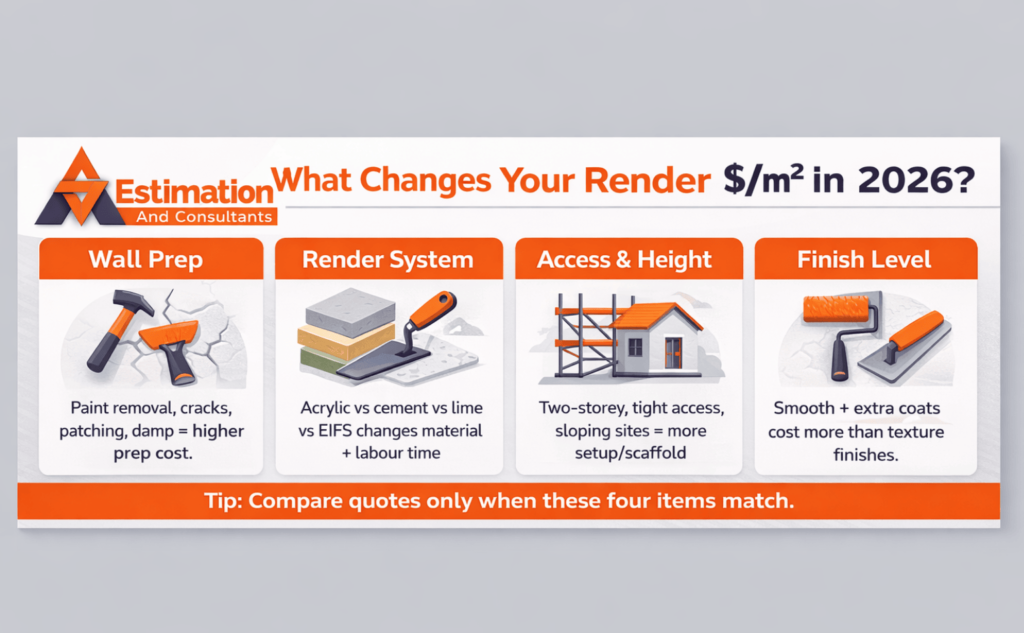
In Australia, render cost per m² in 2026 changes because every job has different conditions, not because one renderer is “randomly expensive.” The main render cost drivers (mix type, thickness, access) come down to four buckets: wall prep, reinforcement, access, and finish level. Once you understand the labour vs material cost split, you can spot why two quotes look far apart even when the render type sounds the same.
Substrate Condition and Preparation
Prep is usually the biggest swing factor because render is only as good as what it sticks to. If the wall is sound, clean, and flat, the job moves faster and costs less. If it’s cracked, painted, salty, damp, or uneven, the substrate preparation cost rises quickly. This is also where surface quality impact matters—more levelling and patching means more time on the tools. For example, rendering over painted brick often increases because paint may need removal or extra bonding steps. A simple wall prep cost for rendering can turn into a repair job if the substrate is weak.
- Sound vs Unsound Walls: Loose areas need removal and patching
- Paint Removal: Extra labour and dust control
- Cracks and Patching: Repairs before coating
- Damp / Salts: Can require treatment before render
- Levelling Tolerance: Straighter walls cost more time
Reinforcement and Mesh Requirements
Mesh adds cost because it adds materials and time, but it can prevent bigger problems later. You’ll often need it on mixed substrates, around corners and openings, and in higher crack-risk zones. The mesh and reinforcement cost also changes depending on whether the quote allows for full mesh across the wall or just banding in key areas. This is where people ask, “Do I need mesh for rendering?” The honest answer is: sometimes you don’t, but when movement risk is high, mesh is cheaper than future repairs. Expect render mesh cost per sqm to be more noticeable on larger areas or detailed façades.
- Full Mesh: More coverage, higher cost, better crack control
- Banding: Targeted mesh in stress points, lower cost
- Corners / Openings: Common crack areas needing reinforcement
- Mixed Substrates: Different movement rates increase risk
Access, Height, and Scaffolding
Access is a multiplier because it affects how fast a crew can work. A single-storey wall with clear space is straightforward. A double-storey home, tight side access, or a sloping site slows everything down and increases setup time. This is where scaffold and access cost come in—sometimes the render price looks fine, but the scaffold cost for rendering pushes the total up. With two-storey work, safety rules and lifting materials take longer, so two-storey rendering costs often rise even if the render system itself doesn’t change.
- Height: More setup and safer work methods
- Tight Access: Slower movement, more protection work
- Sloping Blocks: Harder scaffold placement and handling
- Protection and Setup: Masking and safeguarding add labour time
Finish Quality and Specification
Finish level affects cost because appearance takes time. A basic texture can hide minor wall variations, while a smooth finish often needs more levelling and tighter control. That’s why render finish quality impact can be huge, even with the same render type. If the spec calls for extra coats to improve colour and consistency, primer and topcoat costs can rise too. This is the reason smooth render cost per sqm is often higher than a more forgiving texture. If a design has detailed edges, openings, or feature lines, the labour increases because detailed work is slow, careful work.
- Smooth Finish: More labour, higher tolerance expectations
- Textured Finish: Often faster and more forgiving
- Extra Coats: Better appearance, higher coating cost
- Detailing Around Openings: Time-heavy, affects final rate
Acrylic vs Cement vs Lime vs Insulating Render: What You Pay For (And Why)
In Australia, the render cost estimate per m² isn’t just about the bag of mix. Each system has its own build-up, labour time, and risk profile, so the “best price” depends on what you’re trying to achieve on your walls. As a quick 2026 reference, homeowner pricing guides commonly show cement render sitting in the lower band, acrylic higher, lime mid-range, and insulating render (EIFS) as the highest because it’s a full wall system, not just a coating.

Acrylic Render (Polymer-Based): Cost Profile and Best Use
Acrylic render is popular on modern façades because it can handle minor movement better than traditional mixes, and it often gives a consistent finish when specified properly. In many 2026 price guides, acrylic render cost per m² is commonly shown around $60–$85/m² in some listings, while other guides place it closer to about $80/m² as a typical figure—your exact number depends on prep, access, and the finish you want. Acrylic usually fits projects where you want a clean look, a flexible coating, and fewer cosmetic cracks, but you still need to lock in the finish specification so the quote doesn’t shift later.
Cement Render: Cost Profile and Best Use
Cement render is the traditional option, and it can be cost-effective when the walls are sound and the detailing is simple. For 2026, sources commonly place cement render cost per m² in a broad band—roughly $30–$50/m² in some homeowner guides, and $45–$65/m² in others—because labour and site conditions drive the final number more than the material itself. Cement render makes sense when you want a proven base system and you’re prepared to handle curing time and crack control properly. If the wall needs extra mesh and reinforcement, costs rise, but that’s often cheaper than repairs later.
Lime Render: Cost Profile and Best Use
Lime render is usually chosen for breathability and heritage or restoration work, where the wall needs to “manage moisture” better than dense cement mixes. That comes with a labour premium because the work is more specialised and the program can be slower. In 2026 pricing guides, lime render pricing is often shown around $50/m² as a reference point, but real quotes move with surface condition, detailing, and access. Lime is a good fit when material compatibility matters more than speed—especially on older masonry—so you’re paying for the right system and the right contractor rates, not just a cheaper square metre.
Insulating Render (EIFS): Cost Profile and Best Use
Insulating render (EIFS) is a different category because it includes insulation boards fixed to the wall, then a basecoat with mesh, and a finish coat system on top. Industry descriptions break EIFS into layers—insulation (often EPS/XPS), attachment, reinforcement mesh/basecoat, and a finishing coat—so your cost reflects a whole façade build-up, not just a render skim. That’s why 2026 homeowner pricing guides often place the insulating render cost estimate around $100–$150/m². EIFS fits best when thermal performance and comfort are part of the brief, and you’re willing to pay more upfront for the system.
A Simple Way to Estimate Render Costs (So Your Quote Feels Predictable)
If you want a render quote that stays consistent, you need to give the contractor clear details. Most price surprises happen because the scope is vague—like “render the front wall” without saying what the wall is made of, how rough it is, or how high it sits. A simple estimate works when you break the job into the same parts every time: area, system type, prep, access, finish, then a small buffer for unknowns. That’s how you get a realistic range using supply and install render rates, instead of a number that changes later.
To calculate render cost per sqm, don’t try to guess one perfect price. Aim for a sensible range based on what you can see today. If you’ve got paint to remove, cracks to fix, two-storey access, or a smooth finish, your rate per m² will move. A small allowance for risk items and contingencies is normal because walls can hide problems until work starts.
A simple estimating method you can follow:
- Measure your area: Estimate the net wall area you want rendered.
- Pick the render system: Acrylic, cement, lime, or EIFS.
- Rate the wall condition: Is it clean and sound, or does it need repairs and prep?
- Add the big add-ons: Mesh (if needed), access/scaffold, and finish level.
- Add a small buffer: For minor repairs and unknown wall issues.
Quick Estimating Checklist (What to Gather Before Calling Contractors)
If you want better quotes, give better inputs. Contractors price faster and more accurately when they can see the wall condition and access challenges. This checklist helps you explain the job clearly and makes it easier to compare prices later. It’s the most practical part of how to estimate render costs, and it stops your quote from being padded “just in case.”
What to gather before you ask for a quote:
- Photos: Full wall shots + close-ups of cracks, flaking paint, damp marks, and any old render.
- Substrate type: Brick, concrete, fibre cement sheet, AAC, painted masonry, or existing render.
- Cracks and repairs: Where they are, how many, and if any areas sound hollow or loose.
- Height and access notes: Single or double storey, tight side access, sloping ground, obstacles like gardens or pergolas.
- Finish preference: Smooth or textured, and any feature lines or detailed edges.
- Timing: When you want it done and whether the site is lived in (affects protection and setup).
Regional Price Variation in Australia (2026): How to Adjust Expectations
In 2026, the regional price variation in Australia 2026 is real for rendering. Two identical homes can get different $/m² simply because of location. Metro areas usually have more competition, but also higher overheads, while regional jobs often carry travel time and loading costs. Local contractor rates shift with labour supply, demand, and how easy it is to schedule crews.
The weather also matters more than people think. Humid, wet, or windy periods can slow work, stretch timelines, and affect availability. So when you compare render cost Sydney vs Brisbane or check render cost Melbourne against render cost Perth, treat it as a range, not a fixed number.
- Metro vs Regional: City pricing can be steadier, regional pricing can swing more job to job.
- Travel and Loading: Longer drives, parking limits, and material handling time can lift the rate.
- Local Labour Availability: Fewer available crews usually means higher contractor rates.
- Demand and Seasonality: Busy building periods push quotes up; quieter periods can soften them.
- Weather Windows: Rain, humidity, and heat affect scheduling and productivity.
- Supplier Network: Material availability and delivery fees differ by state and distance.
Comparing Render Quotes: Apples-to-Apples Table
| Check This | What the Quote Must Say | Red Flag |
| Inclusions | Exactly what “supply and install render rates” covers | No clear list |
| Prep | Cleaning/patching/paint removal spelled out | “Prep as required.” |
| Mesh | Full mesh vs banding + where it’s used | Mesh not mentioned |
| Finish | Smooth/texture + coat count/finish level | “Standard finish” |
| Access | Scaffold/platform included or excluded | Access “TBC” |
| Exclusions | Painting, major repairs, and traffic control are listed | No exclusions |
Red flags that usually mean variations later:
- Vague prep wording
- No mesh clarity
- Access is not locked in
- Finish not specified
- Unrealistic timelines
FAQs
There isn’t one single “average” that fits every job. Render cost per square metre in Australia changes mainly with wall prep, access height, finish level, and the render system you choose. Regional price variation in Australia 2026 also matters—Sydney, Brisbane, Melbourne, and Perth can price differently because contractor availability and site conditions vary. The best way to avoid guessing is to request quotes with the same inclusions so you’re comparing the same scope.
Often, cement looks cheaper on paper, but it depends on the wall and the finish. Cement render cost per m² can be lower when the substrate is sound, and the finish is simple. Acrylic render cost per m² may come in higher because it’s a different system and is commonly priced with tighter finish expectations. Acrylic can offer better tolerance to small movement on modern façades, so the better question is “which one suits my wall and finish” rather than only “which is cheaper.”
You usually need mesh when the cracking risk is higher or the wall is likely to move. That includes mixed surfaces (like brick meeting fibre cement), corners, and areas around windows and doors. Existing cracks and uneven substrates also increase the need for reinforcement. Mesh adds mesh and reinforcement cost, but it can reduce callbacks and repairs later. Always ask whether the quote includes full mesh or banding, because coverage level changes the real total.
Scaffolds can change the rate quickly because it affects setup time, safety requirements, and how fast the crew can work. Scaffold and access costs usually rise on double-storey homes, tight side access, sloping blocks, or sites that need extra protection. Instead of chasing one number, get the access method confirmed in writing and ask if it’s included in the supply and install render rates or listed as a separate line item.
Start by matching the scope, not the headline $/m². When comparing render quotes, check that each one lists the same project scope inclusions: prep standard (cleaning, patching, paint removal), mesh coverage, finish specification (smooth/texture and coat count), and access method (scaffold included or excluded). Also, confirm exclusions like painting, major repairs, and traffic control. If the scope doesn’t match, the prices can’t be compared fairly.
Conclusion
For most modern homes, acrylic is usually the safest pick for a clean finish. For tight budgets, cement can work—only if prep and mesh are clearly included. For older or heritage walls, lime is usually the better match. For thermal upgrades, EIFS makes sense because it’s a full system. Before you choose, keep comparing render quotes only when the scope matches.