Most homeowners start a renovation with a budget that feels solid and well thought out. The problems usually appear later. DIY estimating mistakes homeowners make aren’t about carelessness—they come from missing structure, incomplete information, and optimistic assumptions. Understanding where DIY budgets fail is the first step toward avoiding costly surprises and building a renovation plan that actually holds.
Why DIY Estimating Is Structurally Risky
DIY cost estimating often feels manageable at first, but it lacks the structure needed to control real project risks. Without systems, data, or safeguards, small homeowner budgeting errors quietly stack up. That’s why DIY estimating mistakes homeowners make often lead to stress, delays, and budgets that fail halfway through.
- No Estimating System
DIY estimates rely on rough guesses instead of a step-by-step method, which makes costs easy to miss and hard to track. - Cognitive Bias
Homeowners naturally stay optimistic, assuming best-case prices and timelines instead of planning for real-world issues. - Incomplete Information
Many costs are unknown at the start, including prep work, compliance, and finishing details. - Hidden Cost Blind Spots
DIY cost estimating often overlooks indirect and supporting costs that professionals plan for early. - No Built-In Safety Net
Without buffers or checks, small errors quickly explain why DIY budgets fail.
The 5 Core DIY Estimating Failure Points
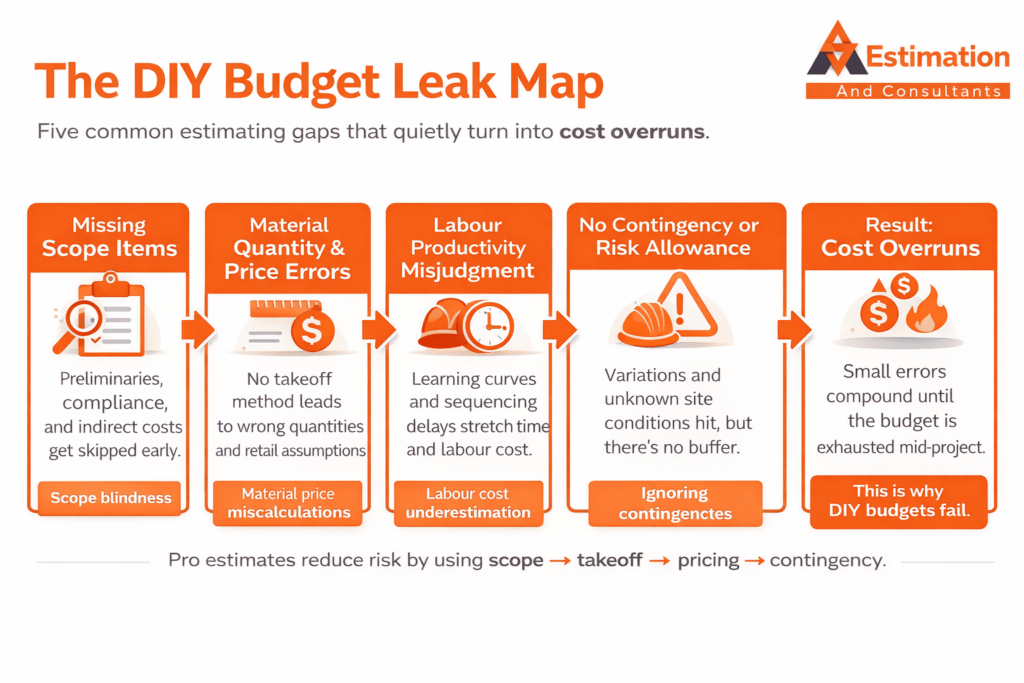
Most DIY budgets fail for the same reasons. They don’t break all at once. They weaken at specific pressure points that quietly drain money as the project moves forward. These five failure points explain where DIY estimating mistakes homeowners make usually start—and why DIY budgets fail even when the plan looks reasonable on paper.
Missing Scope Items
Scope blindness is one of the most common causes of budget blowouts. Homeowners often price the visible work but miss the supporting tasks that make the job possible. Preliminaries, compliance requirements, and indirect costs are rarely listed, which leads to missing scope items and hidden renovation costs appearing mid-project. These missing scope items in estimates force last-minute spending with no room to adjust.
Material Cost & Quantity Errors
DIY residential estimates usually skip proper quantity takeoffs. Instead of measuring accurately, homeowners rely on rough guesses and retail pricing assumptions. This creates material price miscalculations and inaccurate material quantities. Without material takeoff accuracy, small shortages, wastage, and price differences stack up quickly, pushing the budget higher than expected.
Labour Productivity Misjudgment
Labour is rarely priced realistically in DIY plans. Homeowners assume steady progress without accounting for learning curves or task sequencing. In reality, labour productivity assumptions are often optimistic, and delays between trades slow everything down. This labour cost underestimation makes timelines longer and labour rates higher than planned.
No Contingency or Risk Allowance
DIY budgets are fragile because they assume everything will go right. Variations, unexpected repairs, and unknown site conditions are ignored. With no contingency allowance or risk planning, even small surprises cause financial stress. Ignoring contingencies in DIY projects leaves no buffer when reality differs from the plan.
Quote Comparison Errors
When comparing quotes, many homeowners focus only on the lowest price. This decision bias leads to quote comparison mistakes, especially when provisional sums are misunderstood. Comparing quotes incorrectly hides exclusions and future costs, turning a “cheap” option into an expensive problem once the work begins.
DIY Estimating vs Professional Estimating: How the Same Mistakes Are Handled
| Estimating Area | DIY Estimating Approach | How Professionals Avoid the Problem |
| Scope Definition | Focuses on visible work only, often missing prep, compliance, and indirect costs | Defines full scope upfront so nothing critical is priced later |
| Material Quantities | Uses rough guesses and retail assumptions | Performs detailed takeoffs based on actual measurements |
| Labour Planning | Assumes steady progress and ideal productivity | Uses realistic labour rates and proven productivity data |
| Risk & Contingency | Assumes nothing will go wrong | Builds contingency into the budget from the start |
| Quote Comparison | Chooses the lowest headline price | Compares line items, exclusions, and provisional sums |
| Cost Control | Sets the budget once and reacts to overruns | Tracks costs continuously and adjusts early |
How These Mistakes Cause Cost Overruns
DIY estimating errors rarely stay small. One missed cost leads to another, and each adjustment pushes the budget further off track. This error compounding explains most cost overruns in DIY projects. Without cost control methods, early mistakes drain cash fast, leaving homeowners exposed before the project is finished.
- Small Errors Stack Up
Minor gaps in early estimates multiply as work progresses and costs layer on top of each other. - Mid-Project Price Shocks
Unplanned materials or labour force last-minute spending at higher rates. - No Cost Control Checks
DIY budgets lack tracking systems to catch problems early and correct them. - Reactive Spending Decisions
Fixes are made under pressure, not planned choices. - Budget Exhaustion
Funds run out before the work is complete, forcing compromises or delays. - Limited Recovery Options
Once money is gone, homeowners have few practical ways to regain control.
The Professional Estimating Process Explained
Professional estimates work because they follow a clear, repeatable structure. Instead of guessing, professionals rely on transparency and logic at every step. This professional estimating process builds trust by showing where numbers come from and how risks are managed, which is why construction budgeting best practices consistently outperform DIY budgeting.
Scope Definition Comes First
Professionals start by defining the full scope of work before pricing anything. This includes visible tasks, supporting activities, and indirect requirements that homeowners often miss. By locking the scope early, estimators reduce surprises later. Clear scope definition is the foundation of how professionals estimate renovation costs accurately and avoid hidden expenses.
Detailed Takeoffs Replace Guesswork
Once the scope is clear, professionals measure quantities in detail. Every material, fixture, and finish is counted using structured takeoff methods. This step removes assumptions and improves accuracy. Detailed takeoffs ensure pricing is based on real quantities, not rough estimates, which protects the budget from slow leaks caused by shortages or overbuying.
Pricing Is Based on Real Market Data
Professional pricing reflects current labour rates, supplier pricing, and realistic productivity levels. Instead of optimistic assumptions, estimators use data and experience. This keeps numbers grounded and defensible. Accurate pricing is a key reason professional estimates stay reliable even when market conditions change during construction.
Contingency Is Planned, Not Optional
Professionals expect things to change. That’s why contingency is built into the estimate from the start. Risks, site conditions, and variations are planned for instead of ignored. This final step completes the process and explains how professionals estimate renovation costs without budget shocks or panic decisions mid-project.
How Homeowners Can Apply Pro-Level Thinking
You don’t need to become a professional estimator to budget smarter. Applying pro-level thinking means knowing where DIY works and where it creates risk. By setting clear boundaries and using realistic renovation budgeting, homeowners can avoid costly surprises while still staying involved in their project.
- Define DIY Boundaries Early
Decide which tasks you can confidently estimate and which ones carry higher risk. - Focus on Big Cost Drivers
Pay extra attention to labour, materials, and scope, not just finishes. - Use Conservative Assumptions
Plan for real-world delays and costs instead of best-case scenarios. - Outsource the Numbers, Not the Vision
Let professionals handle estimating while you control design choices. - Treat Estimates as Living Documents
Review and adjust budgets as information improves. - Aim for Control, Not Perfection
Good budgeting reduces risk, even if every number isn’t exact.
When Hiring a Professional Estimator Actually Saves Money
Hiring a professional estimator isn’t an added cost—it’s often a cost shield. When compared to overspending caused by poor planning, the fee is small. Clear estimates improve decision clarity, helping homeowners avoid overruns, rework, and rushed choices that quietly drain budgets.
- Avoiding Costly Surprises
Early clarity prevents expensive fixes later. - Spending With Confidence
Decisions are based on facts, not assumptions. - Reducing Overruns
Accurate estimates protect against budget blowouts. - Better Trade Pricing
Clear scopes lead to cleaner, fairer quotes. - Smarter Trade-Offs
You know where to save and where not to. - Protecting Your Total Investment
Controlled costs preserve long-term value.
FAQs
DIY renovation budgets often go over because important items are missed early. Incomplete scope, optimistic pricing, and no contingency mean small errors build up. Without a structured estimating system, costs appear later when there is little room to adjust.
Homeowners can estimate small, simple projects, but larger renovations are harder to price accurately. DIY cost estimating usually lacks detailed takeoffs, realistic labour assumptions, and risk planning, which are critical for keeping budgets under control.
The biggest mistake is missing scope items. Many homeowners focus only on visible work and forget indirect costs like prep, compliance, and finishing. These hidden renovation costs are a major reason DIY budgets fail mid-project.
Professionals follow a clear process: scope definition, detailed takeoffs, realistic pricing, and built-in contingency. This structured approach explains how professionals estimate renovation costs while reducing surprises and controlling risk.
In many cases, yes. The cost of a professional estimate is often far less than the cost of budget overruns, delays, and rework. Clear numbers improve decision-making and protect the overall renovation budget.
Conclusion
DIY estimating doesn’t fail because homeowners lack effort—it fails because the process lacks structure. Missing scope items, optimistic assumptions, and no contingency quietly push budgets off course. By understanding where DIY breaks down and when professional estimating adds value, homeowners can make smarter decisions, control costs, and complete renovations with confidence instead of stress.